Sahara dust can enhance removal of methane from the atmosphere
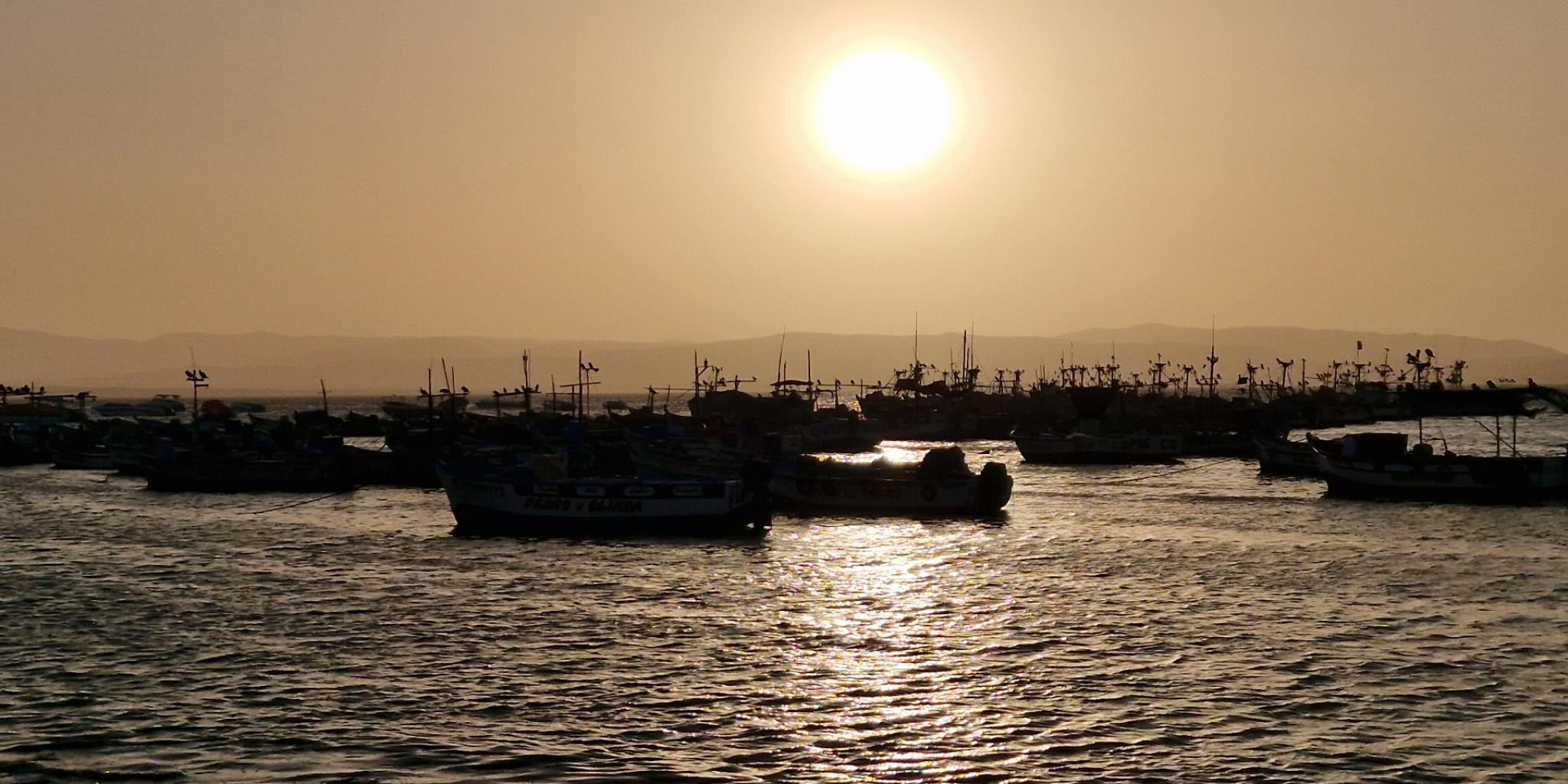
There is a hidden link between Saharan dust clouds and the levels of atmospheric methane – a strong greenhouse gas. A team of international scientists, including Jan-Berend Stuut, studied a mechanism that could significantly alter our understanding of methane emissions and their impact on global warming. The implications for our planet's climate future are potentially huge. The results of this study are published this week in the Proceedings of the National Academy of Sciences.
Dust visible in the sunset, off the coast of Peru. Photo: Jan-Berend Stuut (NIOZ)
Sahara dust important for climate
“Sahara dust plays a series of important roles in our planet’s climate,” says Jan-Berend Stuut. “In high regions of the atmosphere, it controls the amount of sunlight reaching the earth’s surface. And it can trap heat in the lower part of the atmosphere. The dust is also fertilizing phytoplankton in the oceans. Plankton captures CO2 from the atmosphere. The iron and silica rich dust is their only food source far away from land.”
This new research incorporates a new mechanism whereby blowing mineral dust mixes with sea-spray to form ‘Mineral Dust-Sea Spray Aerosol’ (MDSA). The results suggest that MDSA is activated by sunlight to produce an abundance of chlorine atoms, which oxidize atmospheric methane and tropospheric ozone via photocatalysis. MDSA is the dominant source of atmospheric chlorine over the North Atlantic, the study finds.
Sea salt binds methane
Stuut: “Under the influence of sunlight, the iron from desert dust forms so-called chlorine radicals from sea salt (NaCl). These ions bind to the greenhouse gas methane (CH4), thereby removing it from the atmosphere.” Methane is a greenhouse gas that causes ~30x as much warming as CO2. The removal of this greenhouse gas is therefore also a natural way to combat warming.
Missing carbon isotope 12C
The newly discovered mechanism allows researchers to better understand global CH4 budgets (emission vs deposition). The chemical reactions of these chlorine radicals cause the lighter carbon isotope 12C to be removed more strongly than the heavier 13C. This observation had already been made in the Caribbean. “Measurements from Barbados showed that atmospheric methane was enriched in 13C especially in summer and autumn,” says Stuut. “But there was no explanation for this.”
It is precisely in summer and autumn that a lot of Saharan dust is blown towards the West. Maarten van Herpen, first author of this study and working at Acacia Impact Innovation, concluded after discussions with Jan-Berend Stuut that this could be the 'missing link' for the observation of carbon isotopes over Barbados. The link was quickly confirmed.
Further research
How the MDSA mechanism may operate in other parts of the world is not well understood and requires further research, the study argues. Follow-on research is underway. “Our current research is focused on getting a better understanding of what exactly influences how much methane MDSA particles are removing from the atmosphere,” said Van Herpen, “To do that, we are analyzing air samples from across the North Atlantic, provided by atmospheric observatories and commercial ships. Seafarers are helping advance our research by filling flasks with air as they cross through the African dust cloud. We have collected 500 flasks so far. Early results are looking very encouraging, but we need a full year of data before we can draw conclusions.”
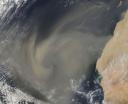
Satellite image of Sahara dust storm moving over the Atlantic Ocean. Photo: NASA.org