
Complex life developed earlier than previously thought, Nature study reveals
The research led by the University of Bristol was published in the scientific journal Nature 3 December, the research indicates that complex organisms evolved long before there were substantial levels of oxygen in the atmosphere, something which had previously been considered a prerequisite to the evolution of complex life.
Prokaryotes as the only forms of life
‘The earth is approximately 4.5 billion years old, with the first microbial life forms appearing over 4 billion years ago. These organisms consisted of two groups – bacteria and the distinct but related archaea, collectively known as prokaryotes,’ said co-author Anja Spang, from the Department of Marine Microbiology & Biogeochemistry at the Royal Netherlands Institute for Sea Research (NIOZ). Spang had previously made important discoveries in this field and was involved in the analysis and interpretation of the results within this new study.
Prokaryotes were the only form of life on earth for hundreds of millions of years, until more complex eukaryotic cells including organisms such as algae, fungi, plants and animals evolved.
Previous ideas were speculation
Davide Pisani, Professor of Phylogenomics in the School of Biological Sciences at the University Bristol, explained: ‘Previous ideas on how and when early prokaryotes transformed into complex eukaryotes has largely been in the realm of speculation. Estimates have spanned a billion years, as no intermediate forms exist and definitive fossil evidence has been lacking.’
Molecular clocks
However, the collaborative research team has developed a new way of probing these questions, by extending on the ‘molecular clocks’ method which is used to estimate how long ago two species shared a common ancestor.
‘The approach was two-fold: by collecting sequence data from hundreds of species and combining this with known fossil evidence, we were able to create a time-resolved tree of life. We could then apply this framework to better resolve the timing of historical events within individual gene families,’ added co-lead author Professor Tom Williams in the Department of Life Sciences at the University of Bath.
The researchers collected evidence from more than a hundred gene families in multiple biological systems. In doing so, they focused on the characteristics that distinguish eukaryotes from prokaryotes, such as the transport of compounds within the cell via vesicles. With that information the team were able to begin to piece together the developmental pathway for complex life.
The cell nucleus existed before the mitochondrion
Surprisingly the researchers found evidence that the transition began almost 2.9 billion years ago – almost a billion years earlier than by some other estimates – suggesting that the nucleus and other internal structures appear to have evolved significantly before mitochondria. ‘The process of cumulative complexification took place over a much longer time period than previously thought,’ said author Gergely Szöllősi, head of the Model-Based Evolutionary Genomics Unit at the Okinawa Institute of Science and Technology (OIST).
The new scenario: CALM
The data meant the scientists have been able to reject some scenarios put forward for eukaryogenesis (the evolution of complex life), and their data did not neatly fit with any existing theory. Consequently, the team has proposed a new evidence-based scenario for the emergence of complex life they have called ‘CALM’ - Complex Archaeon, Late Mitochondrion.
A number of disciplines
Lead author Dr Christopher Kay, Research Associate in the School of Biological Sciences at the University of Bristol, explained: ‘What sets this study apart is looking into detail about what these gene families actually do - and which proteins interact with which - all in absolute time. It has required the combination of a number of disciplines to do this: palaeontology to inform the timeline, phylogenetics to create faithful and useful trees, and molecular biology to give these gene families a context. It was a big job.’
Mitochondria arrived later than previously thought
‘One of our most significant findings was that the mitochondria arose significantly later than expected. The timing coincides with the first substantial rise in atmospheric oxygen,’ said author Philip Donoghue, Professor of Palaeobiology in the School of Earth Sciences at the University of Bristol.
‘This insight ties evolutionary biology directly to Earth’s geochemical history. The archaeal ancestor of eukaryotes began evolving complex features roughly a billion years before oxygen became abundant, in oceans that were entirely anoxic.’
Nature-onderzoek: complex leven ontwikkelde zich veel eerder dan gedacht
Complex leven begon zich bijna een miljard jaar eerder en over een langere periode te ontwikkelen dan eerder aangenomen. Dat blijkt uit onderzoek van onder meer NIOZ-onderzoeker Anja Spang. Het onderzoek zet vraagtekens bij bestaande theorieën op dit gebied. Zo blijkt de beschikbaarheid van veel zuurstof geen randvoorwaarde te zijn voor evolutie van complexe leven.
Het onderzoek van de Universiteit van Bristol en NIOZ is 3 december gepubliceerd in het wetenschappelijke tijdschrift Nature. Het wijst erop dat complexe organismen al evolueerden lang voordat er aanzienlijke hoeveelheden zuurstof in de atmosfeer aanwezig waren. Tot nu toe werd zuurstof beschouwd als een voorwaarde voor de evolutie van complex leven.
Prokaryoten als enige levensvorm
‘De aarde is ongeveer 4,5 miljard jaar oud en de eerste microbiële levensvormen verschenen meer dan 4 miljard jaar geleden. Deze organismen bestonden uit twee groepen: bacteriën en de afzonderlijke maar verwante archaea. Samen kennen we ze als prokaryoten’, aldus auteur Anja Spang van de afdeling Mariene Microbiologie & Biogeochemie van het Koninklijk Nederlands Instituut voor Zeeonderzoek (NIOZ). Spang deed eerder belangrijke ontdekkingen in dit vakgebied en was binnen dit nieuwe onderzoek betrokken bij de analyse en interpretatie van de resultaten.
Prokaryoten waren honderden miljoenen jaren de enige levensvorm op aarde, totdat complexere eukaryote cellen evolueerden, zoals die van algen, schimmels, planten en dieren. Die cellen hebben bijvoorbeeld een celkern waarin het erfelijk materiaal zit.
Eerdere ideeën waren speculatie
Davide Pisani, hoogleraar fylogenomica aan de School of Biological Sciences van de Universiteit van Bristol, legt uit: ‘Eerdere ideeën over hoe en wanneer vroege prokaryoten zijn getransformeerd in complexe eukaryoten waren grotendeels gebaseerd op speculatie. Schattingen liepen uiteen van een miljard jaar, omdat er geen tussenvormen bestaan en definitief fossiel bewijs ontbreekt.’
Moleculaire klokken
Het onderzoeksteam heeft een nieuwe manier ontwikkeld om deze vragen te onderzoeken, door voort te bouwen op de ‘moleculaire klokken’-methode die wordt gebruikt om te schatten hoe lang geleden twee soorten een gemeenschappelijke voorouder hadden.
Tom Williams van de afdeling Levenswetenschappen van de Universiteit van Bath: ‘Door DNA-volgorden van honderden soorten te verzamelen en te combineren met bekend fossiel bewijs, konden we een tijdgebonden stamboom van het leven creëren. Vervolgens konden we die gebruiken om de timing van historische gebeurtenissen binnen genfamilies beter te bepalen.’
De onderzoekers verzamelden bewijsmateriaal uit meer dan honderd genfamilies in verschillende biologische systemen. Daarbij concentreerden ze zich op de kenmerken die eukaryoten van prokaryoten onderscheiden, zoals het vervoer van stoffen binnen de cel via blaasjes. Met die informatie kon het team beginnen met het samenstellen van het ontwikkelingspad voor complex leven.
Celkern was er vóór het mytochondrium
Verrassend genoeg vonden de onderzoekers bewijs dat de overgang bijna 2,9 miljard jaar geleden begon – bijna een miljard jaar eerder dan sommige andere schattingen – wat suggereert dat de kern en andere interne structuren aanzienlijk eerder zijn geëvolueerd dan mitochondriën. ‘Het proces van opstapelende complexiteit vond plaats over een veel langere periode dan gedacht’, aldus Gergely Szöllősi, hoofd van de Model-Based Evolutionary Genomics Unit aan het Okinawa Institute of Science and Technology (OIST).
Het nieuwe scenario: CALM
De gegevens betekenden dat de wetenschappers enkele scenario's voor eukaryogenese (de evolutie van complex leven) konden verwerpen, en hun gegevens pasten niet helemaal in een bestaande theorie. Daarom heeft het team een nieuw, op bewijs gebaseerd scenario voor het ontstaan van complex leven voorgesteld, dat ze ‘CALM’ hebben genoemd – Complex Archaeon, Late Mitochondrion.
Verschillende disciplines
Hoofdauteur dr. Christopher Kay, onderzoeksmedewerker aan de School of Biological Sciences van de Universiteit van Bristol: ‘Deze studie is bijzonder omdat we in detail hebben gekeken naar wat deze genfamilies eigenlijk doen – en welke eiwitten met welke eiwitten samenhangen – en dat alles in absolute tijd. Hiervoor was een combinatie van verschillende disciplines nodig: paleontologie om de tijdlijn te bepalen, fylogenetica om betrouwbare en bruikbare stambomen te maken, en moleculaire biologie om deze genfamilies in een context te plaatsen. Het was een hele klus.’
Mytochondriën kwamen later dan gedacht
‘Een van onze belangrijkste bevindingen was dat de mitochondriën aanzienlijk later zijn ontstaan dan verwacht. De timing valt samen met de eerste substantiële stijging van het zuurstofgehalte in de atmosfeer’, aldus Philip Donoghue, hoogleraar paleobiologie aan de School of Earth Sciences van de Universiteit van Bristol. ‘Dit inzicht koppelt de evolutiebiologie rechtstreeks aan de geochemische geschiedenis van de aarde. De archaea-voorouder van eukaryoten begon ongeveer een miljard jaar voordat zuurstof overvloedig aanwezig was, complexe kenmerken te ontwikkelen in oceanen die volledig zuurstofloos waren.’
 Anja Spang
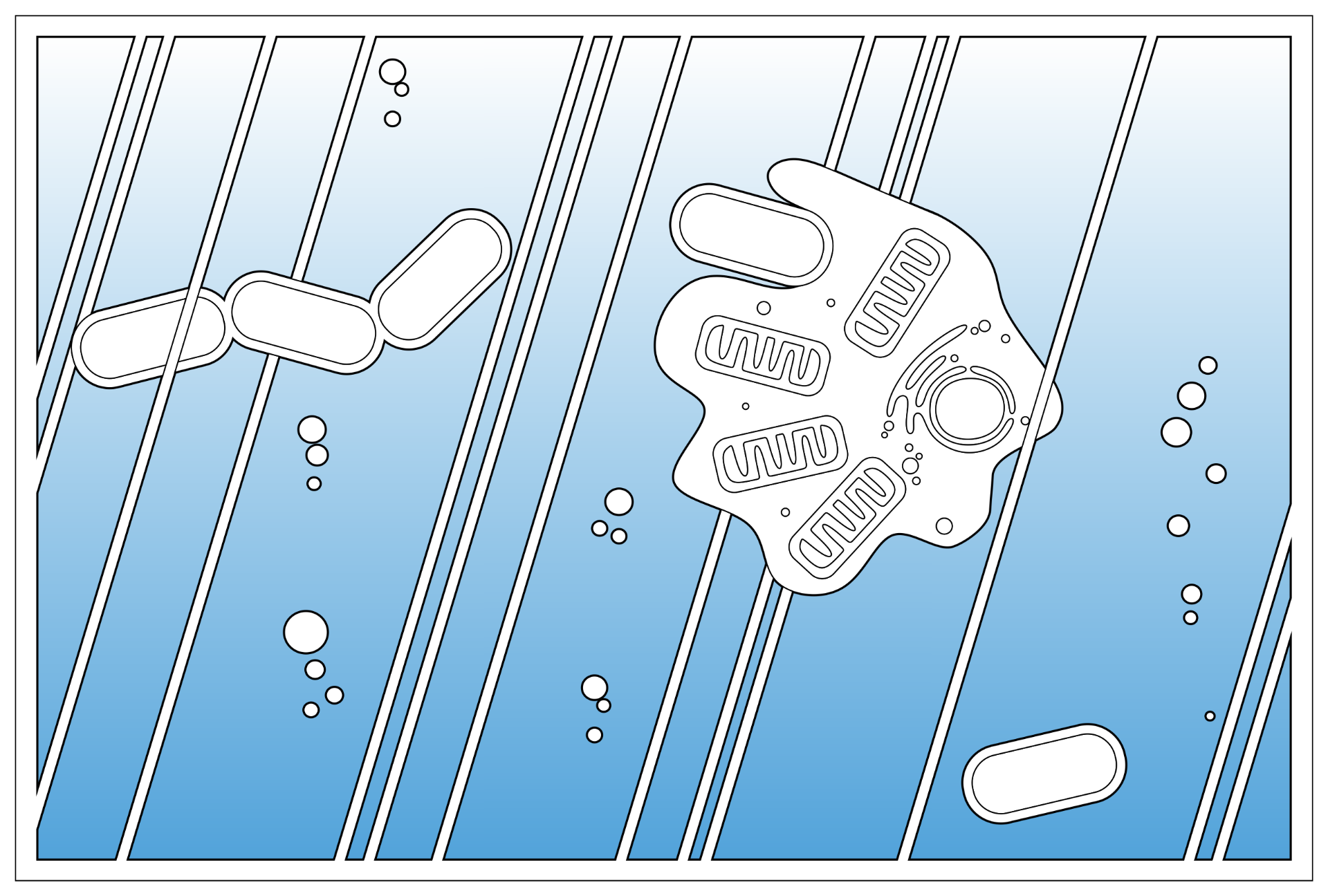
Images: dr. Christopher Kay.
Read the scientific article in Nature:
Dated gene duplications elucidate the evolutionary assembly of eukaryotes by C. Kay, A. Sprang, G. Szöllősi, D. Pisani, and P. Donoghue.
