Curious to the very bottom: successful Open Days to mark NIOZ’s 150th anniversary
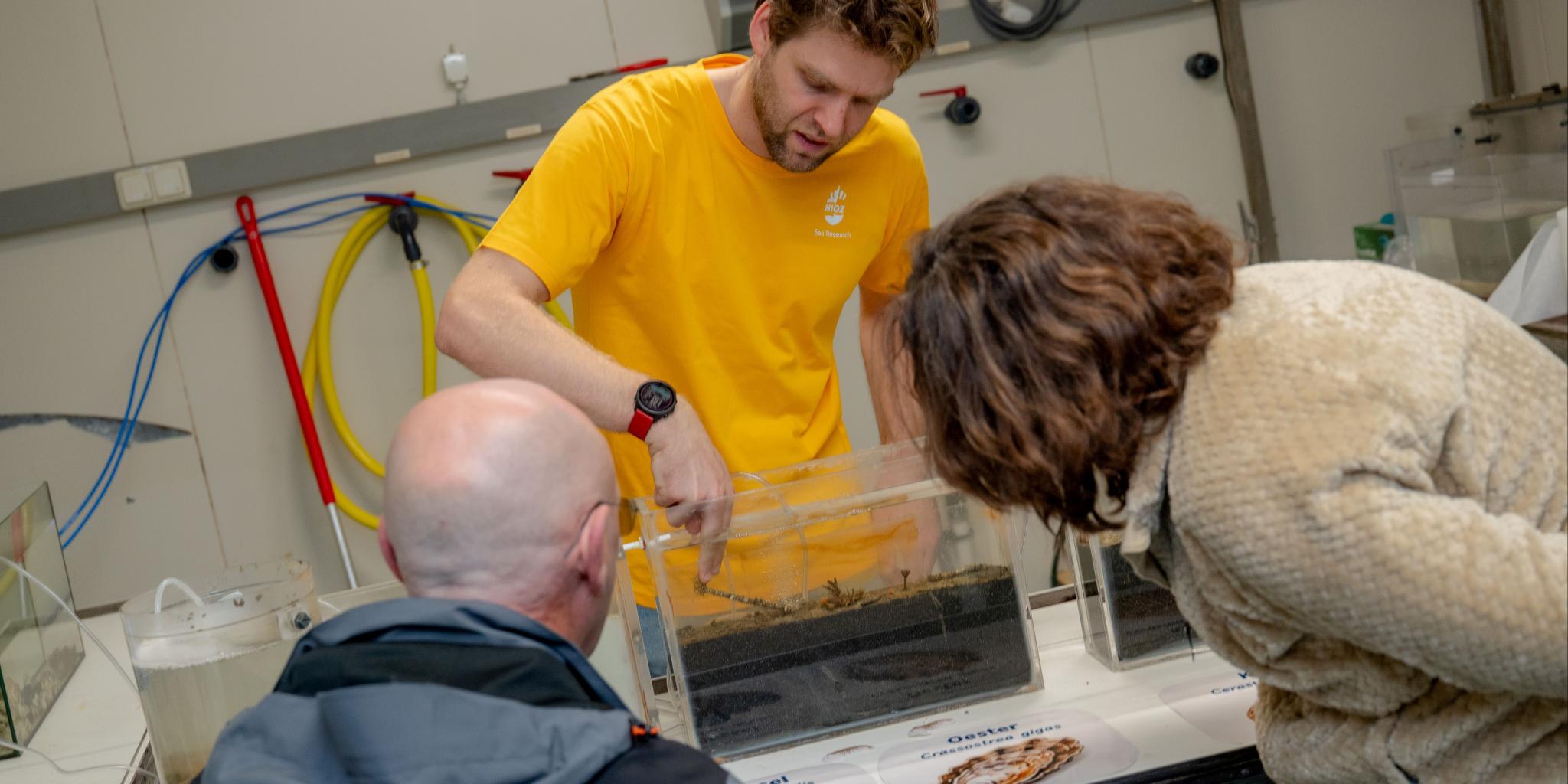
Aquariums showed different benthic organisms, such as worms and shellfish (photo: Anika Bos)
Conducting experiments, discovering marine life and asking researchers all sorts of questions: during the Open Days on Texel on 3 October and in Yerseke on 10 October, a total of over 2,100 visitors of all ages came to the Royal Netherlands Institute for Sea Research (NIOZ). To mark our 150th anniversary, we opened the doors of our institute and brought marine research to life.
What lives in a drop of seawater? How do you study the deep sea? And how can plants and animals help protect our coastline? Under the theme ‘Curious to the very bottom’, visitors were given a glimpse behind the scenes at the NIOZ and the chance to explore the world of sea research themselves.
From a drop of seawater to the deep sea
On Texel, visitors could to isolate DNA themselves, view marine life through a microscope or take a dive into the deep sea and discover just how much life exists there. They were also able to discover life and work aboard a research vessel via the Virtual Ship experience, as well as the various pieces of seagoing equipment on display. Children enthusiastically re-enacted the journey of migratory birds across the Wadden Sea, the influence of salt and cold water on ocean currents was demonstrated, and the wealth of information that can be gleaned from sediment was highlighted. The programme of talks highlighted even more clearly just how diverse our marine research is: from micro-organisms and the Wadden Sea’s food web to ocean currents and climate.
Brilliant. There was so much to experience and see. It’s great how the children are really drawn into the different themes in various ways.
Research on your doorstep
The programme in Yerseke brought visitors closer to research into the delta and the coast, much of which takes place almost at their doorstep. There were aquariums containing oysters and other benthic life found in the salt marshes and mudflats in the vicinity, plankton from the Oosterschelde under the microscope, and seaweed to make art or food with! Coastal protection and working with nature are key themes in NIOZ’s research in Yerseke, and thus were a recurring feature in the programme: with an escape room on sea-level rise, building dykes out of Lego, and in talks on the use of oyster reefs or seagrass to protect our coasts.
It was fascinating and great fun to see the staff talking so enthusiastically. They really explained everything so well!
Surprising conversations
The activities provided plenty of opportunities for conversation. This allowed NIOZ staff to share their knowledge of the sea, the ocean and the coast with a wider audience. Or to pass on their passion to young people, who may well be the next generation of marine researchers. “And visitors’ questions sometimes give us a surprising new perspective on our work,” said NIOZ researcher Aimée Slangen. “Someone from outside the scientific community can ask questions about things we take for granted. That makes you look at your own research with fresh eyes again.”
150 years of sharing research with the public
The Open Days formed part of the programme marking NIOZ’s 150th anniversary. “This year is all about celebrating 150 years of marine research, sharing our story and strengthening connections with partners, organisations and the people linked to NIOZ,” says NIOZ Director Maaike van de Kamp. “With 1,500 visitors at the Open Day on Texel and 650 in Yerseke, and the many positive reactions we received from them, we can safely say that we succeeded to do so!”