This is how the Netherlands can move forward for decades with its new research vessel
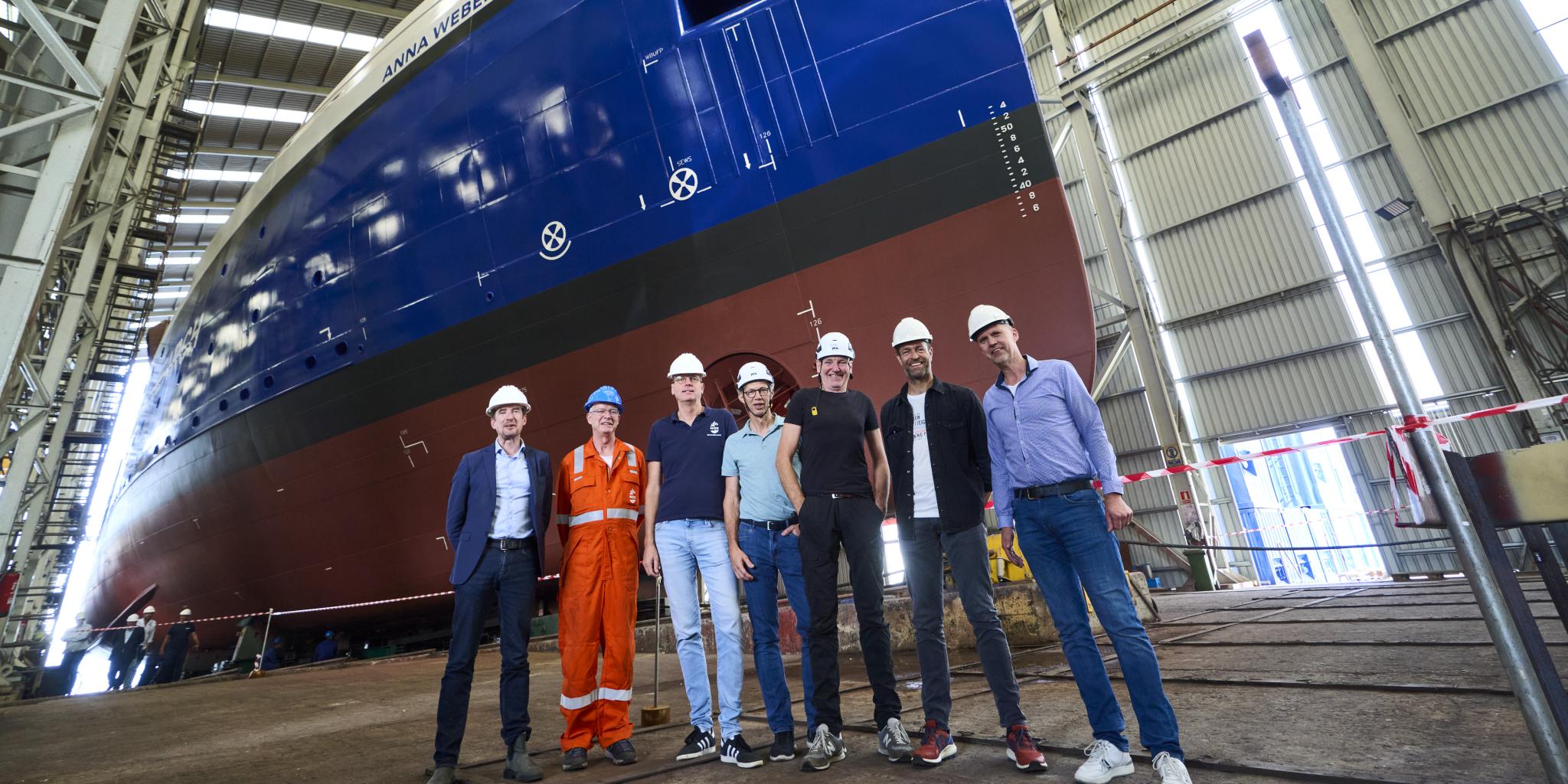
RV Anna Weber-van Bosse under construction. (Credit: NIOZ)
Ocean scientist Gert-Jan Reichart has been working on it for ten years, and on 12 March 2026, the time will have come. That day the largest Dutch research vessel ever will be christened. With RV Anna Weber-van Bosse, marine researchers will be able to conduct innovative research for decades to come. Smart design tactics will make this possible.
A disaster scenario: a new European research vessel was launched and had to be refitted at a cost of millions of euros before it could take measurements. It had a so-called bulbous bow: a large bulge under the waterline at the bow. As expected, this had a favourable effect on fuel consumption, but it also caused a lot of bubbles. ‘These were disastrous for the reception of signals by the sound sensors under the ship,’ says Gert-Jan Reichart, illustrating how challenging it is to design a research vessel.
The new pride
As the head of the NIOZ Ocean Systems department, Reichart is closely involved in the development of RV Anna Weber-van Bosse. This research vessel is set to become the new pride and joy of the Dutch research fleet, now that the beloved ship RV Pelagia has been taken out of service. Ten years ago already, Reichart and the team involved in the new-build sat down with scientists, marine engineers and crew members and later, together with the construction supervision team, visited shipyards as part of the European tender process. Now Armon Shipyard in Vigo, Spain, will soon deliver the new Dutch ocean-going research vessel, which will be christened in the NIOZ harbour on Texel on the 12th of March.
Separate container labs – highly flexible
Developments in technology and science are happening so fast – how do you design a research vessel that will enable you to conduct innovative research for 35 years? ‘We work with separate container labs on board,’ says Reichart. You can take them on board in varying combinations, adapt them and replace them if necessary. ‘This system with separate labs was developed at NIOZ a long time ago and we have had very good experiences with it.’ On the RV Pelagia, depending on the type of analyses that had to be carried out on board, different containers were hoisted onto the ship and anchored on the deck and in the belly of the ship. The new ship can carry more of these containers. ‘That makes the vessel very flexible.’
Collecting water samples and sediment
The new ship can carry more researchers, thirty instead of twelve. ‘This allows us to undertake larger projects, or several at the same time.’ The deck will be more spacious and on both sides of the ship research activities can be carried out. ‘One researcher will be able to take water samples with the CTD, while immediately afterwards someone else can be taking sediment samples with the piston core that goes down.’ Previously, researchers had to wait for each other longer. The sediment samples that researchers extract from the seabed can come from depths of up to 32 metres below the seabed, twice as deep as now. ‘It will also be safer to lower the CTD into the water: thanks to the CTD deploy frame, no one will have to hold ropes.’
Larger, but economical
At almost 80 metres in length, the new ship will be about 14 metres longer than the old one, but it is intended to consume hardly any more fuel. ‘It has an axe bow that rises straight up.’ This reduces fuel consumption compared to a bow that slopes forward, but hopefully does not cause the same problematic amount of bubbles as a bulbous bow.
Enormous eardrums
Another feature designed to save fuel is the way in which the acoustic sensors are mounted under the ship. They look like enormous eardrums. ‘They are now mounted separately in a large gondola under the ship, where they pick up the echo of transmitted sounds, just like whales do with clicks,’ says Reichart. ‘Previously, the gondola with sensors hung a short distance below the ship to avoid the bubbles. That did cost extra fuel.’ The new ship has a design in which the sensors are housed in a thickened plate: a raised edge is intended to divert the bubbles to the side. This prevents them from interfering with the measurements.
Space for future equipment
To be ready for the future, the ship has been designed with expansion options for additional equipment and sensors. ‘The aft deck in particular has been made extra large by moving the superstructure as far forward as possible. From there, a remotely operated vessel (ROV) can conduct research on the seabed and act as the eyes and arms of science from a distance.’ The new ship will also have a drone deck and a so-called drop keel. ‘This allows you to lower sensors a few metres below the ship.’ Space has been left in the drop keel for possible future sensors that do not yet exist. ‘We have also ensured that the ship can grow in weight by a few tonnes without compromising its stability and sailing performance,’ says Reichart.
Sailing behaviour
Sailing behaviour remains a challenging part of ship design. Reichart shows a video in which a yellow boat moves wildly on waves. In 2023 this oversized model of RV Anna Weber-van Bosse. floated in the MARIN simulator in Wageningen, which can test ship models under realistic conditions. This allows the developers to be almost certain how the design will behave at sea. The real test will come during the trial runs around the time of delivery.
Linked staff
Gert-Jan Reichart
Head of Ocean Systems

Building a ship
Gert-Jan Reichart at the start of build ceremony of RV Anna Weber-van Bosse
Under construction
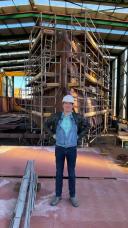
Gert-Jan Reichart stands for RV AW-vB under construction