Part I of the NIOZ 150 Colloquium Series: Exploring the Future of Marine Research with Leigh Storey
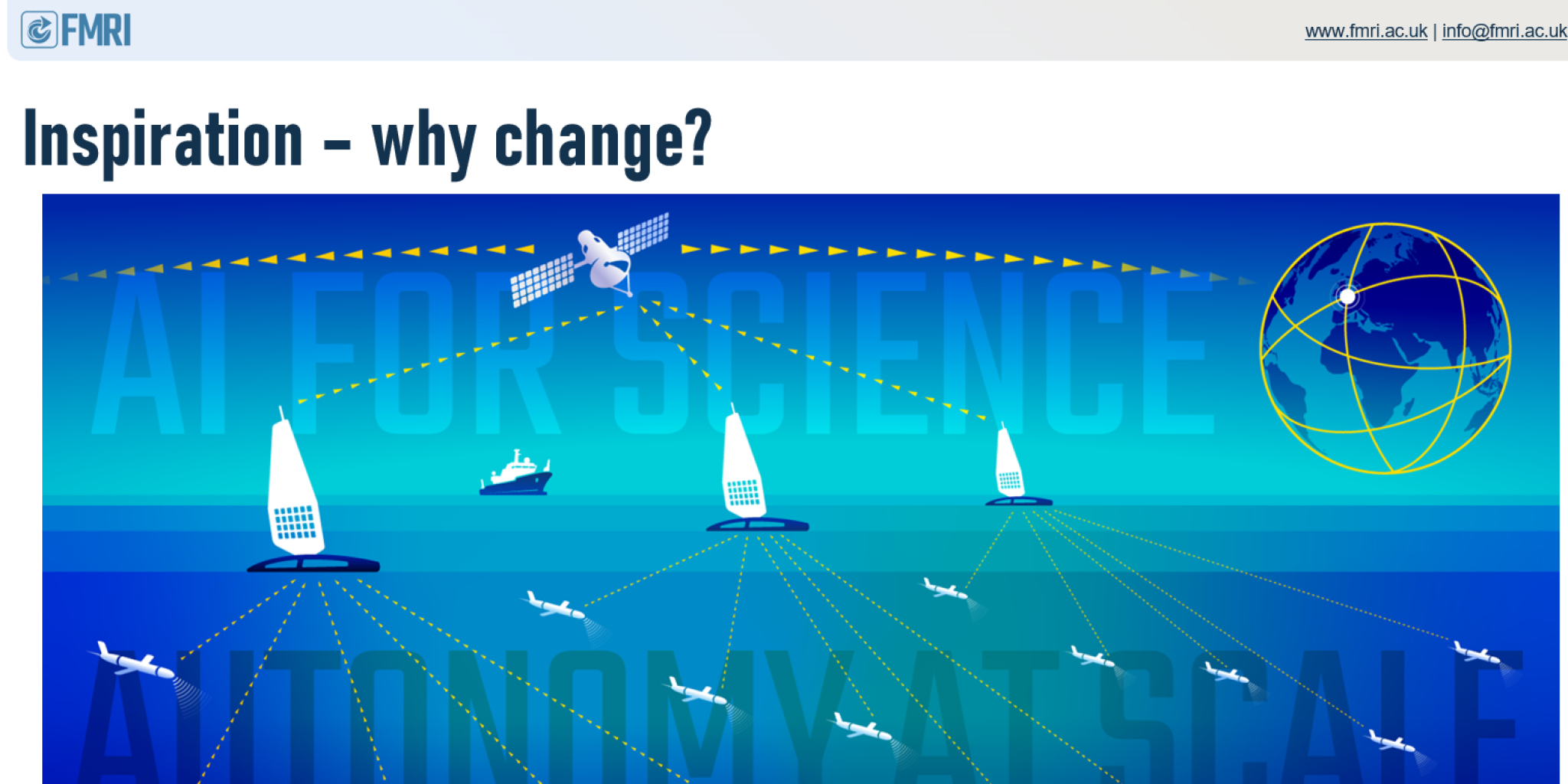
Slide of presentation of the first colloquium (image: Leigh Storey)
This year, NIOZ celebrates its 150th anniversary. As part of the festivities, our Colloquium Committee is hosting a special colloquium series featuring internationally renowned speakers at the forefront of marine science. The first edition took place on Thursday, April 23, and was organized in collaboration with the National Marine Facilities (NMF) department. On this special day, we were treated to a behind-the-scenes look at our own NMF department, followed by an inspiring vision of the future shared by guest speaker Leigh Storey, Senior Responsible Owner at the Future Marine Research Infrastructure (FMRI) in the United Kingdom.
The Future
"Are marine scientists ready to embrace marine autonomous systems at scale?" Leigh Storey asked the audience provocatively. He outlined a future where research vessels are no longer the sole platforms for discovery, but instead function as hubs for a fleet of autonomous underwater and surface vehicles. By utilizing technologies such as AI, data can be collected more intelligently and on a much larger scale, all without the significant ecological footprint of traditional, large ships.
Net-Zero Research
A crucial element of Storey’s vision is the transition to net-zero oceanography. As research vessels worldwide switch to alternative fuels like methanol, their operational range often decreases due to lower energy density. "We cannot simply do less research," Storey stated. The solution lies in the smart combination of shorter ship expeditions with autonomous systems that can independently collect data for months at a time, for instance, in remote areas.
Learn from others
Storey’s message was clear: the way we study the ocean is changing radically. This transformation is essential to meeting climate goals and continuing to expand our knowledge. "Learn from others," Storey urged. He emphasized that we do not need to reinvent the wheel. By collaborating intensively and learning from one another’s (technological) successes and failures, we can accelerate the use of autonomous research systems?
It is precisely by connecting expertise internationally that we can (collectively) tackle the complex challenges of modern oceanography.
Inspiration part II
This lecture was the first in a series of five. Through these lectures, we aim to stimulate dialogue between disciplines, connect people and ideas, and strengthen the international scientific community surrounding NIOZ. The next lecture will be held on June 24 in Yerseke. Our guest will be Prof. Joanne Preston, a leading expert in coastal restoration ecology from the Institute of Marine Sciences at the University of Portsmouth in the United Kingdom. You can register for attendance via the link below.
About Leigh Storey
Leigh Storey is Senior Responsible Owner at Future Marine Research Infrastructure (FMRI) in the United Kingdom. FMRI is a national initiative that aims to transform the UK’s marine science capabilities by developing an integrated, next-generation research infrastructure for the ocean. Leigh Storey works at the interface of science, policy, and infrastructure development, helping coordinate investments and partnerships that will enable innovative marine research, advanced observation technologies, and improved access to marine data to support sustainable ocean management and scientific discovery.
About the NIOZ 150 Colloquium Series: Exploring the Future of Ocean Science
This year, the NIOZ is celebrating its 150th anniversary. As part of the celebrations, our Colloquium Committee organizes a special lectures series with internationally renowned speakers working at the forefront of marine science. From cutting-edge research infrastructure to biodiversity, restoration, climate tipping points, and microbial processes. This series offers fresh perspectives on the future of ocean research. The lectures aim to spark dialogue across disciplines, connect people and ideas, and strengthen the international scientific community around NIOZ. The series is open to anyone interested, both within and outside NIOZ, and aims to celebrate science and highlight scientific excellence.
About the National Marine Facilities (NMF)
NIOZ provides the Netherlands’ marine scientific community with a wide range of state-of-the-art facilities. These include research vessels and seagoing equipment to explore and sample the oceans, advanced analytical laboratories and technical support, as well as library services and a data portal that ensures long-term access to knowledge and scientific information.
Linked staff
Nanco Klein
Head of National Marine Facilities

Zeynep Erdem
NMF policy officer
