Joint grant from the Netherlands and Germany for 3 NIOZ studies on Wadden Sea
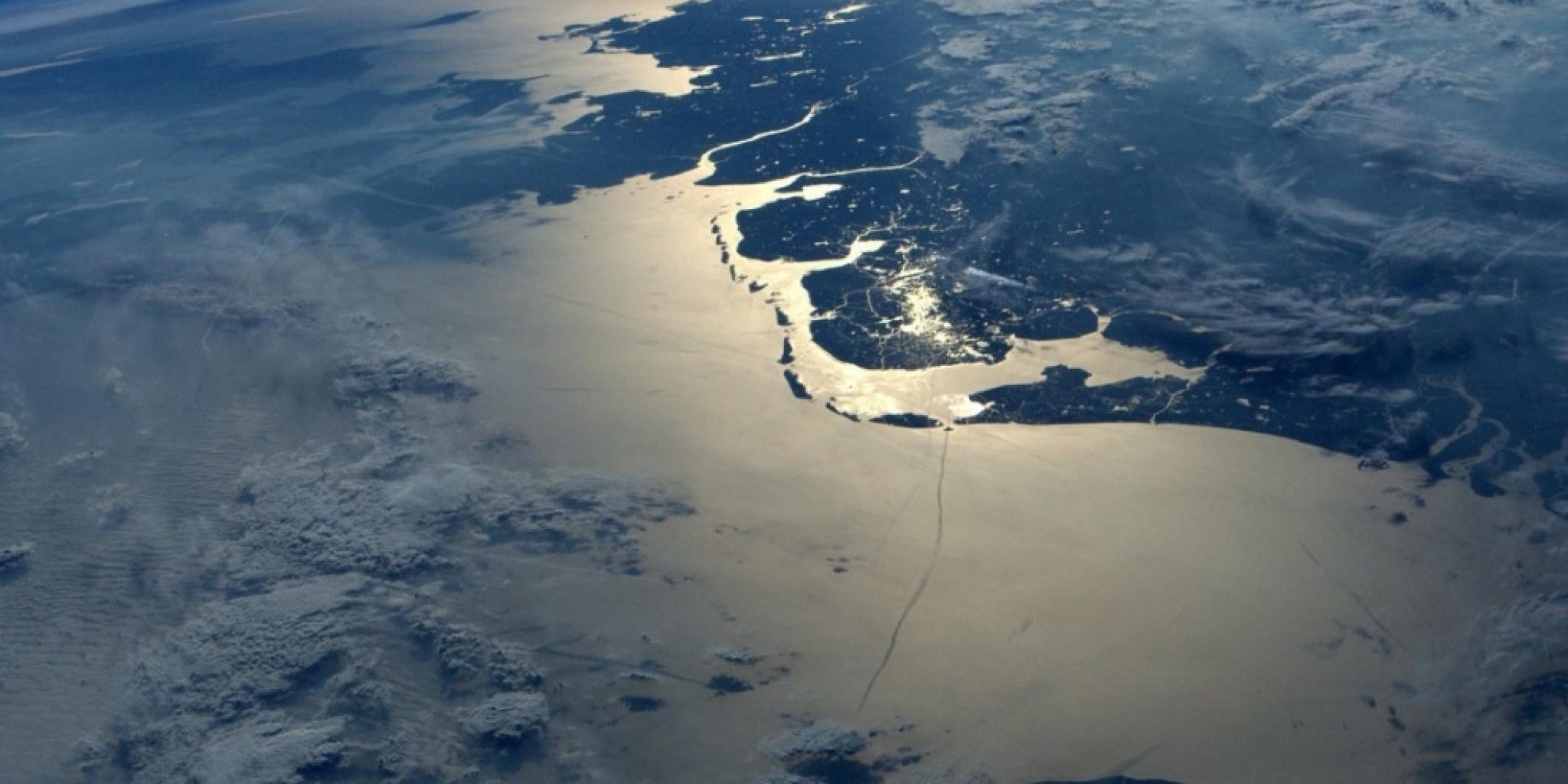
Aerial view of the Wadden Sea with sunlight reflecting on the water and visible islands and tidal channels (photo: International Space Station)
The Netherlands and Germany are jointly investing €15 million in research projects aimed at effective protection and management of the Wadden Sea. NIOZ researchers are involved in 3 of the 5 awarded projects, in which they will work, among other things, on a new 'decision support system' so that governments and policymakers can make better informed choices for conserving the Wadden Sea.
The Wadden Sea, seen from the International Space Station (credit: ISS)
Karst Jaarsma of the Ministry of Agriculture, Nature and Food Quality: "It is really our intention that these research consortia will influence government actions. We will get more information on how to preserve and improve the status of this high-value global area. With this knowledge, the government can take the right measures to preserve the Wadden Sea."
NIOZ is involved in three of the five research consortia that have been funded: in one as lead applicant and in two as co-applicant.
SedWay: Safeguarding the natural sedimentary processes in the Wadden Sea for biodiversity and people
Tjisse van der Heijde (NIOZ) is lead applicant, together with Bernd Siebenhüner (Carl von Ossietzky University Oldenburg)
Lead applicant Tjisse van der Heijde: "With this project, we want to better understand the role of biobuilding species such as mussels, oyster and eelgrass on sediment dynamics in the Wadden Sea, and investigate how humans influence these processes. Ultimately, Sedway will produce a so-called 'decision support system', which will enable managers and policymakers to make better-informed decisions to maintain the natural dynamics of the Wadden Sea."
In addition to NIOZ and Carl von Ossietzky University Oldenburg, the consortium includes the University of Groningen, HZ University of Applied Sciences, Deltares and NLPV Nationalpark Niedersächsisches Wattenmeer. In addition, a total of 12 cooperating partners are involved, with from the Netherlands Natuurmonumenten, Staatsbosbeheer, and Rijkswaterstaat.
PaRCA: Pathways for Realising Climate Adaptation in the Wadden Sea
Johan van de Koppel (NIOZ) is one of the co-applicants
The precious ecosystems of the World Hertitage Wadden Sea are facing multiple threats of climate change, rapid human-induced changes in biodiversity, and pollution. Sea level rise and corresponding changes in waves and currents will impact the tidal flat systems. It is assumed that without any action tidal flats will drown in the future. This project analyses different measures to support tidal flat growth, spanning from sand nourishments to managed retreat. Experts of natural and social sciences, engineering, and management from universities, research organisations, and administration form a large consortium to develop future management options for a sustainable Wadden Sea.
SALTGARDEN: Sustainable Adaptive Landscapes through Transdisciplinary Gardening to Advance the Resilience and Dynamics of our Ecological Natural‐heritage
Daphne van der Wal (NIOZ) is one of the co-applicants
We urgently need to prepare vulnerable coastal systems in the Wadden Sea for the impacts of the triple ecological crisis. SALTGARDEN advocates for biodiverse, dynamic salt marshes to improve ecosystem functions and services at all levels. With a transdisciplinary approach combining mesocosm experiments, field observations, model simulations and socio-economic assessments, we seek to quantify and predict future developments of biodiverse-dynamic versus static-cultivated salt marshes. Together with trilateral stakeholders, we will co-create Nature-based Gardening strategies to promote adaptive landscapes and sustainable wetland management beyond coastal protection. SALTGARDEN will inform adaptive policy pathways for future-proofing the Wadden Sea salt marshes and communities.
About the Wadden Sea call
This programme is an initiative of the German federal and Dutch national governments, and NWO as part of the Dutch Science Agenda (NWA). A total of 5 bilateral research consortia have received funding from this 'Wadden Sea call'. The aim is to better understand the complex load of the Wadden Sea, by studying the relationship between sediment, ecology, human co-use, flood safety and effective protection and management. In addition, the programme is an investment in a new generation of Wadden experts and a new bridge between countries, disciplines, institutes and types of stakeholders.
Linked staff
Daphne van der Wal
Research Leader
Tjisse van der Heide
Senior Research Leader
Johan van de Koppel
Research Leader
