(Almost) ready for the expedition with RV Anna Weber-van Bosse
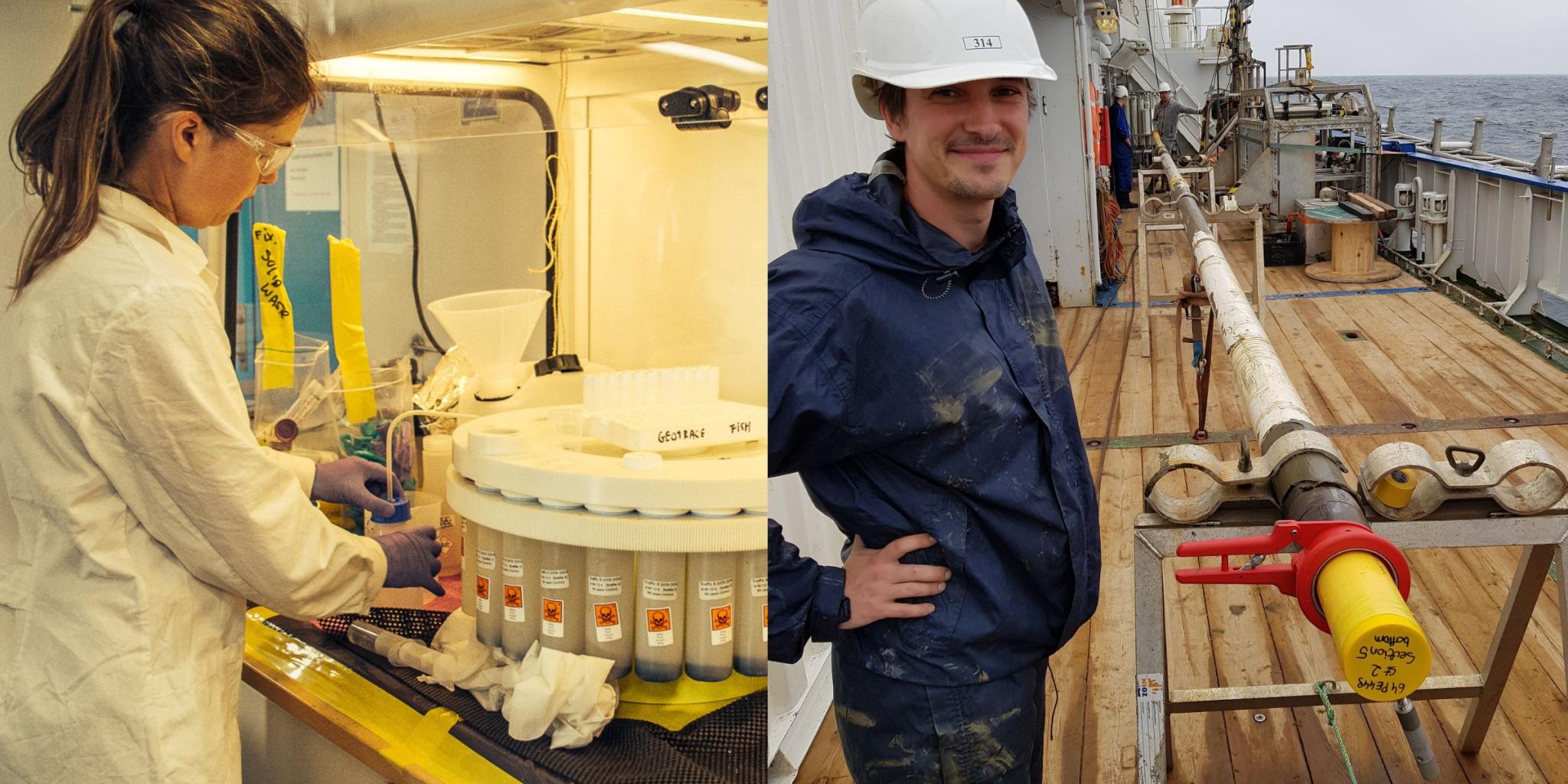
Michelle van der Does and Rick Hennekam
From millenia-old river sediment to desert dust: the brand new research vessel RV Anna Weber-van Bosse is ready to collect research data. NIOZ scientists Michèlle van der Does and Rick Hennekam are preparing for their first expedition with the ship. This brings with it a fair amount of (positive) excitement.
Going on an expedition by research vessel for the first time in ten years is special in itself. Earth scientist Michèlle van der Does is also responsible, as chief scientist, for the coordination and logistics of all scientific activities on board the brand-new ship RV Anna Weber-van Bosse. From 15 to 27 April, the newly delivered ship will embark on its second scientific expedition.
Preparations take longer than expected
After completing its first week-long research trip in the North Sea, the ship will sail from Las Palmas to Cape Verde. A month and a half before departure, Van der Does says that the preparations are taking longer than expected. ‘As chief scientist, I am responsible for all the scientists on board, from logistics to safety. Does everyone have a visa, and have they completed the Safety at Sea training? They come from all kinds of countries, and precisely because we are sailing near Africa, Zeynep (Zeynep Erdem
Opens in a new tab, ed.) has ensured that African scientists can also join us.’
RV Anna Weber-van Bosse at the sea trials on 6 February at Vigo (photo: ARMON)
On board, Van der Does is the point of contact for the captain. ‘There are daily schedules for all the planned research, but in consultation with the captain, we determine if the weather is good enough for the day's activities, if the waves are too high and whether we will arrive where we need to be on time.’ Even though all the equipment has been tested, it is still very exciting for all users. ‘Everyone still has to get used to where everything is, and some of the software is new.’
Emptying dust buoys
For her own research, Van der Does will collect the results of dust collectors along the shipping route, she explains. 'Sediment traps deep in the sea, attached to moorings, fill a new bottle with water and everything in it every four days. Floating buoys filter dust from the air. Every twenty days, the device turns a new filter in front of the inlet. With this wonderful resolution, we can measure the results of individual dust storms.
Desert dust as fertiliser
Dust is an intriguing research topic
Opens in a new tab. Desert dust that blows long distances through the atmosphere is a potential fertiliser for the ocean. To discover how this works and what effects it has, researchers led by Jan-Berend Stuut collect data annually and exchange the jars and filters.Van der Does received an NWO grant
Opens in a new tab to analyse the data: how much mineral-rich Saharan sand blows into the sea and how does this stimulate marine life? Thanks to this grant, she can now lead the expedition. During her PhD research between 2012 and 2016 she joined several expeditions to install and maintain these instruments.Green Sahara
Oceanographer Rick Hennekam was also planning to join this trip. Unfortunately, however, due to a lack of time, his segment has been postponed until 2027. For the recently funded EMBRACER project
Opens in a new tab and also for his Vidi projectOpens in a new tab, he needs core samples: metres-long samples from the seabed. He uses these to study the history of the climate. ‘I am investigating climate tipping points that we know have occurred in Africa. In the past, the Sahara has been very green several times, with rivers. The ecosystem has shifted from dry to wet and later back again. My hypothesis is that these changes did not occur as abruptly as we now think. We want to investigate that.’ With this kind of knowledge, Hennekam and his colleagues hope, among other things, to predict the consequences of current climate change for the longer term, after 2100Opens in a new tab.Dormant rivers
For his research, he needs core samples with sediment up to 10,000 years old. ‘We have to collect them just off the coast, at the mouths of dormant rivers.’ These rivers no longer flow, but in the days when the Sahara was green, they carried sediment to the sea. ‘Together with the fresh water that suddenly flowed into the sea, that nutrient-rich sediment had all kinds of consequences in the sea.’ Hennekam wants to find and analyse that sediment to learn more about the events and their effects. ‘In a thousand years, such a river could deposit up to a metre of sediment.’ So he needs to take metres-long cores to go back 10,000 years in time.
It could also go wrong
In itself, taking such core samples is no problem at all for the new research vessel: it can even take much longer cores than its predecessor, the RV Pelagia. But Hennekam is not sure yet. ‘Although all the equipment has been tested, this ship has never actually taken a core sample. It will be exciting to see if everything really works.’ He also still needs permission from the countries in whose territorial waters he wants to drill. That permission has not yet been granted. ‘Sometimes it only comes through on the day you want to drill. Or not. Last year, I received a text message from Senegal, but no official statement of permission. So we didn't drill.’
Is it already over?
As exciting as it is for everyone, the researchers are really looking forward to the expedition. Van der Does: ‘The previous times, I thought at the end: is it over already? And I'm optimistic, I assume we can do everything we plan to do.’ She is not afraid of seasickness either. ‘On the first day, I always had to get my bearings, as they say. Spend a lot of time outside, looking at the horizon. Every ship is different, but on this larger ship it will certainly be no worse than on Pelagia.’
Linked staff
Michèlle van der Does
Postdoc

Rick Hennekam
Senior Scientist