Allocating sailing time on a research vessel – a meticulous puzzle
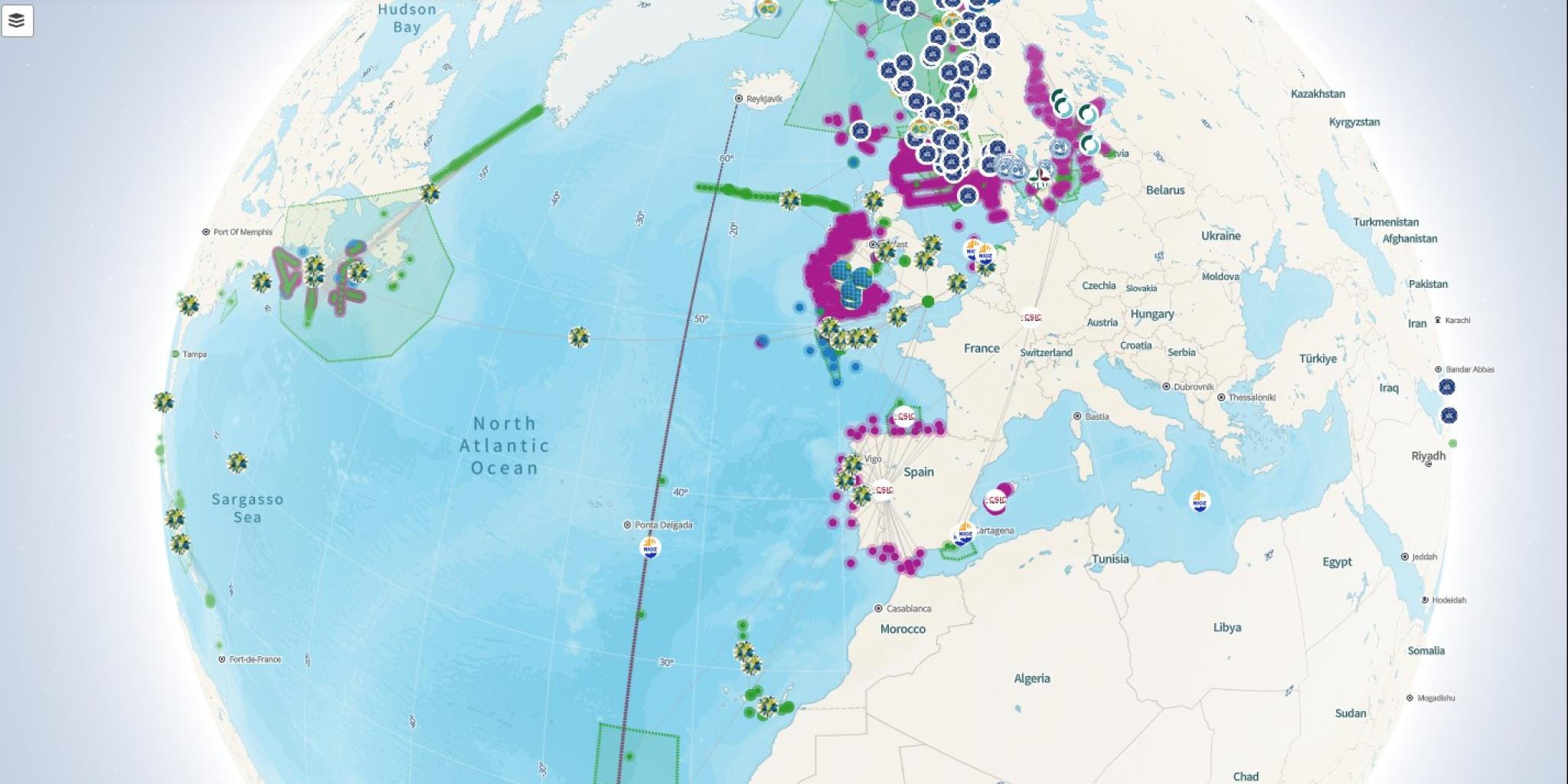
Marine Facility Planner showing research vessels.
The National Sailing Time Committee exists to maximize the use of the Dutch research fleet and facilitate and enable the most scientific research possible. Chair Francesca Sangiorgi (UU) and ‘puzzler’ Zeynep Erdem (NMF, NIOZ) explain what their work involves.
On a freely accessible online world map
Opens in a new tab, Zeynep Erdem shows where: research vessels from all over the world sail. From the Mediterranean Sea and the Bermuda Triangle to the far north and south, dozens of ships are on the move. They accommodate groups of scientists, biologists, chemists, geologists, collecting water, particles and organisms from the surface to the deepest part the ocean and sediments from the seafloor to several meters below it. They then search for specific substances or life forms, often on the spot, bobbing on hopefully not too high waves.
Zeynep Erdem planning sea research. (Credit: NIOZ))
All requests come in
Erdem works at the NIOZ on Texel and until 2020 she joined research expeditions as a paleoceanographer. Now she is the science coordinator in the National Marine Facilities department and a member of the National Sailing Time Committee
Opens in a new tab. She receives all requests from researchers who want to join a research expedition. They request sailing timeOpens in a new tab via the Marine Facilities PlanningOpens in a new tab platform. Erdem: ‘They specify a location and a preferred period, because some research can only be executed during a specific season, for example. They also fill in how much sailing time they need and what research activities are planned, together with the equipment needed on board.’ That's a lot to consider, and there is a whole team behind checking the feasibility of the proposed project. Applications are often submitted before the research grant has been awarded. ‘I don't schedule and present those applications to the committee yet, but itis convenient to know what might be coming,’ says Erdem.Planning tool
Every year around August, Erdem gets to work on what she considers one of the most enjoyable parts of her job: mapping out the optimal route for the Dutch research fleet based on all the applications. The fleet consists of three ships. RV Adriaen Coenen, a small vessel, used for day trips to the shallowest parts of the sea. The coastal vessel, RV Wim Wolff can also operate in the wind parks in the coastal Netherlands. The ocean-going research vessel, RV Pelagia, will soon be replaced by RV Anna Weber-van Bosse. Erdem uses the MFP research planning tool that makes it possible to create an efficient schedule with a minimum number of transits and zigzag movements. ‘Sailing time is valuable, and we also need to pay attention to the sustainability. The Mediterranean Sea looks close by on a typical map, but reaching Crete, for example, takes almost 2 weeks.’
Many things need to be considered during the planning phase. ‘When I organized the first research expedition years ago, this planning tool wasn’t available. I made the mistake of choosing a route where the water was sometimes too shallow, so the ship couldn't get through at all,’ Erdem recalls. She shows the planning tool on her computer, which allows her to visualise all kinds of aspects: suggested routes considering the water depth and marine protected areas to locations of wind farms and marine traffic. ‘The ship also has to dock at ports at regular intervals to refuel and replenish supplies, and occasionally out of the water for maintenance.’
Points instead of money
Erdem puzzles out the route that makes the best use of the ship and can honour the most research requests. Sometimes researchers are asked to decrease their proposed sailing time, but it is almost always possible to help everyone. ‘Sometimes scientists need to wait longer than they hoped before sailing.’ And sometimes it is not possible to accommodate all requests on the only Dutch ocean-going ship, which can only be in one place at a time. That is why Erdem works mainly with European colleagues, part of Ocean Facilities Exchange Group (OFEG)
Opens in a new tab. Many international researchers also traveled on the (beloved!) RV Pelagia. ‘Instead of constantly asking for or paying money, we exchange points. That exchange is fairly balanced.’After a few weeks of puzzling, Erdem has worked out three scenarios for the coming year, with some flexibility for exchanges or research projects for which funds have become available. She submits these scenarios to the National Sailing Time Committee, of which she is one of five members. The chair is Francesca Sangiorgi, senior lecturer at the Department of Earth Sciences at Utrecht University. Despite seasickness, she has joined several expeditions, for example, to Antarctica and the Gulf of Mexico. ‘Nowadays, I also try to let young researchers join expeditions.’

Francesca Sangiorgi (credit: UU)
The decision meetings
The sailing time committee meets twice a year: once to discuss the two smaller research vessels and once to discuss RV Pelagia, which will soon be replaced by RV Anna Weber-van Bosse. In this transition period meetings are more frequent. ‘Thanks to Zeynep’s good preparation and planning, these meetings are usually not complicated,’ Sangiorgi praises coordinator Erdem. ‘She presents us with excellent plans, in which the ship is used as often as possible, with as few port days as possible and propose multiple options. Our job is then to evaluate the advantages and disadvantages of these options and make a decision’ The committee is independent and expressly has no mandateOpens in a new tab to assess the quality of the requested research in order to base permission to sail on it. ‘However, we can sometimes point out that too many sailing days have been requested for what needs to be done.’
RV Anna Weber-van Bosse: more berths and more ice
The puzzle for 2026 looked different than before. RV Anna Weber-van Bosse is bigger than RV Pelagia and can also sail in regions with light sea ice conditions, so it can sail further into the high latitudes. It can host more equipment for sampling, measurements, and containers (laboratories) and more people: maximum berths available is 31, compared to 12 on RV Pelagia. Sangiorgi: ‘We hope that these extra places will provide more opportunities for scientists but also for educators, and outreach experts. With an excellent video connection, university and secondary school teachers can connect to land and show what it's like to be offshore and do ocean research and show what's happening on the ship, right from the ship.’ As far as she is concerned, Sangiorgi hopes that more students, for example those of the Marine Sciences programme, which Sangiorgi coordinates, will soon be able to be on board and/or participate in a virtual ship course. ‘They will also receive research data real-time from the ship, which they can use for their assignments in the class.’
Coming soon
The construction of the new research vessel RV Anna Weber-van Bosse is in its final stages. It will be christened on 12 March 2026 in the NIOZ harbour on Texel.

RV Anna Weber-van Bosse. (Credit: NIOZ)