16 Million to keep the Dutch delta liveable – even as it changes
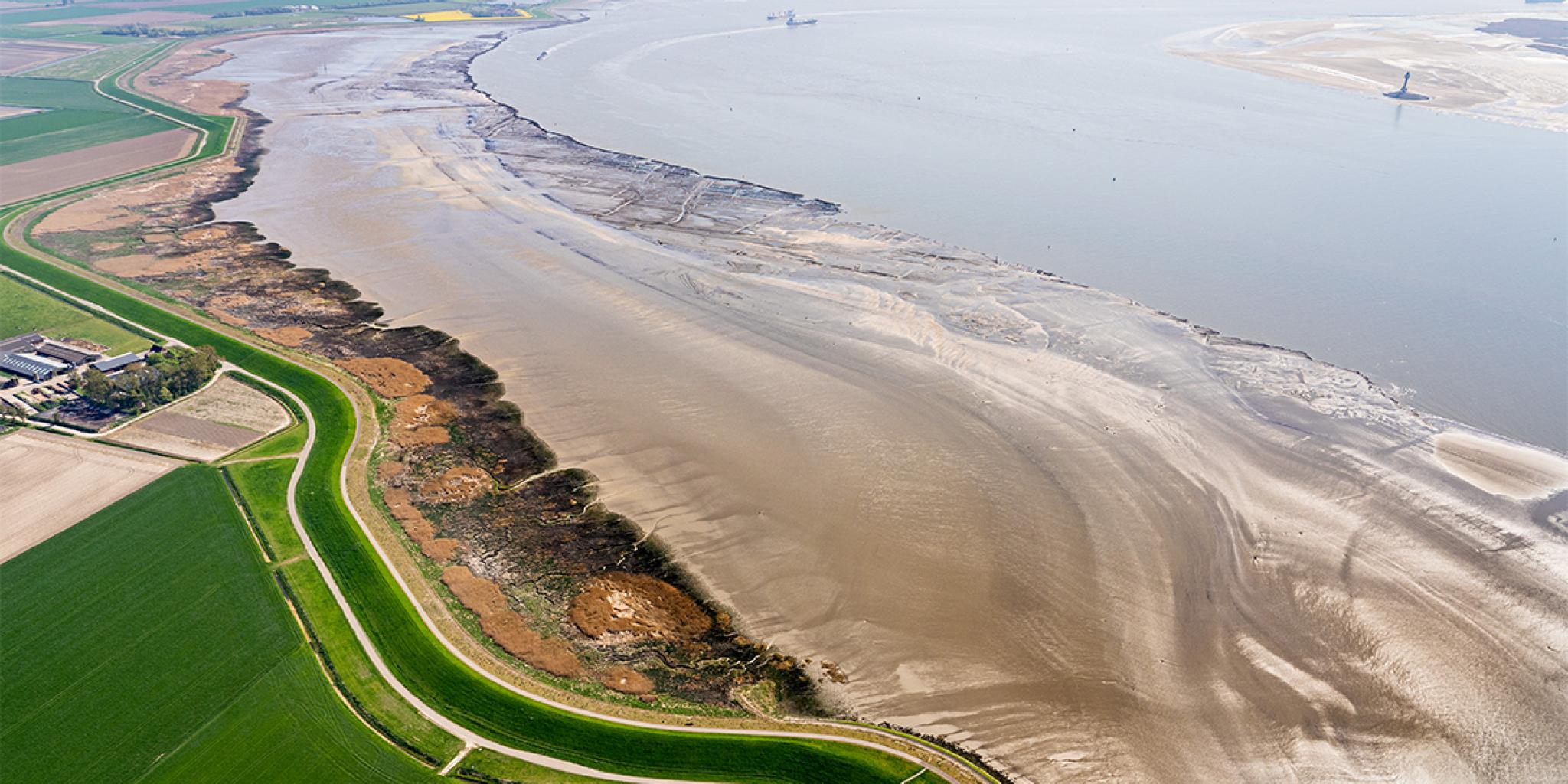
Salt marshes in the Westerschelde, near Rilland (photo: Edwin Paree)
Deltas and coastal plains are attractive places to live: fertile, flat, open to the sea. These lowlands are, however, also vulnerable to climate-change and sea-level rise. To better predict how deltas develop in the future we need a thorough understanding of their biogeomorphology – how organisms, currents, waves, water and sand discharge all shape the delta-landscape. Today it was announced that Δ-ENIGMA, a project that focuses on the development of the delta-landscape, is one of the projects to be awarded through the Dutch Research Council (NWO) Large-scale Research Infrastructure call (LSRI). The 10-year project will receive 16 million euros.
Illustration of Delta ENIGMA.
Collaboration
The project is a collaboration between Utrecht University, NIOZ, TU Delft, University of Twente, Wageningen University & Research, Deltares and TNO. Biogeomorphology lies at the heart of Δ-ENIGMA. The programme provides infrastructure for intensive observational and experimental research of the Dutch delta. This will improve our ability to predict future development, and help us live on happily in a changing delta.
“We do not yet have the models to accurately predict changes in deltas in the coming years to decades, mainly because our knowledge of the interaction between physical and ecological processes in the formation of deltas is insufficient,” says Gerben Ruessink, Δ-ENIGMA project leader and professor at Utrecht University.
Important investments in coastal research
More than 2.5 million euros will be spent on expanding NIOZ's research equipment. These investments will give NIOZ a leading role in the biological part of the project. The new equipment offers unique opportunities to study the effects of climate change on plants and animals that make up our dunes, mudflats and salt marshes. This will give us insight into how climate change is affecting the landscapes that are so important for coastal defense and Dutch biodiversity.
Open data and labs
A coherent open database of the measurement results will be accumulating over the project’s 10-year period and will be freely available to researchers, policymakers and delta managers. “∆-ENIGMA will strengthen national and international collaboration, as the collected data will be open and FAIR and the laboratory facilities will be accessible to others,” Ruessink says.
Dutch contribution to European research infrastructure
"With this grant, we can purchase specialized equipment that will allow us, to better assess the effects of various human interventions on the Dutch delta," says Prof. Tjeerd Bouma, Utrecht University and Royal Netherlands Institute for Sea Research (NIOZ). "Think for example of drones and 3D laser scanners for measurements in the field, but also the construction of globally unique lab facilities to be able to investigate the effects of the upcoming climate change in detail." In doing so, the Netherlands are making an important contribution to the European research infrastructure for river-sea systems, DANUBIUS-RI. We also expect that many fellow European researchers will use these new facilities at NIOZ.
About NWO-LSRI
Large-scale scientific infrastructure is essential for Dutch science. It may be highly specialised equipment, such as large telescopes, high field magnets or advanced sensors and measurement networks necessary for biological and earth science research. But also ‘virtual’ facilities, such as large databases, scientific computer networks, or data and sample collections. “Investments in large-scale infrastructure contribute to the international position of the Netherlands as a country of knowledge. Science and research cannot do without the right scientific infrastructure,” said Minister Robbert Dijkgraaf.
Linked staff
Tjeerd Bouma
Senior Research Leader

Tjisse van der Heide
Senior Research Leader