NanoMare expedition: nanoplastics in the North Atlantic
Expedition AW-109: The fate of nanoplastics in the ocean.
Welcome to the NanoMare expedition blog! Here you can follow the RV Anna Weber-van Bosse and crew on their journey from Iceland to the Azores in search of the very small. The main goal of this expedition is to investigate the fate of nanoplastic concentrations in the ocean and their effects on microbes in the North Atlantic - from polar to subtropical latitudes.
7 September - The End
Written by Helge Niemann
We’re back on land. The pilot for Angra Harbour on the Azorean island of Terceira navigated our vessel to the pier, and the customs officers have also just left the boat. Everyone is itching to explore Terceira, to stretch out, see some other faces… But I have to say this: it feels a bit strange to leave this ship so soon. Anna Weber-van Bosse has been our home for the last four weeks, crossing the Atlantic Ocean from the polar regions north of Iceland and then always heading south… to 32°N, almost 1,000 km southwest of the Azores.
We spent about 150 hours on station, launching a series of instruments: CTD, high-pressure samplers, different nets, box corer… watching the first data come back from the sensors. And then countless hours in the labs afterwards, starting one set of incubations, finishing another—night shifts to modify and repair gear. We fell into the rhythm of the ship, the daily routine of changing watches, mealtimes structuring the day like a metronome.
It feels like yesterday that we boarded the ship in Reykjavík, but almost 6,000 km are behind us—an entire ocean basin. And you can see that: those who were at sea for the first time walked with slightly wobbly legs when the first waves rocked us… back then, still in Icelandic waters. Now everyone has sea legs. Our equipment is, for the most part, packed up and stored in boxes and containers. Colleagues are embracing each other, and you can sometimes even see a tear glistening… In a way, that is a good sign - a team has been forged.
It was a fantastic cruise, with a nice atmosphere among the scientists and also with Anna Weber’s crew. Smaller and bigger technical problems were solved, and we were able to collect a wealth of samples and data. I can’t wait to see what we found. How much nanoplastic is there in the Atlantic? What effect does it have on microbes and algae? But the answers to these questions must wait.
It’s good to relax now, to get out of the 24/7 working mode, not to plan the next station or discuss data and instrument problems. I’ll spend a few days in the Azores, hiking and slowly coming back down to earth.
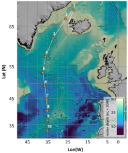
Route of the Anna Weber-van Bosse during Expedition AWvB109
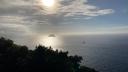
Arrival of RV Anna Weber-van Bosse seen from Terceira (Photo: Philip Süßle)
3 September - Notes from an Insider
Written by Paula Eisnecker
I am a bit of an outsider on board. Unlike the other scientists, I will not fly back to the Netherlands when this cruise ends. I live on Terceira, an island in the Azores archipelago, and conveniently, it’s the island we arrive on with this ship. I am also an outsider on the main research topics of this expedition around marine plastic pollution. I work at the University of the Azores where I study the impact of climate change on phytoplankton in the North Atlantic.
The Azores sit in a special spot in the North Atlantic. In summer, the ocean here is what we call oligotrophic, or "empty" of nutrients. Without nutrients, phytoplankton cannot grow, and the entire food chain that is built on phytoplankton has nothing to eat either. But in winter and spring, the wind stirs the water hard enough to mix nutrients up from deeper water, waking up the stratified ocean. Phytoplankton starts to bloom, and even whales swing by the islands for a feeding stop during their migration. One concern related to climate change is that this area of “empty” surface water in the subtropical North Atlantic will expand, which would then also affect the marine ecosystem of the Azores.
As I already live surrounded by that same ocean, why sail for weeks just to scoop up water I could reach any day from right in front of my door?
Because to see the bigger picture, I cannot only seek answers in the waters around Terceira. By sailing on a transect from Iceland down to the Azores, I can observe how the surface ocean biogeochemistry, including phytoplankton communities and marine carbon, is changing when nutrients become scarce. Later, I can even combine those results with decades of satellite images to compare past and current observations. As interesting as this might be to me, what can we say looking ahead?
To get a blink of what could happen in the future, I am running multiple experiments simulating future ocean conditions with increased CO2 levels. These experiments give an indication on what the ocean might ‘taste’ like for the local microbial communities, and I can investigate how and if they can cope with this. After preparing seawater in two-liter bottles and adapting CO2 concentrations, it’s time to wait, mix the bottles, and wait a lot more. Eventually, something happens: Phytoplankton grows, too small to see one organism at a time, but in large numbers, they are visible with the naked eye as green-brown slur in my bottles. In the ocean, such phytoplankton blooms are even visible from space!
This color change is the clue to stop the experiment – Today, that hour happens to be 8 pm. Well, too bad… A long night shift lies ahead of me, filtering the water onto special filters, which are then stored at -80°C, waiting for me to analyze them in the lab back home.
Somewhere around 2 am, between filter runs, I quickly step out on deck. The ship seems all asleep (well, not the officer on the bridge), no lights but our own. Just the waves, which seem quite intimidating in the dark, and the salty sea breeze on my face. This is the ocean reminding me that it is still there, even when sometimes the day seems too busy to look at it. A quick last salty breath, taking in this moment that makes up for such night shifts and makes me realize again how special this job is. Then it is time to go back to the filtration. There is something comforting about life on a research ship: when you spend weeks working, eating and living together in such a small space, you quickly become more than just colleagues to each other. Right now, they sleep just steps away from my lab. At sea, you are never really alone, and after all, not an outsider either.
2 September - Nano-perspective in the massive ocean
Written by Yu-Hsin Huang
A gentle breeze brushed against my cheeks, while warm sunlight spilled softly across my face, leaving it tingling as though gently tickled. I sat on the deck, reflecting on the days that had passed. It felt as if everything had happened in an instant, yet somehow, it also felt like we had already been out at sea for quite some time. We are almost there, approaching our final destination: Terceira, Azores.
The expedition really started for me at Station 1, in the Denmark Strait east off Greenland. We collected seawater using High Pressure Incubators (HPI), in a way a bottle that is made of titanium and designed to collect seawater from targeted depths (ranging from 4,000 meters to 50 meters). These bottles preserve the original pressure of the targeted depth, allowing me to carry out incubation experiments with nanoplastics under in situ conditions.
The goal of this project is to understand what happens to nanoplastics during microbial degradation and whether marine microbial communities from different environments, i.e., varying in depth and climate, are capable of degrading nanoplastics.
Our work usually began several days before sampling. We prepared the HPI bottles and loaded everything onto the CTD rosette, so that it was ready for deployment early the next morning. Preparation often lasted until midnight, so my teammates, Zakiya and Isabella, and I started calling ourselves the “Nanococktail” team. To keep our spirits up during these late nights, we created our own chant, played loud music, did Taiwanese morning exercises, and planned our next movie night. Although this was my third research cruise, it was my first time leading a team as a PhD student. I learned that maintaining team spirit is one of the best ways to work efficiently, especially during long and demanding days. Of course, I was also very lucky to have such a wonderful team; this work would not have been possible otherwise.
We recently completed our final sampling station, collecting 144 HPI bottles and 72 glass bottles. During the busiest period, we worked almost continuously from 8 AM until midnight for two days. There were many changes to the plans, which is something that often happens during a research cruise, so staying flexible became another important lesson. Despite the shifting schedules, we managed to adapt our sampling times, stayed focused, and still enjoyed the process.
We did it!
We are proud, but at the same time, a little sad to see this journey coming to an end. Although there is still laboratory work waiting for us in the coming days, it feels as if the expedition itself is nearly over.
Besides the late nights in the lab, we were also able to enjoy ourselves in this vast blue mystery. We saw pilot whales and countless flying fish; the latter reminded me of home, Taiwan. My first two cruises were in the Pacific Ocean, while this time I had the chance to sail across the North Atlantic.
That is the beauty of oceanography: it allows you to see the world from different perspectives. Places may seem far apart, but when you look more closely, you realize how deeply connected they are. At the same time, you also realize how small we are, or perhaps, how “nano” we are in comparison to this immense blue mystery.
Yet everything adds up. Every observation, every phenomenon, every question. And I hope that one day, together, we can reveal a little more of this God’s blue creation.
29 August - Some proper sunlight
Written by Lauri Stevens
It is August 29th, we have been on our way for more than two weeks. Gradually we have seen the temperature go up, from the ice-cold water of the Arctic circle to the current 21 degrees approaching the subtropics. These past two days are also the first that we’ve seen proper sunlight since leaving port in Reykjavík. It has been quite a luxury to be able to comfortably work on deck in a t-shirt, and to not freeze our hands when taking water samples. Almost as if it’s summer!
This is my first research expedition: I am a master’s student in Utrecht and have joined the trip as part of my thesis. Together with Nemat, our aim is to quantify the concentration of nanoplastics throughout the North Atlantic Ocean. We have been taking samples from a range of water depths, the deepest being more than 4 kilometres(!) below the surface. Together with our air filters and sediment samples, these measurements will allow us to get some insight into how nanoplastics move through the ocean, and how they are exchanged between the air and the sea.
Especially taking the sediment samples has become a popular event among the scientific crew. The box corer is lowered into the water, and slowly goes all the way down, where it takes a ‘bite’ of sediment from the seafloor and brings it back to the surface. It is always exciting to see the crew take the corer back on deck. Did it work? How much sediment did we get? What does it look like?
The crew looks amused every time we gather around our tub of mud pointing excitedly at the tiny shrimp, worm tubes, or rocks we encounter. But being excited is what we are! It is not every day that you get to see what this remote a part of the world looks like. With the clay on our faces resembling something halfway between a face mask and war paint, we take our samples in long cylinders, to allow us to look at the vertical structure of the sediment.
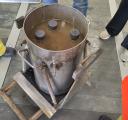
Gathering around to take our sediment samples (photo: NIOZ)
When we are back on land, we will have lots of lab work to do to analyse our samples. But for now, we have a lot to look forward to: even nicer weather once we get closer to the beautiful Azores, and three more locations to take samples at. Each one is a puzzle piece that brings us closer to understanding the distribution of nanoplastics in the ocean.
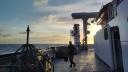
Nemat on his way to take some surface water samples (photo: NIOZ)
28 August - Sampling
Written by Georgina Panagiotounakou
I am writing this halfway through our expedition with the research vessel Anna Weber van Bosse from Iceland to the Azores. There hasn’t been a moment when I didn’t feel incredibly lucky to be part of it, even when God Poseidon was angry, making the boat roll like we were being stirred in a big pot. Only a bit annoying that I cannot always enjoy Mihai’s (our cook) tasty food…But what makes this cruise an unforgettable experience is mostly the people. It brings me so much joy that we are such a good team, both among crew members and fellow scientists.
I have two sampling methods to accomplish in this expedition: A Manta Trawl to capture particles from surface waters and a Multinet for deeper waters, all the way to 300 meters. While I am mostly investigating the mass distribution of microplastic particles, my nets catch many plankton species as well -after all, both the Manta and Multinet are traditionally used for plankton, anyway. For my work, it is important to investigate the plastic-to-organism ratio, which describes, in simple words, how much life there is in comparison to microplastics and how harmful these particles might be for plankton. And believe me, there’s plenty of life under threat!!! However, for exact results, I will have to wait until I am on shore to process my samples. Until then, I can only enjoy the sample collection, which I must say is probably the most fun part of my journey! After this expedition, I can actually share stories about the dangers our oceans are probably facing because of the man-made plastic pollution, which I have now seen with my own eyes.
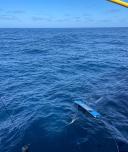
Manta net in action and, on the left, a piece of plastic in the cod end (photo: NIOZ)
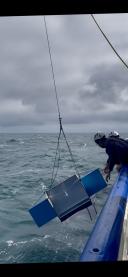
Manta net deployment requiring the help of 3 sailors, Peter, Jacco and Elien, due to strong winds (photo: NIOZ)
But let’s take it from the start! 14th of August, we begin our journey. I’m spending the free days until our first location on the bridge, asking Henk (captain) and Trevor (officer) a bunch of questions, trying to learn what all the screens (or most of them) on the bridge show. I also learned some cool (and important!) stuff, such as how you can recognize an iceberg on the radar screen.
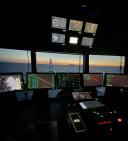
The bridge of Anna Weber van Bosse (photo: NIOZ)
Fast forward: My first sampling day is here, the 17th of August, and I’m stressed: Is everything prepared? Are the cod ends for collecting the samples well attached to the nets? How are my samples going to look like?
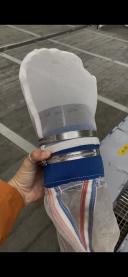
The manta net cod end (photo: NIOZ)
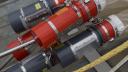
The multinet cod ends (photo: NIOZ)
All these questions are running in circles in my head. The first Manta trawl was successful; such a relief. Sadly, the Multinet seemed to have other plans. Three hours of staring at the software screen just to realize that no sample had been taken because we forgot to unlock the nets. Luckily, we had time to do it all over again. As my supervisor Peter said through a video call while he was all the way sailing the Pacific for the same reason as me, “the first sampling is like the first pancake you bake, always a little miehhh” … After that, everything has been running smoothly!
Manta sampling is a lot of fun, as the monitoring of the net (checking if it flows well) is accompanied by sea gazing, a bit of Vitamin D absorption, and nice music from the beautiful hand-made speaker that René (electrical engineer) and Jacco (one of the sailors) made. Based on René’s idea and design, they literally glued together old pieces of wood to create the box and then added a grill grate from the kitchen, a piece of metal winch, and a few good electrical components fixed together by René. We can put on music streamed from our phones, and often listening to music comes along with singing or even dancing!
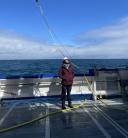
Annalisa catching some sun in between manta net deployments (photo: NIOZ)
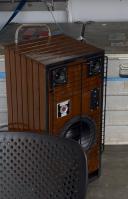
The hand- made speaker of Jacco and René (photo: NIOZ)
At other times, we just talk with each other while waiting to recover the manta net. On the contrary, multinets are less fun as I am staring at a screen all the time during their deployment. However, good company in the lab and watching the depth of the Chlorophyl maximum on the screen make the multinet procedure “a time well spent”. One time, I could even see ‘little creatures sneaking with their helmets’ to watch pilot whales. I am actually writing this during a multinet deployment; my eyes move from screen to screen while in between I say things like “winch can go down with speed 30 meters per minute”, or “you can stop the winch now”; how beautiful does that sound?
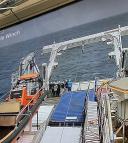
Camera showing the multinet winch during deployment (photo: NIOZ)
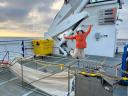
Me jumping out of happiness because another multinet was ready to be deployed in the best possible weather (photo: NIOZ)
Once the net is on deck, the fun part begins and Annalisa (PhD student) and I, sometimes accompanied by Samuele (MSc student) turn the cod ends in all possible directions to flush everything out of the net into sampling bags. Teamwork makes the dream work!
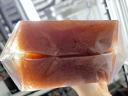
The multinet catch from a depth of 40 metres, collected in a Whirl-Pak bag (photo: NIOZ)
Day after day we take samples, update our data logs and on the transit days, we prepare or repair equipment with the help of Dave (our general support) and René. A special place in my heart has Samuele, who saves a chocolate croissant for me on these transit days when I don’t hear my alarm for breakfast! And since there is still time left, I also do a bit of Marine fauna observation and write down everything interesting that I see. Otherwise, I do an ocean survey using the Ocean Cleanup app. Fun fact: you can also do these surveys wherever you are in the world, river or ocean, and they are very valuable data for them. The whole crew and fellow scientists also let me know if they see something like a piece of plastic or a marine animal. And they have seen both! If we see nothing, then we try to “call marine mammals” from the bow of the vessel, but it does not seem to work ;)
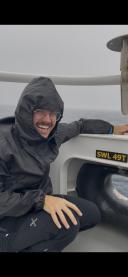
Samuele calling out to marine mammals from the bow of the vessel (photo: NIOZ)
So, our days go on, following pretty much the same routine. However, our evenings have a different taste. The gym on R/V Anna Weber has caught our attention. My favorite workout is boxing, and if schedules align, I go together with Annalisa and Samuele and our coaches Dali (sailor) and Jacco. Otherwise, we coach ourselves ;) If you don’t find me there, I’m probably watching a nice movie, or bonding with the fellow scientists in the lounge, or I’m snacking in the mess room. As we have been going South from Iceland and are now at 41° N latitude, almost at the same latitude as the Azores, the night sky is finally darker. So, I hope to be stargazing from now on, hopefully seeing the Milky Way without light pollution!
Four years ago, I wanted to find a bachelor’s project about plastic pollution (I did not), and three years ago, I dreamed of being on a research expedition in the Aegean Sea (I wasn’t); But look at me now, in the middle of the North Atlantic Ocean working on my master’s project on plastic pollution!! All in all, I feel grateful for my previous choices and all the experiences that finally brought me to this present, and I’m excited for the future. How much microplastic is there in the ocean compared to nanoplastic? What are the dominant sizes and materials of plastics in different regions and depths? Does the mass distribution of microplastic differ between the subpolar and subtropical gyre that we are crossing? How does plastic distribution vary between surface and deeper water layers? These are all questions that I hope to help answering with this project. Helge (NanoMare) and Peter (Ocean Cleanup), I hope I don’t let you down! Until the next one, xxx Georgina.
23 August - Am I dreaming, or am I awake?
The voice of David Attenborough fills the messroom of the Anna Weber van-Bosse, lulled by the waves that rhythmically hit its hull on this stormy day. After a week of tight schedules and frenetic work, I have finally found some time to sit on the couch after lunch, next to Paula and Laura. It feels like a rainy Sunday afternoon at home: the wind battering on the windows behind me, the tea at hand, the TV screen switched on, and my legs interlaced over the cushions. Except I am in the middle of the Atlantic Ocean, and it’s not even Sunday. Today it’s transit day. When you’re doing research at sea, the days of the week are of no importance; what matters is whether we will make a stop to take measurements or not. And today nothing has to be sampled, calibrated, measured, we can only wait until we reach the next stop: a blue point in the middle of the sea, hundreds of kilometres away from the Southern coast of Iceland.
To tell the truth, a day off doesn’t really mean we can take time off. Or at least, that’s what Helge, the chief scientist on board, reminded us on the first days at sea. Some of us still need to prepare for the next day, labelling bottles or sterilizing vials and other equipment they used for the previous sampling station. Does that mean that I should also go back to my computer in the laboratory downstairs and find a way to work my head around the data of air composition we’re collecting? But if I stare at the screen for too long, I get numbed by seasickness and my stomach starts revolting.
Perhaps I should get another pill against nausea. But that makes my throat dry and sore and diminishes my senses and makes me feel drowsy. And what about the drowsiness I feel now, while watching the documentary Ocean on the couch? Does it come from the fact that Laura and Paula next to me are also starting to close their eyes? Maybe I’ll sleep only 20 minutes and wake up to the next big wave that will make the room creak and some distant door left open in the lower decks slam. Or I might keep watching this documentary, which will end in less than half an hour and I might feel awakened as the plot becomes more engaging 1and the horrifying footages about bottom trawling are shown – I have already watched this movie at the cinema last year, when it came out.
But look: they’re now talking about plankton, the tiny, funky and diverse animals (zooplankton) and algae (phytoplankton) that are omnipresent in the ocean and are so important for the balance of our ecosystems. Attenborough is explaining that phytoplankton are tiny, algae-like organisms that harvest energy from sunlight - just as plants on land – and about half of the oxygen that we breathe originates from them. While I’m gently slipping into a foggy sluggishness, the boundaries between zoo- and phyto- blur and I realize that I saw some zooplankton just yesterday with my own eyes, trapped in the manta nets that my colleague Georgina hauled from the sea. She is counting microplastic fragments that float at the ocean surface, but often a handful of plankton gets caught in her nets as well. That always leaves us with a bitter sense of remorse. We keep it for ourselves while we carefully organize and prepare the samples for the laboratory analysis, but after that we take turns in reminding each other that sometimes it’s inevitable to sacrifice some of these beautiful organisms with the goal of saving even more.
As a matter of fact, there’s something else I found out while being on this boat, that David Attenborough hasn’t mentioned: plankton, just as any other organism in the ocean, might already be full of nanoplastics, pieces thousands of times smaller than those Georgina is trying to catch with her nets. The idea that these organisms might be eating tons of nanoplastics every day sends me shivers. Yet, here we are: a composite of students and scientists trying to figure out the effects of nanoplastics on ocean life. Sounds like it will take a lot of time and effort to actually find these answers.
So for now, just let me take a short nap on this couch and dream, just a little bit, about plankton, and water, and possible oceans...
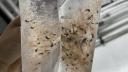
Some of the zooplankton Georgina collected with her manta net at 300 m depth below the ocean surface (photo: Samuele Stante)
20 August - Iceland
Written by Nemat Omidikia
Despite the wealth of information available on global plastic production, much less is known about what happens to plastic once it enters the environment. It is estimated that between 8 and 14 million tons of plastic enter the oceans each year. Plastic debris entering the sea can undergo physical and chemical fragmentation, eventually forming micro- and nanoplastics. This raises several important questions: What are the concentrations of nanoplastics (NPs) in the ocean? How do these concentrations vary between different water depths? Is there an exchange of nanoplastics between the ocean and the atmosphere?
For months, we have been preparing for this expedition, developing and learning new strategies for sample collection, data acquisition, and data analysis. During our journey from Iceland to the Azores, we will continuously monitor ocean emissions and concentrations of volatile organic compounds (VOCs) using our air sampler and a specialised mass spectrometer. We will also stop at several stations along the way to collect samples that will later help us piece together the story of plastic pollution in the marine environment.
As an analytical chemist, my research focuses on the quantification of different types of nanoplastics in samples collected from various parts of the marine environment—from different layers of the ocean and deep-sea sediments to filtered air. Combining information on nanoplastics from these different environmental compartments will help us better understand how plastic pollution moves through the environment, how it is distributed, and whether it is exchanged between the ocean and atmosphere.
Now, the Anna Weber-van Bosse moves through the cold, dark waves. Dressed in our work suits, we stand ready, waiting for the next sampling station. Soon, another set of samples will be collected. Each one carrying a small piece of information that may help us understand the much larger story of plastic pollution in our oceans.
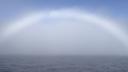
A halo forms where sunlight meets ice crystals on the horizon (photo: Nemat Omidikia).
16 August - Denmark Strait, north of Iceland
Written by Helge Niemann, Chief Scientist during cruise AW-109
I escaped the heatwaves in the Netherlands, apparently the new normal, even if some people do not like to admit it. But that is another story… We went out into the North Atlantic for another reason: plastics.
We have all heard about it: plastic waste floating in our oceans and its negative consequences for marine life. A never-receding avalanche of waste pours out of our civilisation into the sea. Larger plastic objects float at the sea surface, drift with the currents and are broken into ever-smaller fragments by the sun’s scorching UV light and the smashing force of the waves. In this way, larger pieces become smaller; macroplastics become microplastics, until…
…well, until what?
We already discovered that at least some of these larger macro- and microplastics are broken down into particles smaller than one-thousandth of a millimeter. That is very small. Imagine a thin human hair: it is at least 50 times thicker than one-thousandth of a millimeter. These tiny plastic particles - smaller than one-thousandth of a millimeter -are called nanoplastics and are invisible to the naked eye.
Nanoplastics also behave rather oddly. Larger plastic objects usually floats or sinks. For example, plastic bags are often made of polyethylene (PE) and float, while soda bottles are made of polyethylene terephthalate (PET) and – if not closed with a lid - sink. But nanoplastics neither float nor sink, regardless of whether they consist of PE, PET or another type of plastic. Nanoplastics behave like milk in coffee: the milk’s tiny fat droplets remain evenly dispersed, neither immediately rising to the surface as cream nor sinking to the bottom of the cup.
For the ocean, this means that nanoplastics can be distributed throughout the water column, from the sea surface to the deep sea. Almost all marine life may therefore come into contact with nanoplastics. We found that nanoplastics constitute the lion’s share of plastic pollution in the North Atlantic (ref. ten Hietbrink et al., Nature 2025). However, we do not yet know exactly how much nanoplastic is out there globally or how it affects marine life.
Are nanoplastics concentrated near the ocean surface, where they form from macro- and microplastics? Do nanoplastic concentrations differ when comparing for example arctic, temperate and subtropical regions? How much has already reached the deep sea? What happens to microbes - the base of the marine food web - when they are exposed to nanoplastics? What is the fate of nanoplastics in the ocean: do they eventually break down completely?
These are some of the many questions that we are trying to answer with the data collected during this expedition. Funding from the EU has allowed me to establish the NanoMare project and bring together an excellent team of scientists - and we are fortunate to conduct this expedition aboard the shiny new flagship of the Dutch research fleet, RV Anna Weber-van Bosse.
Over the coming weeks, we will breathe science: collecting samples, making measurements, discussing our findings and starting experiments. And we will cover a wide geographical range, from the ice-cold Arctic waters to the balmy subtropical waters around the Azores - during expedition AW-109.
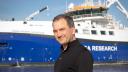
Helge Niemann, ready for the expedition to start (Photo: Anneke Hymmen)
13 August - Arrival in Reykjavik
Written by Pauline Cretin
This is D-Day. All the scientists take the plane to Reykjavik, where our ship, Anna van Bosse, is waiting for us. Fifteen scientists are brought together by a common concern: What is the impact of nanoplastics on the ocean?
During this cruise, we will collect samples at different locations, from Greenland to the Azores. But for now, tonight is our last night on land before heading out to sea for three weeks. We all take this opportunity to walk through the beautiful streets of Reykjavik.
One last goodbye to Iceland—it’s time to weigh anchor. Our destination: Greenland!
For most of us, this is our first cruise, and an opportunity to experience seasickness firsthand! On top of that, we have to prepare all our equipment for tomorrow, which will be our first sampling day.
We’ve arrived at our first station! We’re close to Greenland, and the temperature outside is around 8°C. It’s time to swap our summer clothes for sweaters.
As a marine microbiologist, my role on this expedition is to collect samples at various stations and depths. The water is then filtered to retain only the microorganisms. This part of the work will complement the efforts of my colleagues, who are investigating the levels of nanoplastic contamination at these same depths.
At the same time, with the help of my intern, we collect surface water and culture the microorganisms it contains over several days in the presence of nanoplastics.
I could have chosen any depth, but based on a previous cruise in the North Atlantic, we know that the surface waters are more frequently contaminated with nanoplastics. Furthermore, the ocean surface is rich in photosynthetic microorganisms—that is, organisms capable of producing nutrients and oxygen using solar energy and carbon dioxide. Photosynthetic activity at the ocean surface is particularly important, given that around 70% of our planet is covered by water. The oxygen produced by marine microorganisms accounts for about 60% of the oxygen we breathe, making the ocean a major contributor to the oxygen in our atmosphere.
The goal of these cultures is to determine whether nanoplastics have an impact on the formation of microbial communities between Greenland and the Azores. In addition, we will be able to shed light on the metabolic processes carried out by these microorganisms in order to determine whether nanoplastics have a toxic effect or whether they serve as a new nutrient source for some of them.
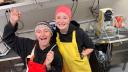
Technician Natalia Zwolak (left) and Dr Pauline Cretin (Postdoc; right)(Photo: NIOZ)
Linked staff
Helge Niemann
Senior Research Leader

Pauline Crétin
Postdoc
Yu-Hsin Huang
PhD student
Natalia Zwolak
Research Assistant
Follow updates
Curious about the NanoMare project?
Find out more about the NanoMare project here: "Nanoplastic in the sea – how much is there and can microbes eat it? 3.5 million EU grant for Helge Niemann."
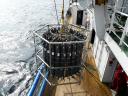
Example of a large volume CTD Rosette system on board RV Pelagia (photo: NIOZ)