Nanoplastic in the sea – how much is there and can microbes eat it? 3.5 million EU grant for Helge Niemann
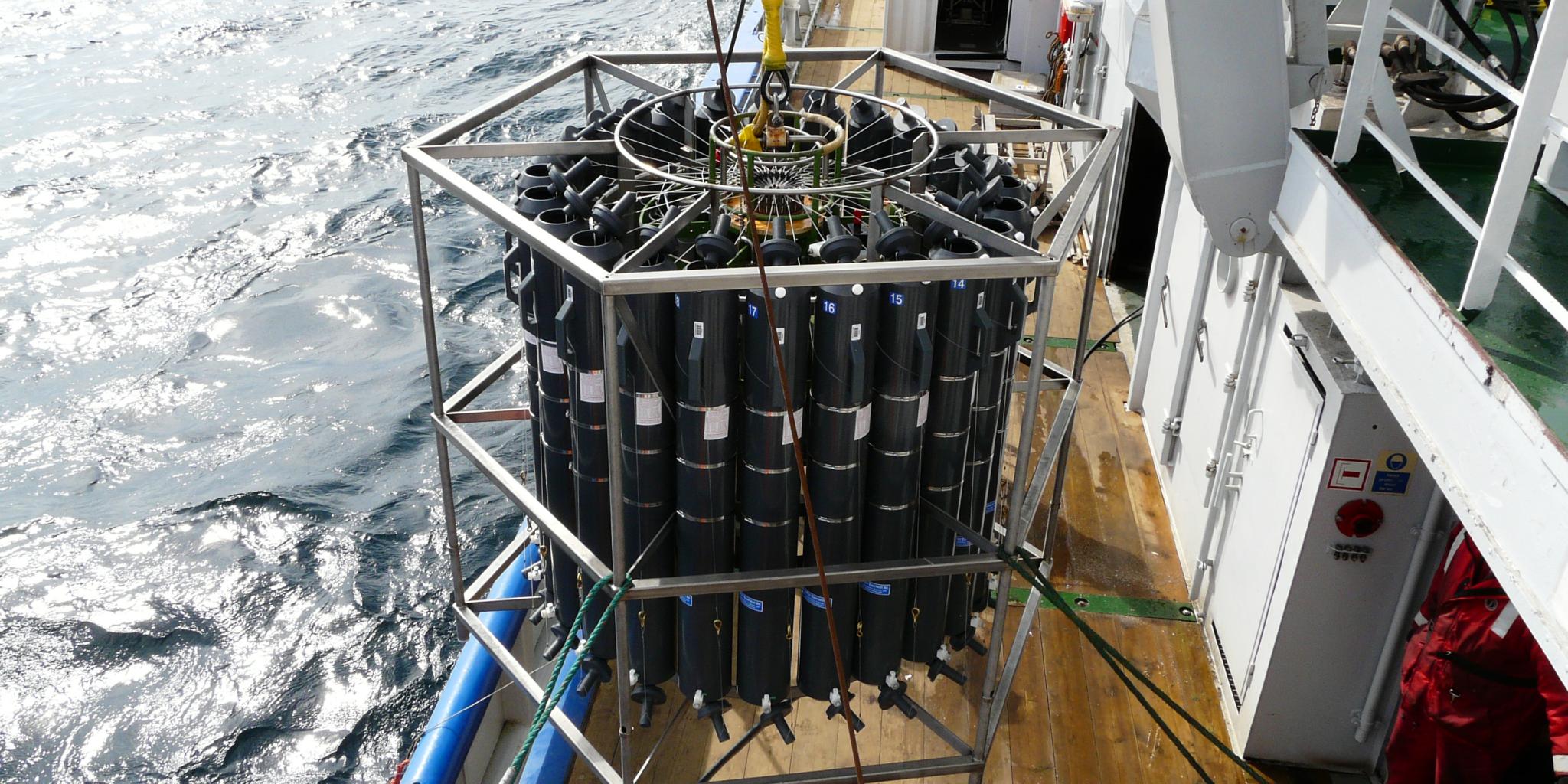
Example of a large volume CTD Rosette system on board RV Pelagia (photo: NIOZ)
Helge Niemann has been awarded a 3.5 million euro ERC Advanced Grant for his NanoMare project. The biogeochemist will use the grant to focus his research on nanoplastics and their fate in the ocean. Niemann is a senior research leader at NIOZ and professor for Microbial and Isotope Biogeochemistry at Utrecht University. His previous work indicates substantial concentrations of nanoplastics in both surface waters and the deep sea.
Illustration for NanoMare project. (Credit: Helge Niemann/NIOZ)
Nanoplastic, extremely small plastic litter pieces, smaller than 1 μm, have only recently been discovered in the marine realm. Their small size makes it virtually impossible to measure their distribution or quantity, or whether there are microbes that can break down these particles. Niemann's research team is the first to successfully investigate this using ultra-sensitive methods.
Substantial concentrations of nanoplastics
Niemann: “Preliminary results indicate high concentrations of different types of nanoplastics in both surface waters and in the deep sea. This could mean that nanoplastics make up a large proportion of all plastic waste in the ocean.” It also became clear that there are marine microbes that can degrade plastic. However, Niemann notes that other marine microbes, which are important in keeping the marine ecosystem healthy, may also be negatively affected by nanoplastics.
From coastal waters to the open ocean and deep sea
With the European grant that has now been awarded, Niemann's team will conduct experiments at sea. “We will take a large number of seawater and sediment samples, from coastal waters to the open ocean, and from the sea surface to the deep sea.” Through numerous experiments at sea and in the laboratory, the NanoMare project aims to provide much more clarity about nanoplastics in the sea. How much plastic there is and how it is distributed, but also how plastic degradation works. From the molecular degradation process and the degradation products to the genes that enable certain marine microbes to do this.
Five-year research grant
The grant comes from the European Research Council (ERC)
Opens in a new tab. The Advanced Grant that Niemann is now receiving is intended for ambitious, groundbreaking long-term research by senior scientific leaders. Niemann will receive the maximum amount of 3.5 million euros spread over a period of five years.Linked staff
Helge Niemann
Senior Research Leader
