Deep-sea corals, whales and squids
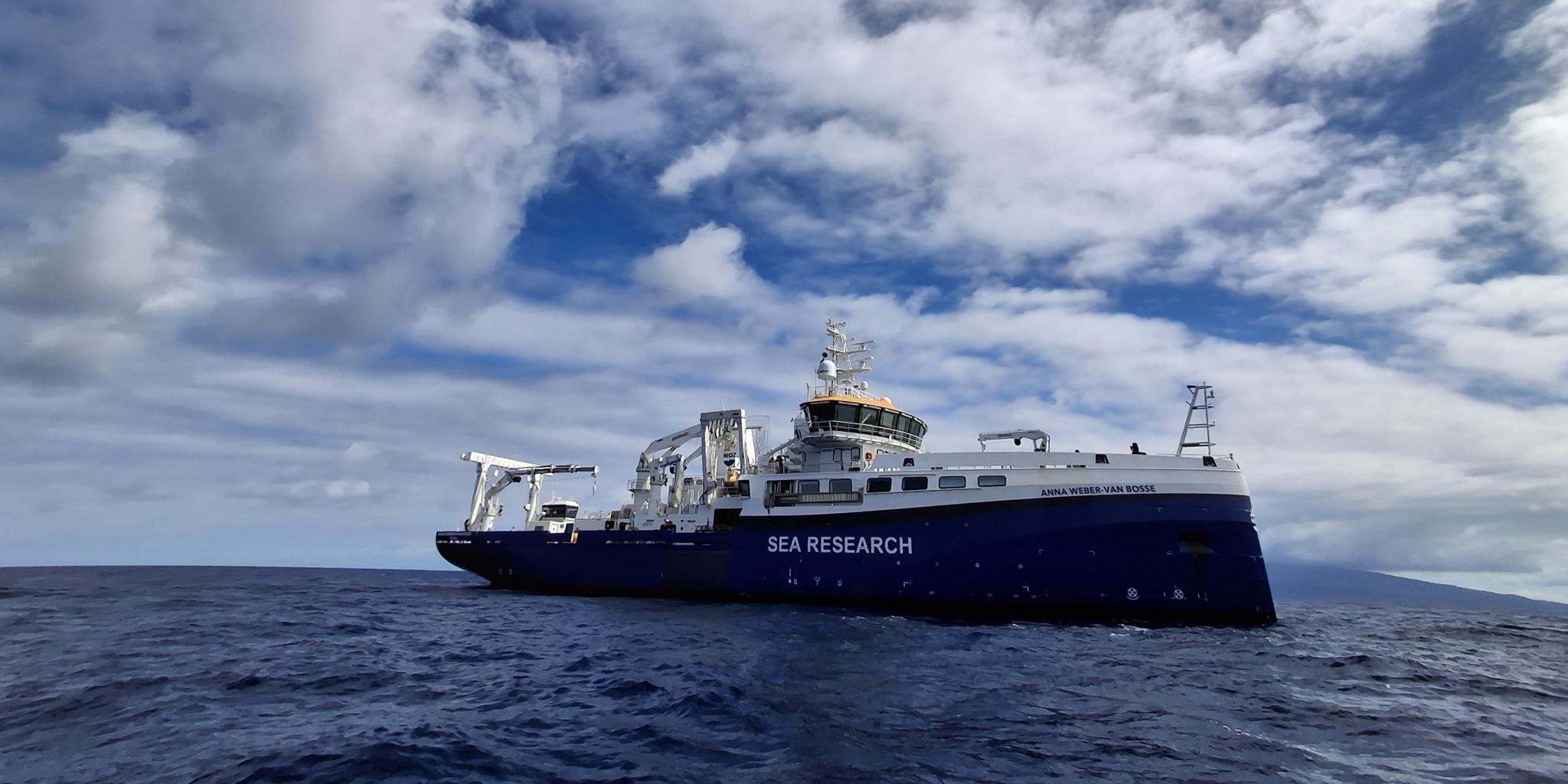
RV Anna Weber-van Bosse from the perspective of a whale (Photo: NIOZ)
This expedition on the RV Anna Weber-van Bosse from 11-22 September combines the 2026 deep-sea pray-hunting whale project of Fleur Visser and the CONDOR seamount project, investigating the deep-sea ecosystems near the Azores.
Introduction
By Fleur Visser, Chief Scientist NIOZ
Welcome on board of Anna Weber van Bosse! We are underway for our research cruise off the islands of Terceira and Faial of the Azores, to investigate how (and why?) whales forage in the deep sea, for the NWO project ‘Tracing top-predator prey interactions into the deep sea’ and to explore how we can restore ecosystems on the deep-sea floor, for the EU- Project REDRESS.
To do so we combine a range of methods, in a team of scientists and crew of a wide range of expertises. The deep sea is a huge ecosystem, and it is difficult to reach and observe. Combining skills and techniques is almost a must, in order to advance. Our team joins deep-sea ecologists, oceanographers, whale and squid biologists, bio-acousticians, deep-sea technicians, theoretical ecologists, deep-sea benthic ecologists and DNA specialists – plus a highly experienced research vessel crew. We observe and record the deep sea using echo sounders, hydrophones, video transects, environmental DNA- and nutrient sampling. We also deploy moorings for long-term recording of deep-sea predation, and landers to monitor the behaviour and growth of the corals that are returned to the deep-sea floor. If fact, I, as a whale scientist, am currently watching the whale prey I am looking for -deep-sea squid and octopus- during a video transect in a coral restoration site, ran by our oceanography and coral specialists.
Join us for a little while, and, if inspired, perhaps also for our haiku competition
squid is hard to find
we must behave like whales, to
write in sepia
Listening to the Deep: Long-term Cetacean Acoustic Monintoring in the Azores
10-11 September by Jace Fuller, Simone Baumann-Pickering and Bruce Thayre
In the 24 hours before recovery of our mooring off Terceira, we captured a remarkable succession of six cetacean species. Sperm whales dominated the afternoon; beaked whales, false killer whales, and unidentified dolphins filled the small hours. Below, we walk through who we are, what we are working on — and what the ocean told us.
Representing the Marine Bioacoustic Research Collaborative, Scripps Institution of Oceanography at the University of California San Diego, are Dr. Simone Baumann-Pickering, Principal Investigator of the Acoustic Ecology Lab; Bruce Thayre, Marine Technician; and Jace Fuller, a PhD student in the Acoustic Ecology Lab.
Our long-term goal is to monitor the density of cetaceans and their prey off Terceira Island and correlate cetacean diving behavior with prey and oceanographic conditions to learn about predator-prey dynamics and species interactions. On this cruise, we recovered a year-long mooring deployment from which the photos and cetacean acoustic data in this post were sourced. We plan to deploy a similar mooring for another year of data, as well as a small passive acoustic mooring for an additional year of observations, making this our 6th year of recordings.
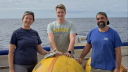
Simone Baumann-Pickering, Jace Fuller, and Bruce Thayre with the recovered mooring buoy
Our multi-instrument mooring included a continuously sampling High-frequency Acoustic Recording Package (short HARP) to record cetaceans and other environmental sounds, active acoustic fisheries echosounders (Simrad Wideband Autonomous Transceiver, WBAT) to identify backscatter layers throughout the water column and locate prey, and oceanographic sensors (Sea-Bird microCAT) to measure temperature, salinity, and dissolved oxygen at various depths. These instruments allow us to relate the acoustic presence of cetaceans to the physical and biological structure of the water column.
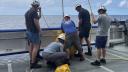
The team secures the large yellow surface buoy on deck before processing the instrument package below (Photo: NIOZ)
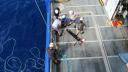
The Simrad Wide-Band Autonomous Transceiver (WBAT) is visible on deck as the team brings it aboard.
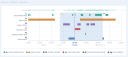
Overview of species found on september 10 and 11 (Credit: Marine Bioacoustic Research Collaborative)
Example of recording echolocation clicks of sperm whale and goose-beaked whale (Credit: Marine Bioacoustic Research Collaborative)
Here above you can hear a short fragment of the acoustic layering of two deep-ocean foragers. The sperm whale's lower-frequency echolocation click train anchors the scene below 30 kHz, while the goose-beaked whale's frequency-modulated echolocation pulses cut through the upper register — two species occupying complementary acoustic niches in the deep sea, at the same moment.
The spectrograms are from an autonomous high-frequency acoustic recording package (HARP) deployed in the Azores, 10–11 September 2026. Top panel: long-term spectral average (LTSA), Time average = 5 s, FFT = 1000 points, Sampling rate = 200 kHz. Bottom panel: bandpass-filtered detail clip (2–98 kHz). Colour indicates signal amplitude with warmer colors having higher amplitudes.
In the deep blue sea
we recorded marine life
myst'ries to be solved
From eDNA to whale prey
By Ina Vornsand, PhD student, GEOMAR and Clara Planitz, MSc student, GEOMAR
Did you ever wonder how one would study those animals in the deep ocean that cannot be found by typical sampling methods such as nets and video dives? That is exactly what we are doing by collecting so-called eDNA (environmental DNA) from water samples between surface and the deep-sea. As animals in the ocean live and move, they leave behind genetic material, including tissue cells, feces, or mucus – just as we lose hair or skin scales – and this material contains DNA that we can use to identify the organism it came from. By analyzing eDNA present in the ocean, we can paint a picture of biodiversity across depths without having to see or capture the animals.
Over the past days, we sampled water via bottles on a CTD rosette and then filtered it over a membrane of very small pore size to retain all types of DNA. Since this process is highly sensitive to contamination, we always had to make sure to work carefully and as sterile as possible, with many cleaning steps along the way and before/after the actual sampling. Collected samples were eventually frozen at -80°C to preserve the contained DNA. Our main work on the vessel was to take the samples; all the following analysis steps (extraction, library preparation) will be done in the lab back at our institute.
Cool, so we can see what animals were there, but why is that actually useful? Well, first of all, the deep sea is still the last underexplored frontier on planet earth. Our knowledge about our oceans beyond the coastal areas is quite limited. So, this kind of baseline work of characterizing ocean communities is a super important task on itself. Furthermore, we can infer information on the food web and predator-prey-dynamics off the Azores from our data, which is what we are mostly interested in. Our sampling stations were specifically selected to lie within known cetacean foraging habitats (Risso’s dolphin, Sowerby’s beaked whale, goose-beaked whale and sperm whale), but our samples will be analyzed for genetic traces of their prey, namely fish and cephalopod species. In that way, we can get an idea of prey distribution and their relation to the whale’s hunting behavior. The eDNA data will eventually also complement the acoustic and imagery data of the paired system of video hopper and WBAT, which tackle questions on biodiversity and prey distribution from a different angle.
Haliphron, where have you gone?
Why all these days of avoiding me?
Haliphron, please come find me!
(By Ina Vornsand: Haliphron atlanticus, or seven-arm octopus, is a favourite prey item of sperm whales, has rarely been observed alive)
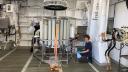
Sampling the CTD. From left to right: Luís, Ina, Clara
Ship life as a “it’s my first time” scientist
By Clara Planitz, MSc student, GEOMAR
Before I got on the Anna Weber van Bosse I wasn’t sure what to expect. Sure, I heard about all the great stories of going on research vessels from my colleagues before. About the science you experience live, about having people who are experts in their field always in close vicinity, and about navigating the social side of it. But I am a person who overthinks everything a thousand times. I have to live through the experience once, before I am comfortable with the thought of it (not ideal, I know). So, with little idea on what was going to happen and how to do the job I was there for, I was just thrown head first into the adventure.
The first few days were rough. I had to adjust to living and working at sea, while being overwhelmed by the new environment and constant noise of the ship. I took multiple 1 1/2 h naps, even if I was not doing much on the days. Even after more than week of being at sea, I still get super tired. I was told that it is completely normal and it is getting better as we speak. So far, I have learned two pieces of wisdom – on from the crew and one from the scientists, respectively. First is that you have to keep a full stomach to avoid getting nauseous. Salad is great for that – giving your tummy volume and something to work on. Second is that yellow tape is good for everything. Do you have something you have to fixate somewhere? Yellow tape. Something to fix? Take yellow tape. Something to label? You can use the yellow tape! This has gone so far that I fixed a broken phone charm with yellow tape as well. It is really useful, can’t deny that.
Sacred yellow tape
Is good for everything –
Do not eat it though!
Trying to convey a deeper message than just “Yellow tape is the sh*t“– I saved you some highly inspirational words for last: If you ever talked to scientists about working at sea, you can believe them when they say that it is a lot of fun. Everyone is open to talk to, answer your questions and do some non-scientific things when they have the time for it. You can connect with scientists from all over the world that you would likely not meet otherwise. And all that without a lot of pressure, because they are focused on their part and you are focused on yours. My experience is also that they are really understanding if you need time for yourself and to adjust to ship life. Keep your own timeline and open up when you have the social battery for it (they will most likely also need some time to warm up). And lastly, I just wanted to say: It is okay to be scared of going on a research vessel. It is a big step. But if you have the opportunity and capacity, go do it scared. It is worth it!
Stick around to hear about the actual science that I am here for. This is an ongoing learning experience :)
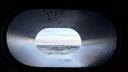
The view from my window when we are out at sea (if there is a lot of waves, they sometimes crash into it and completely fill it up).
Our echo sounders map deep-sea biomass
By Emma Bronswijk, PhD student, NIOZ
It’s our fourth day aboard, and we’ve become a well-oiled machine. It is only 8 a.m. and we’ve already taken the video frame out of the water and put the CTD frame in. We hear Federicio’s Italian-accented Dutch crackling over the radio to the winch operator: “Naar de bodem, graag!” Meanwhile, Ina moves the last sterile jugs into the eDNA lab. On deck, one of the WBATs is already being prepared for its next deployment.
The WBAT is an autonomous echosounder, which we use to measure the distribution of prey of deep-diving toothed whales, that is fish and squid. With our system we can detect fish and squid up to 1800 m depth. We mounted two so-called WBATs onto the Hopper video frame. This gave us the idea for the catchy name; ‘the double whopper’. However, Furu winces every time she hears the word ‘Hopper’, because the Hopper frame hasn’t been hoppering for a very long time as more advanced methods for taking photos have been developed. Furu came up with the catchy alternative ‘two wideband autonomous transceivers (WBATs) mounted on the tethered camera system’. Other suggestions are welcome.
While the WBAT system is getting ready for its next descent, Daisy rolls out the fishing line attached to the calibration sphere. This perfectly round ball will hang below the WBAT to check the performance of the system under the changing pressure of the deep sea. After having the CTD back on deck, the video frame heads down to 1400 m. Time to enjoy live HD camera footage of the deep sea!
Daisy is busy annotating in PelNav, ‘fish on cam1’, ‘physonect on cam2’, ‘ctenophore on bottom cam’. Meanwhile, a bead of sweat rolls down Jesse’s forehead as she copies hours of HD video data from previous deployments to multiple hard drives onto four different laptops (to speed up the process). Hopefully at least two drives will be ready before the next deployment. Suddenly a squid flashes by, a greenish cloud of ink lingers behind it. Everybody in the drylab cheers out of excitement. And then, just like that, it’s time to bring the double whopper back on deck before dinner.
For most, the day ends with a stunning sunset, and dolphins next to the vessel. But not for everyone... For Daisy and Jesse the search continues. They’ll bring the video system down to the deep sea again and will find what the night has to offer.
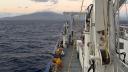
The best place to stand on the ship (in my opinion). With Terceira in the background and all the cool science instruments and the place where they are deployed from right in front of you.
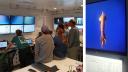
Scientists awaiting visitors on the video footage of the Hopper in the Dry Lab & one such visitor!
Searching for whales
By Daisy Greuter, MSc student, University of Amsterdam & NIOZ
Today started out searching for whales from the bridge. We were trying to decide whether we would go out with the small boat in order to try and obtain fecal samples from deep-diving whales in order to study their diet. Sperm whales near the vessel!
We discussed with the bridge and got safety instructions, which were especially important when the smaller boat is towed down into the sea and heaved back up. And off we were, together with two crew members we made our way towards the last known location of the sperm whales. These animals can take lengthy foraging dives and it is important to get a sense of their direction and timing. Luis and Jesse were spotting from the bridge in order to support the effort. We were searching for a while, looking to see if we could spot the blows again and possible get pictures for photo ID. After some waiting, we saw them come up again and managed to get close. We got photos of their flukes, from which they can be identified. On the way back we had a great view of the ship and were accompanied by a large group of spotted dolphins, a nice end of the effort.
When we got back to the AWvB we did another hopper operation at night, trying to calibrate the echosounders. During the calibration dives, there is a “calibration sphere”, a very expensive metal ball, attached to the hopper frame as a reference target. We know how much echo it should produce based on its properties. The sphere was connected to the frame with four fishing lines, but while we were watching in the lounge during a movie night we saw that one of them had ripped. I was questioning my knot skills and thinking whether I had really checked every connection, as we always do before the frame came in. We also saw a swordfish on the recording a little before we knew that the line had snapped. On the radio someone joked that the swordfish might have cut it. We could not get the hopper back up without the crew, so it had to stay in overnight.
The next day, I went through the camera recordings to clip all squid and other interesting animals. When I was looking at the swordfish encounter, I realized why the fishing line had snapped. Expect the unexpected while working in the ocean.
Sabotaging swordfish
Our precious tungsten calibration sphere
Attacked by the weapon of the sea
Innocent, clinging to the lines
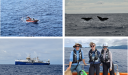
Whale watching from a small boat
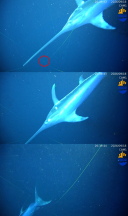
Sabotaging sword fish
Sparking interest
By Luís MD Barcelos, PhD student, University of the Azores
The marine environment, beyond coastal zones and below the surface, poses a major challenge when it comes to detecting and studying species. Most of these species are highly elusive and highly mobile, making their detection and study possible only through the use of technological tools such as eDNA.This method makes it possible to investigate the presence of species already known to occur in the Azores but which had not yet been recorded in that study area or at a particular depth, as well as to detect new species – that is, species not yet recorded in the Azores.
The detection of new species is fundamental to our understanding of marine biodiversity, but also to the monitoring of exotic species that may be invasive. My work as a PhD student focused on marine biodiversity, with an emphasis on marine vertebrates. Taking part in research cruises, both on the RV Pelagia and now on the RV Anna Weber-van Bosse, has greatly contributed to expanding my knowledge of marine biodiversity and how it can be studied using state-of-the-art technology. Furthermore, spending time with the crew and scientists of different nationalities allows me to learn about the cultures and traditions of those countries. The organisation of these scientific cruises off the coast of Terceira Island, and the participation of members of the Azores Universiade, brings visibility and recognition, and sparks interest amongst the local population.
Blue ship in the sea
Whales drift under island skies
Science lights the depth
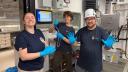
Prepared for sampling the CTD. From left to right: Ina, Clara, Luís.
Corals, Seamounts and Restoration Project REDRESS
By Federicio Gigli, PhD student, NIOZ
During the AWB110 scientific expedition, the teams involved in the REDRESS project began planning the expedition to the Condor Seamount, situated 10 nautical miles from the island of Faial. The main goals of the campaign were to: 1) restore selected sites with coral bycatch previously collected, acclimatized and prepared for deployment; 2) conduct physical and chemical analyses of the water column through CTD casts and water filtration methods; and 3) monitor the restoration effort over a long period using a mini ALBEX lander specifically equipped with a suite of sensors (HD camera, ADCP, oxygen sensors, turbidity and fluorescence sensors) for the campaign. The areas selected for the campaign were discussed and decided in advance based on historical records of the seamount, aiming to address both areas previously impacted by fishing and areas still considered pristine.
The main goal of the REDRESS project is to understand and implement innovative methods for active restoration in European sea areas previously impacted by anthropogenic stress. REDRESS focuses on implementing successful restoration practices and improving the understanding of deep-sea restoration, in order to create a roadmap for future restoration actions. During this campaign we worked side by side with the Coral Ecophysiology Lab from the Azores. The NIOZ team focused on the monitoring aspect of the project through the newly designed mini ALBEX landers, while the Azores team contributed important techniques for coral deployment, such as the badminton method, first developed in Spain and later adopted in the Azores to restore the impacted coral gardens. The method is based on deploying corals, previously bycaught by fishing vessels, by simulating the effect of a badminton ball. Corals are first attached to cobbles using a non-toxic two-component adhesive, then gently released a few meters above the ocean bottom, causing them to fall gently into an upright position.
The results of the campaign will be available next year, when the lander is recollected, providing important information on the in situ environmental dynamics as well as HD videos to study coral behaviour during the restoration process.
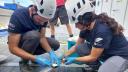
Preparing deep-sea corals for deployment on lander
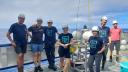
The REDRESS team and members of the Anna Weber-van Bosse crew.
A theoretical view in practice
By André de Roos, Director IBED Institute, University of Amsterdam
before returning to the island of Terceira, part of the Azores. We were on the Ocean but never really in the middle of nowhere, always in sight of one of the islands that make up the Azores. These islands are located around the Mid-Atlantic Ridge, which apparently is part of the longest mountain ridge in the world. Here in the North-Atlantic, the ridge separates the tectonic plates on which Europe and Africa are located from the North American plate. In fact, the Azores are the location of the triple junction of these three plates. Slowly, at 2.5 cm per year these plates drift apart, which is also how the Azores originated: through volcanic activity around the ridge.
Just like the altitude of mountains on land, the mountains at the ocean floor, and hence the ocean depth, varies rapidly over short distances, from the 200 meter depths at the Condor Seamount to depths of more than 1500 meter a short distance away from it. And it is these depths we are exploring with this new Dutch research vessel, the Anna Weber van Bosse. The vessel itself is a prime example of modern technology with automatic systems to keep the vessel in the exact same location, systems to compensate for the heave of the ship while it is lifted up by the waves and lots of high-end computer systems to unveil the world below us.
That world below the ship is the great Unknown that is explored by this group of dedicated scientists on board using underwater video installations, water samplers to collect eDNA at various depths and moorings that are rising up from the ocean floor for more than 1 kilometer and are staying there all year-round to measure the water temperature at various depths throughout the year, collect acoustic data from fish, dolphins and whales and use echosounders to estimate abundance and location of these species.
A theoretical ecologist myself, I have used data like collected during this trip for my research. But I was completely unaware of the effort, dedication and perseverance it takes to collect these data. And yet, the data collected barely scratch the surface of the deep ocean, literally. The saying goes that we know more about the Moon than we know about the deep ocean. But where the Moon is mere rock and dust, the world beneath us is full of life, color and creatures of the strangest shape and form. The frame with video cameras that is lowered to the sea bottom gives us a real-time glimpse of this wonderful and mesmerizing world with corals and sponges that are gently moved by the water currents, squid, octopus and fish quickly scurrying away when the cameras come close, curious dolphins that come and take a look at the camera, sharks very slowly gliding by and swordfish speeding through the image while cutting one of the thin lines attached to the frame. It makes for long days and long nights watching these mesmerizing movies, which the scientist do while meticulously writing down what they observe on the cameras, not unlike Alexander von Humboldt himself when he climbed the Chimborazo more than 200 years ago.
Participating in this cruise has been an awe-inspiring experience. Even though the world above water seems rather empty out here on the Ocean - we mostly have seen birds but never in large numbers, we have glimpses of whales and spotted a fair number of dolphins - the diversity and abundance of life below the surface is stunning. It confronts you continuously with these tantalizing questions that all scientists here on board try to answer: What is all out there? And how for heaven's sake can this persist? What is ultimately the source that allows this richness to persist? Questions that will still take monumental effort to answer but that we can now start to address with the new Anna Weber van Bosse.
Softly rocking boat
Glides over the endless sea
Hiding unknown depths
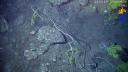
Two rockfish in a coral garden on Condor seamount (photo: NIOZ)
Linked staff
Fleur Visser
Senior Scientist

Furu Mienis
Senior Scientist
Federico Gigli
PhD student
Emma Bronswijk
PhD student
Jesse van der Grient
Postdoc