Counting shrimps on Griend
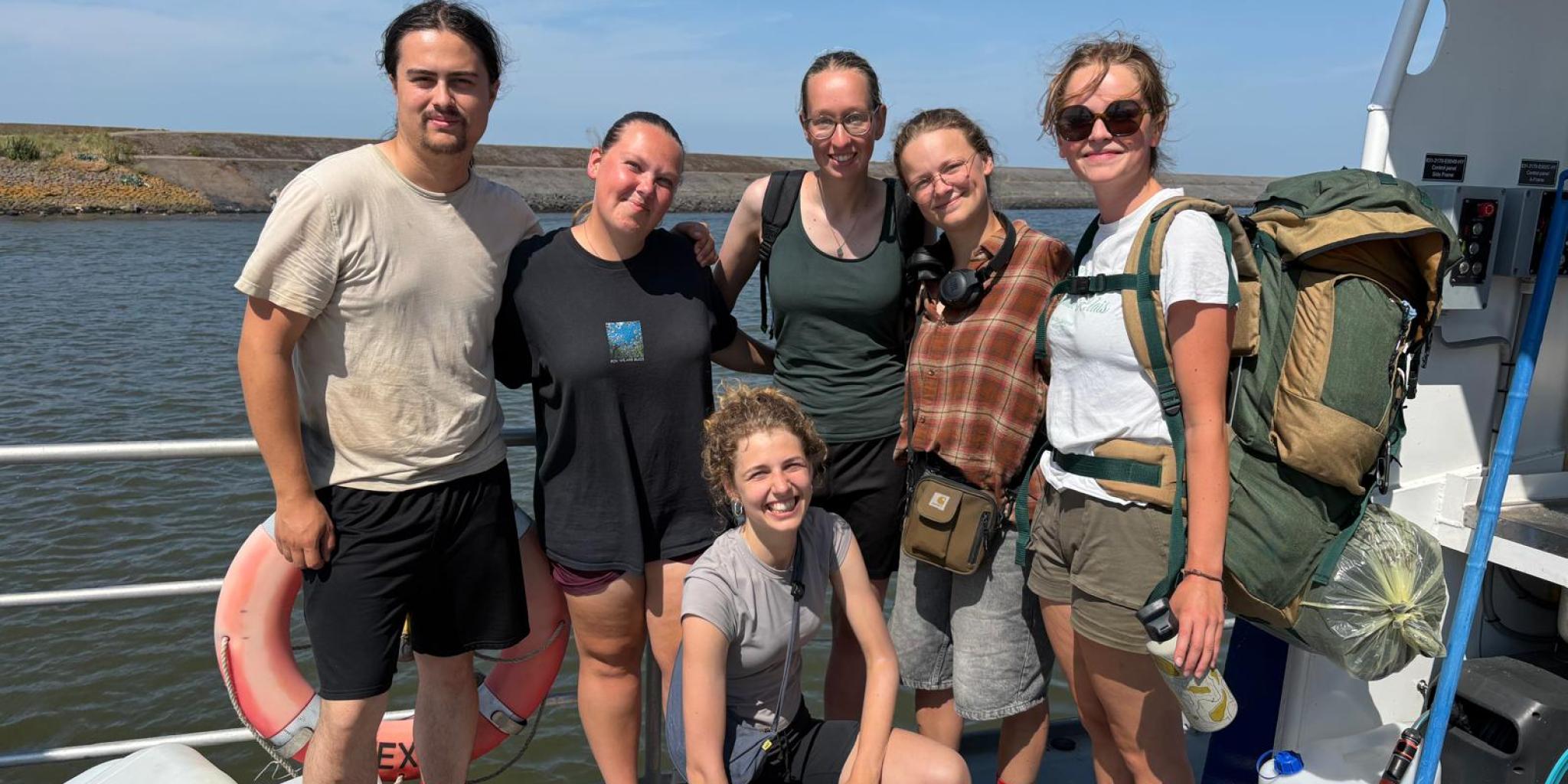
The shrimp crew on board the Adriaen Coenen (photo: NIOZ)
In early August, it’s time for the annual shrimp sampling on Griend! This expedition began as part of research into the diet of sanderlings, led by NIOZ researcher Emma Penning. During this fieldwork week, we take seabed samples on and around Griend, like we do for the long-term SIBES study only using a slightly different method. We’d love to tell you more about this week on the mudflats!
Arrival at Griend
Written by Femke Vermeulen
At 9 o’clock we set off for the NIOZ to load our gear onto the boat and fill up with fresh water, as unfortunately there’s no water available on the island. So that also means we can’t have a shower :( Once everyone had arrived, we were able to set off; it was about a two-hour boat trip, and then we had to use the RIB to get our gear as close to the island as possible, which meant we also had to walk a short distance through the water carrying our things. We then took everything to the cottage and settled in there. You could choose to sleep in the cottage or in a tent, so my tent is looking great! At the end of the afternoon, we headed out onto the mudflats to get the hang of the sampling technique. After that, Lucas and I fetched the remaining water, which was still on the beach. After that, we walked around the island and found two messages in bottles! Then it was time for dinner, which was lovingly prepared by Mirthe and Maaike! Afterwards, it was time to pack our bags for tomorrow and then enjoy the sunset and the many birds on and around Griend.
The first view of the island from the cottage’s balcony (photo: Nienke Zwaferink)
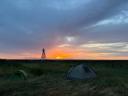
The camp at sunset. In the background stands the Baken, which was historically used as a landmark for seafarers (photo: Femke Vermeulen)
Let’s get started!
Today the alarm went off at 6.00 am and by 6.30 am we were walking towards the mudflats for our first day of sampling! We split into pairs: Nienke and Mette, Mirthe and Maaike, and Lucas and me. We navigated to the correct coordinates and then it was time to take a sample by casting a long pole with a bucket attached into the water. This method was developed by Emma Penning, based on the idea that the ‘surprise attack’ prevents shrimps and other agile bottom-dwelling creatures from being startled and swimming away from the sample. Next, we measure the water depth and take two scoops of sediment from the seabed to sieve. Then on to the next point. The points are 500 metres apart – a lovely walk!
After about two hours of taking samples, it’s time to head back to the house, as the tide is coming in. For the rest of the morning and early afternoon, we spent some time relaxing outside in the sunshine, and afterwards we started processing the samples – this involves measuring all the prawns, crabs, starfish and snails, and counting the amphipods. After that, it was time to head back out onto the mudflats. We started by walking through a channel, where we waded through water that came almost up to our waists. We covered about 11.5 km this afternoon, so we were able to take plenty of samples! We got back at a quarter to nine and were able to sit down to dinner almost straight away, as Nienke and Mette had already cooked.
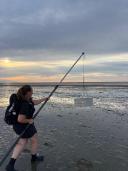
The sampling method put into practice by Femke Vermeulen (photo: by Lucas Norrie)
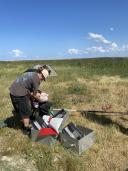
Team Maaike and Mirthe checked, double-checked and triple-checked to make sure all the equipment for the sampling had been packed (photo: Nienke Zwaferink)
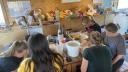
In between fieldwork sessions, a number of samples were sorted. The animals found were identified to species and measured (photo: Nienke Zwaferink)
Sore feet and seals
The alarm went off half an hour later, so today we set off for the mudflats at 7 o’clock. The sun was shining perfectly; our feet were a bit sore from yesterday and our mudflat boots were starting to rub a bit… After another two hours of sampling, we had breakfast and then had a nice rest. In the afternoon, we processed a few more samples, and then it was actually time to head out onto the mudflats again. We had quite a few samples planned for the day! After 1 km, I switched to walking in my socks, as those mudflat boots were really starting to rub by then. Along the way, we came across some really lovely things: beautiful shells, starfish, sea anemones, the tubes of tube-dwelling shell worms, jellyfish and, best of all: seals!!! After collecting all the samples, we walked back towards the cottage; by then it was already half past nine. That evening, Lucas and I did the cooking! After dinner, we went straight to bed.
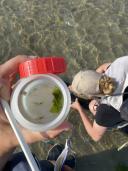
A sample containing brown shrimp (Crangon crangon) and a piece of sea lettuce (Ulva spec.) (photo: Nienke Zwaferink)
A lovely surprise whilst on watch: a group of seals resting! (photo: Lucas Norrie)
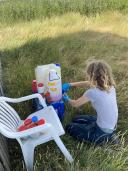
To preserve the samples properly, they are doused in formalin (photo: Mette de Boer)
The final stretch
Today we set off for the mudflats at half past seven! We had quite a few items on the agenda again. My feet were still aching, so another day in my socks. The sun was already beating down nicely and in the end we walked about 11 km! We came across another lovely worm that was wriggling along. Once back at the cottage, we had a nice rest and then had lunch. After sampling with the telescope, Mette and Nienke set themselves up in the dunes to read the rings on waders. Mette has experience with ring reading, so she was able to teach Nienke the tricks of the trade. During our three days on the island, they were able to read the rings of more than 50 birds. These were mainly sanderlings: during their migration south, they gather in huge numbers around Griend, where they are only too happy to peck at a prawn or two from the mudflats!
Later, we sorted through a few more samples, and then it was already time to head out onto the mudflats again. We wrapped up the final details of the trip, and to round off the evening perfectly, we were treated to a stunning sunset as we walked back towards the cottage. After today’s 26 km, we’re all a bit knackered, but we’ve managed to take around 160 samples in three days!! Tomorrow we’ll be packing up our gear here and cleaning up, and then the boat will pick us up again in the afternoon – and we’ll finally be able to have a shower :)
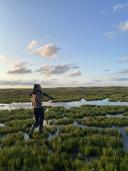
Mette de Boer on the island’s salt marsh, on her way to a suitable spot to read bird rings (photo: Nienke Zwaferink)

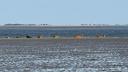
The ‘dessert’ after all that effort: the stunning sunset reflected in the mirror-smooth water (photo: Femke Vermeulen)
Farewell
Today was all about packing up and tidying up! We took down the tents, poured the remaining water into the water tank, emptied the toilet bucket into a hole in the dunes, placed the final samples in formalin, did the washing-up, swept the whole house and carried all our belongings down to the beach. Once we’d finished all the tidying up, we just had to wait to be picked up by the boat. Skipper Wim Jan Boon came to collect us from the beach again, and in two trips all our belongings were back on the Adriaen Coenen!
First we sailed towards Harlingen to drop off three of our travelling companions :( and then carried on towards Texel. Once on Texel, we unloaded the boat, tidied everything away and stowed our samples safely! Then it was time to head home. That meant washing off all the salt from the past few days – lovely!! What a brilliant trip it was with some fantastic people! And the mudflats really are something very special, even after walking 60 km……
Linked staff
Emma Penning
Postdoc

Nienke Zwaferink
Research Assistant