Mobile prey move in predictable locations
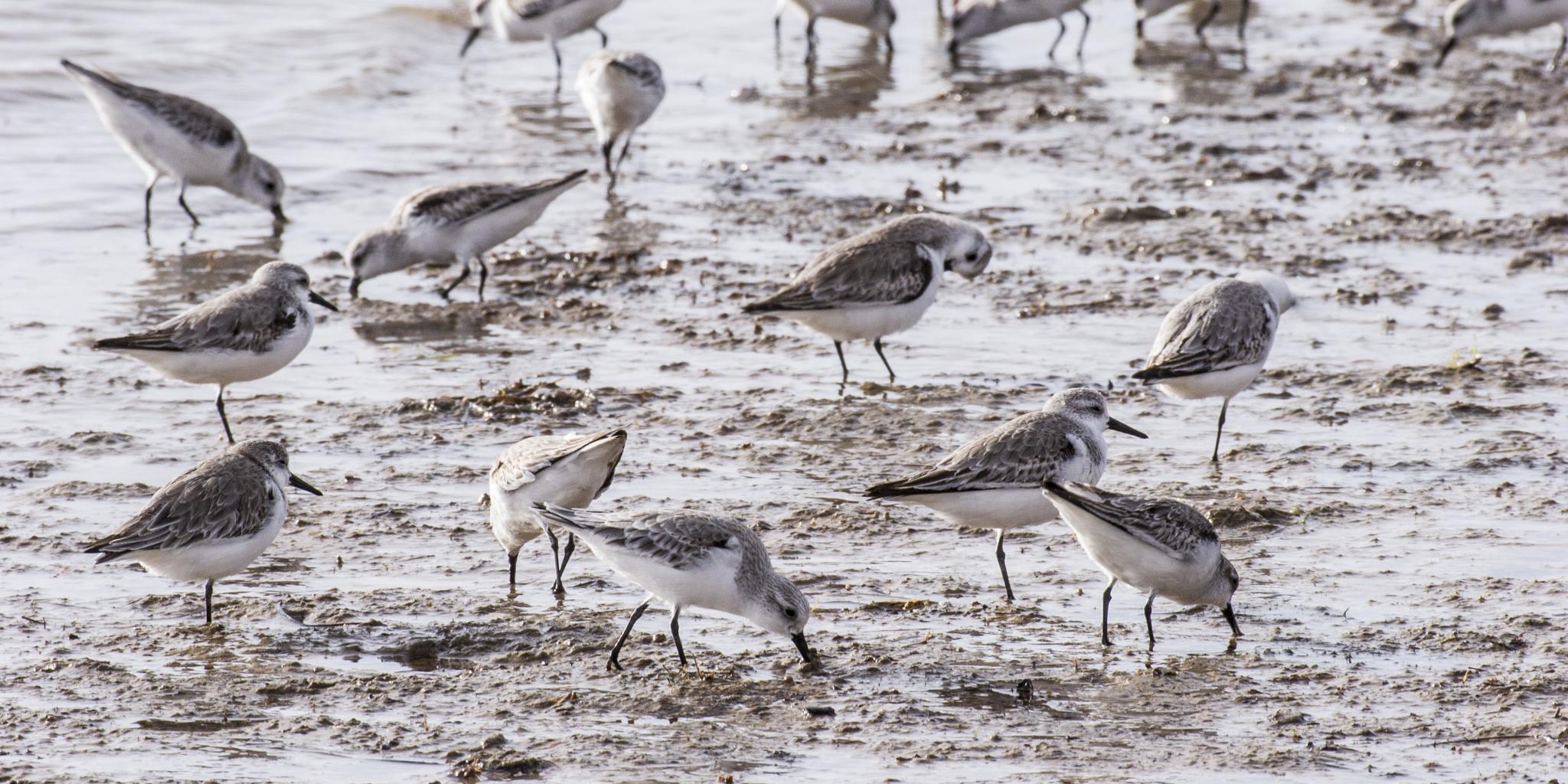
Fouraging sanderlings (photo: Jan van de Kam)
For shorebirds such as sanderlings, food availability is determined not only by the abundance of prey, but also by the precise locations and periods during which prey are available. Research by Emma Penning and others shows that mobile prey, such as shrimps and shore crabs, occur predictably in specific parts of intertidal mudflats throughout the season. This provides shorebirds with better foraging opportunities and highlights the importance of managing intertidal areas that continue to provide rich food resources year after year.
Migratory shorebirds must accumulate large energy reserves during migration. For migratory shorebirds, finding food quickly in a stopover site like the Wadden Sea can make the difference between a successful migration and a failed journey. Along the East Atlantic Flyway, birds rely on intertidal mudflats to replenish their energy reserves during migration and winter. Yet many of their prey species are highly mobile, raising an important question: how do birds repeatedly find food that is constantly on the move?
To answer this question Emma Penning, researcher at BirdEyes and NIOZ, started a new study exploring the predictability of mobile prey on the mudflats of the Dutch Wadden Sea. While previous research has shown that shorebirds can repeatedly return to locations with buried shellfish, much less is known about prey species that can actively move across tidal flats. The study's findings suggest that mobile prey may be far more predictable than previously assumed, helping birds forage efficiently in these dynamic environments.
Following food on the mudflats
The study focused on the mudflats surrounding Griend, a small island in the Dutch Wadden Sea. Emma and her colleagues investigated the distribution of juvenile brown shrimp and shore crabs, two important prey species for shorebirds such as sanderlings. Because these crustaceans are highly mobile and can be transported by tides and currents, the team expected their abundance and distribution to vary considerably over time.
To investigate whether mobile prey occur predictably across the mudflats, Emma and her colleagues developed an innovative sampling method in which they sampled ‘from afar’, allowing shrimp and crab to be sampled without prior disturbance. The method was validated using the flat furrow shell, a sedentary bivalve whose abundance was expected to be highly repeatable. Between July and October, from 2016 to 2018, they conducted weekly surveys around Griend to monitor changes in prey abundance. Repeatability (R), a metric commonly used in behavioural ecology to quantify the consistency of behaviour over time, is applied here to measure the consistency of abundance of prey species. The team quantified how reliably shrimp and crab abundances occurred at the same locations throughout the season.

Researcher Emma Penning collects a sample (photo: Jasper Doest)
Predictable prey in a dynamic environment
As expected, the sedentary flat-furrow shell showed highly stable distributions through time. But surprisingly, juvenile shrimp and shore crabs also occurred consistently in the same locations throughout the season. Even though absolute mobile prey abundance decreased over the season, the relative difference in abundance among locations remained: at least within years. The spatial repeatability among years was not part of the study and could not be confirmed. Repeatable abundances among locations may be explained by stable food conditions for shrimp and crab, protection from predators, or stable environmental conditions. This suggests that even mobile prey repeatedly use favourable habitats, which would allow shorebirds to return to profitable feeding areas.
Reducing search time
Shorebirds feeding on tidal flats have only a limited window around low tide to find food and refuel. The study shows that such prey landscapes are not entirely random: even highly mobile prey like juvenile shrimp and crabs occur predictably in space. This allows shore birds such as sanderlings to learn profitable feeding areas, reducing search time, improving foraging efficiency, and helping them build the energy reserves needed for successful migration.
The study "Avian prey exhibit repeatable abundances on intertidal mudflats"
Opens in a new tab by NIOZ Royal Netherlands Institute for Sea Research and BirdEyes is part of the Waakvogels project, in which six migratory bird species help us understand the state of the Wadden Sea.Linked staff
Emma Penning
Postdoc
