WATLAS: Live tracking of bird movements in the Wadden Sea
To learn how birds cope with threats such as sea level rise and habitat change, the WATLAS project was started in 2017 investigating where birds go and why. Every year, we equip various species of waders with a small WATLAS transmitter. This allows us to accurately track where birds go and how they move in the Dutch Wadden Sea.
Duration
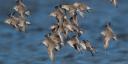
A group of red knots flying above the sea (photo: Gerard Bos)
Millions of birds depend on the Wadden Sea that provides them with safety and food, from worms and shellfish to snails and shrimp. Some species use the Wadden Sea temporarily to breed or to refuel on their long migratory journeys, while others stay there all year round. We track how birds move with the tide, on which mudflats they feed, what they eat, and how individual birds differ in their behaviour.
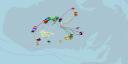
A map of the Wadden Sea showing the locations and trajectories of birds that carry a WATLAS transmitter (credit: NIOZ)
WATLAS stands for Wadden Sea Advanced Tracking and Localisation of Animals in real life Systems. We map bird movements using real-time tracking and mainly track waders such as dunlins, red knots, black-tailed godwits, sanderlings, oystercatchers and curlews. The Wadden Sea is very important to them. We have also tracked other waterbirds, such as spoonbills and common terns.
In this scientific article from 2022
Opens in a new tab, we explain the WATLAS work and its value in detail. In 2026 and 2027, we will expand the project to cover the entire Dutch Wadden Sea. We will do this with the large Wadden Sea Fund programs ‘Waakvogels’ and ‘Wij en Wadvogels’.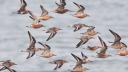
Red knots
Discoveries from WATLAS
We publish the discoveries from WATLAS in scientific journals. Below we list a few insights; see this external website
Opens in a new tab for a complete overview and references.Differences between females and males
Male and female black-tailed godwits search for food in different places. Females with long bills foraged in areas with lots of lugworms and ragworms, which live deeper in the sediment. Males with shorter bills went to areas with more mud shrimp that live closer to the surface of the mudflats.
Red knot personality
Within WATLAS, in 2022 we elaborated on the earlier discovery
Opens in a new tab that red knots have different personality types. It is possible that the fast explorers ‘help’ the slow ones to adapt to habitat change, like that following the climate crisis. We tested our hypothesisOpens in a new tab on red knots in captivity and saw clear evidence of this. Some red knots searched frantically for food under uncertain food conditions, while others waited patiently and befitted from the exploratory behaviour of others.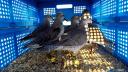
Captured red knots (credit: NIOZ)
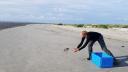
Releasing birds (credt: NIOZ)
More wind, less food
One example of the expected effect of climatic change is the increase of storms on water levels. This will affect food availability and the foraging behaviour of red knots. We have found
Opens in a new tab that storms can make almost half of the mudflats unavailable to red knots searching for food. This can have a significant impact on red knots, but also on all waders. It may also be a preview of the effects of sea level rise on food availability and survival of red knots and other waders, and the Wadden Sea environment in general.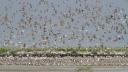
high-water resting place for red knots on the island of Griend. (Credit: Benjamin Gnep)
Tracking the smallest birds
WATLAS showed us that sanderlings choose mudflats with the highest densities of shrimp. These birds are so small that transmitters were too heavy to use on this species for a long time. Within WATLAS, they have been tracked for the first time. More recently, we have also started tracking the even smaller kentish plovers and dunlins.
More food, better adapted
Red knots that had been given unlimited food in captivity departed on their spring migration from the Wadden Sea earlier after their release than red knots that had been given less food. Our research suggests
Opens in a new tab that better food conditions at stopover sites, such as the Wadden Sea, can enable earlier departure. This can help migratory birds to better adapt their breeding season to the increasingly early onset of spring in a warming climate.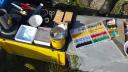
Tools for tracking birds (credit: NIOZ)
Developing the technique
With WATLAS, we track birds with transmitters that send radio signals to base stations (receivers). We can determine the position of the transmitter (and thus the bird) with an accuracy of a few meters
Opens in a new tab by measuring the differences in the arrival time of that signal at minimally three receivers. Technicians from the NIOZ NMF department have developed the ATLASOpens in a new tab tracking system further and create a method specifically for this project, using transmitters of various sizes and receivers in the Wadden Sea.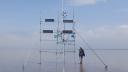
WATLAS receiver (credit: NIOZ)
WATLAS in the media (a selection)
Documentary series Wize fan it Waad
June 2025, FryslânDOK | An attractive and informative five-part series by FryslânDOK about the relationship between humans and nature in Europe's largest tidal area. Featuring NIOZ researchers Allert Bijleveld and Theunis Piersma, among others. From personality differences between red knots to the enigmatic legend of the submerged town of Rungholt – the Atlantis of the Wadden Sea. Watch via NPO Start
Opens in a new tab. (In Dutch)Selin Ersoy (former PhD) wins award for her paper
31 March 2025 - Selin received the IBIS Best ECR Paper award for her paper on differences in timing of migration in Red Knots. Read more about the price here
Opens in a new tabOn gas extraction in the Wadden Sea
10 December 2024, BNNVARA | Gert Elbertsen spoke with ecologist Allert Bijleveld (NIOZ) about the impact of gas extraction under the Wadden Sea. Onze natuur betaalt de prijs voor gaswinning in de Waddenzee - Vroege Vogels - BNNVARA
Opens in a new tabTracking migratory birds far into Russian territory, despite the war
12 september 2024 - New trackers make it possible to follow migratory birds into their breeding areas in Russia. Read or watch the report by Omrop Fryslan (in Frysk)
Opens in a new tabOn red knot personality
Snelle vogels wachten op de slome
Opens in a new tab24 July 2024, newspaper Trouw, following the scientific publication in Biology Letters
Opens in a new tab.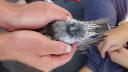
Transmitter on a bird (credit: NIOZ)
Contact
For more information, please contact Allert Bijleveld
Opens in a new tab.Project leader
Allert Bijleveld
Research Leader

Project team
Isla Botting
Visiting PhD

Anne Dekinga
Senior Research Assistant
Bas Denissen
Embedded Software and Electronics Engineer

Remko de Haan
Senior Electronics Engineer

Evy Gobbens
Visiting PhD
Job ten Horn
Senior Research Assistant
Johannes Krietsch
Postdoc

Antsje van der Leij
Software Developer
Frank van Maarseveen
Embedded Software and Electronics Engineer

Luc de Monte
Research Assistant
Emma Penning
Postdoc
Anne Vorenkamp
PhD student