Young grass follows different growth strategies on salt marshes and in dunes
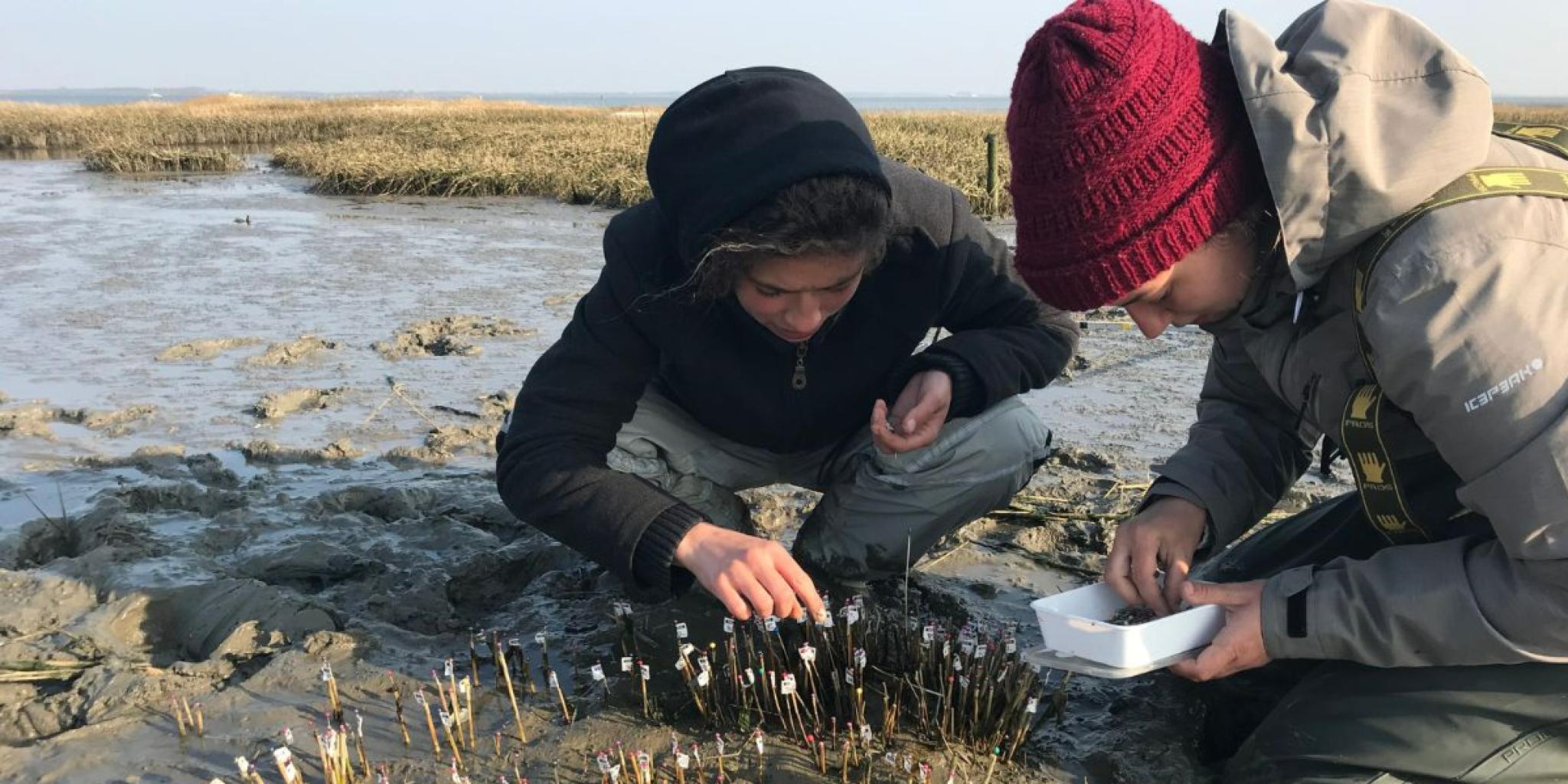
Little Christmas trees: colored pins mark shoot positions of a cordgrass plant to map their spatial coordinates (photo: Valérie Reijers)
Shoots of a young grass plant in the salt marsh grow clustered regardless of environmental factors. Whereas in the dunes, young grasses organize their shoots differently depending on the species and their habitat. With their diverse growth strategies, young grass plants thus deal with the dynamics of their environment in different ways, shaping their landscape. This was published on the same day last week in the two scientific journals Ecosystems and Functional Ecology by researchers from NIOZ and the universities of Groningen and Utrecht.
Grasses are the main builders of dune and salt marsh ecosystems in north-western Europe. They form the first buffer against sea storms and floods, and are also the basis of an entire ecosystem: like trees in a forest, they host dozens of species and thus enable many habitat functions.
Mature coastal grasses break the flow of water or wind, causing sand and silt to settle in the water or air, and the plants thus build up the landscape. But worldwide, dunes and salt marshes suffer from erosion, and are proving difficult to restore. PhD students Carlijn Lammers and Clea van de Ven studied how young grasses can establish themselves in the dynamic coastal zone. Ultimately, characteristics such as the spatial growth pattern of the grasses influence their own survival rate and thus how they shape the landscape.
Scenic walk in front of the light house: We uncovered part of the roots and rhizomes to see how this sand couch plant walks over the beach on Texel (photo: Carlijn Lammers)
Travelling the European coast by camper van
Together with Valérie Reijers, a researcher at Utrecht University, Lammers and Van de Ven travelled the northwest European coast in a camper van in the summer of 2019. At 27 locations in France, the Netherlands, Denmark and Germany, they took samples of young grasses and local environmental conditions in salt marshes and dunes. Based on previous findings of Reijers, the researchers expected that plants might adapt their spatial growth to the amount of physical stress from wind and water that individual plants experience. This appeared to be the case in the dunes, but not in the salt marsh, leading to two scientific publications.

Setting up at the campsite during field survey along the European coast (photo: Clea van de Ven)
Lammers and Van de Ven were pleasantly surprised that, after almost four years of research, both articles were published on the same day by coincidence. Valérie Reijers: "Together, they show that clonally expanding grasses can have specific growth patterns that deviate from random growth patterns, that some species have a flexible growth pattern and others not and that while some species adapt their growth pattern to maximize flow attenuation, others on the contrary, avoid physical stress."
Differences in dune form due to shoot growth
In her publication in Ecosystems, Carlijn Lammers focuses on the influence of young specimens of sand couch (Elytrigia juncea) and marram grass (Ammophila arenaria) on dune formation. Sand couch was found to grow more scattered than marram grass, which grows in a wide variety of patterns. This difference also reflects their difference in dune formation: sand couch builds low and wide dunes and marram grass forms high and narrow dunes.
Surprisingly, the spatial shoot organisation of sand couch was consistent regardless of the environment, while in marram grass the researchers found a wide variation in patterns. Lammers: "We suspect that sand couch weighs the risk of flooding against the potential benefits, such as higher nutrient supply and lower burial rate, while marram grass maximises sand uptake to avoid flooding altogether."
Establishing common cordgrass plants across European marshes show a clustered shoot pattern (photo: Clea van de Ven)
Salt marsh grass avoids stress at an early age
In Functional Ecology, Clea van de Ven describes that English cordgrass (Spartina anglica) in salt marshes always clusters its shoots, regardless of environmental conditions. In a follow-up experiment, she shows that this growth form reduces erosion around the plant.
Van de Ven: "The results show that young plants initially follow a shoot organisation that avoids physical stress. They do this by minimising their impact on the habitat, rather than immediately trying to modify the environment to their own advantage. The clustered shoot pattern of young plants looks different from that of mature plants. When plants are still young, clustering helps them to avoid stress."

Scouting on the mudflat (photo: Valérie Reijers)
Linked staff
Tjisse van der Heide
Senior Research Leader

Tjeerd Bouma
Senior Research Leader
