With her Vici grant, Anja Spang will shed light on the evolutionary history of symbionts
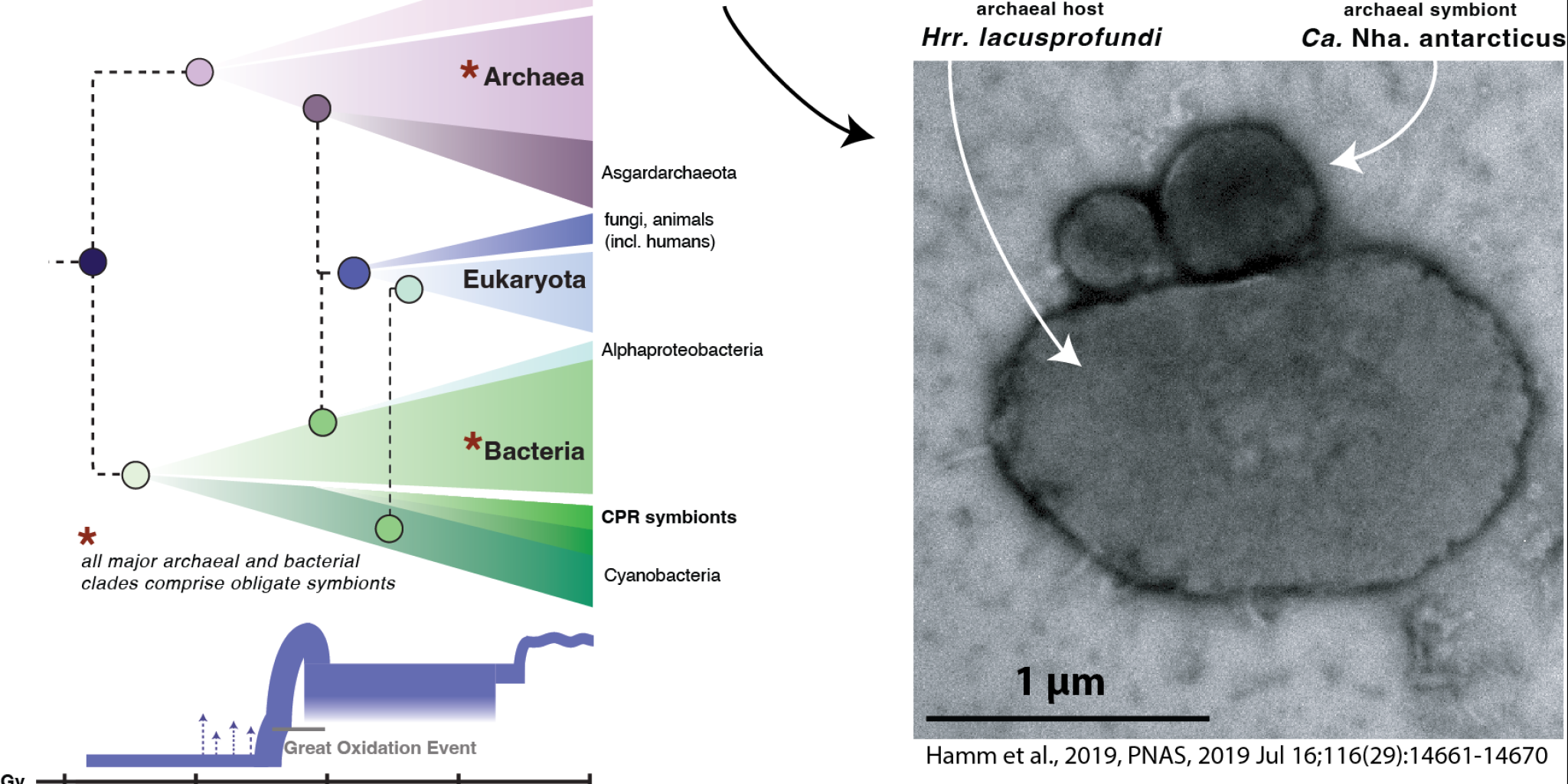
Figure 1: The DPANN symbiont Candidatus Nanohaloarchaeum antarcticus with its host. Credit: Hamm et.al., 2019
Evolutionary microbiologist Anja Spang has been awarded a Vici grant by the Netherlands Organisation for Scientific Research (NWO). She will use this grant to investigate the diversity and importance of symbiosis across the tree of life. A key focus will be on archaeal and bacterial symbionts that depend on other organisms for growth and survival. Intriguingly, we owe our lives to such forms of symbiosis.
Without symbiosis, none of us would exist. Once upon a time, a bacterium lost its independence by merging with an archaeal cell. Now that bacterium is represented as mitochondria in all our cells. The mitochondrion is an organelle that powers eukaryotic cells – cells with a cell nucleus, such as those found in humans. Chloroplasts in green plants and algae were also once independent organisms.
Branches of the tree of life
Symbiosis is very common in the family tree of life and symbionts are integral for the functioning of natural ecosystems ranging from corals to forests and our human bodies. NIOZ scientist Anja Spang focuses on single-celled bacteria and archaea, which make up much of life’s biodiversity and include many symbionts with various different hosts ranging from other single-celled organisms to humans. While some of these symbionts are well known, others have only recently been discovered. ‘Within this grant we will be able to compare the origin, evolutionary history and global abundance of these various symbionts and thereby gain a deeper understanding of what it means to be a symbiont and what role they play in the context of our planet.’
Common denominators
Spang furthermore hopes to bridge symbiont research and identify common denominators. ‘In my project Symbioses across time and space I am going to focus on archaea and bacteria that are obligately dependent on another organism to be able to grow and thrive.’ She hopes to discover whether there are common features that characterizes the evolution of these symbionts, identify who their hosts are and determine when they evolved in geologic time. To uncover evolutionary history, she cannot rely on fossils, for example. She reconstructs ancestral protein content using phylogenetic models and machine learning approaches. ‘And we also cultivate symbionts and their hosts in the lab to study real-time evolution.’
See Figure 1. Left: Illustration of tree of life including the importance of symbioses. Right: the DPANN symbiont Candidatus Nanohaloarchaeum antarcticus with its host.It is one of the obligate symbionts that will be studied within the frame of this grant and the model system we maintain in the laboratory at NIOZ. (Credit: Hamm et al., 2019, PNAS, 2019 Jul 16;116(29):14661-14670)
Figure 1: The DPANN symbiont Candidatus Nanohaloarchaeum antarcticus with its host. Credit: Hamm et.al., 2019
VICI grant: for excellent, experienced senior researchers
A Vici grant is a Dutch grant intended for excellent, experienced senior researchers who have previously supervised young researchers. They must be able to demonstrate that they can develop their own innovative lines of research and are suitable as coaches. They are allowed to build their own research group and can receive up to €1.5 million in support for this. The programme is administered by the Netherlands Organisation for Scientific Research (NWO).
Linked staff
Anja Spang
Senior Research Leader
