What is the impact of viruses on marine phytoplankton and ecosystems?
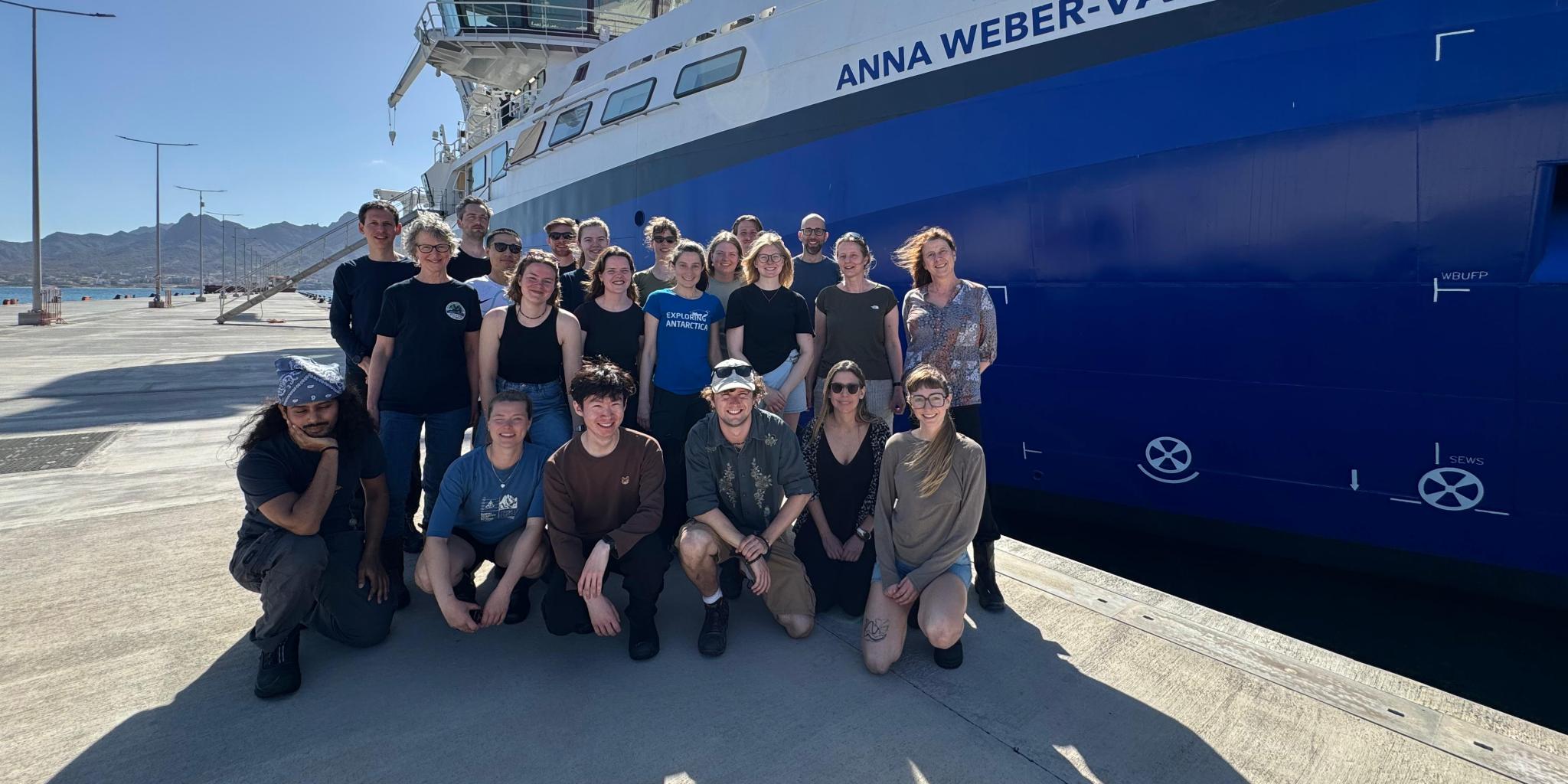
Start of the PHYVIR cruise in Mindelo (photo: NIOZ)
The PHYVIR project, led by Prof Dr. Corina Brussaard of NIOZ/UvA, studies the impact of viruses on phytoplankton, how this influences carbon and nutrient cycling in the oceans and, ultimately, the health of our planet. The consortium wants to bridge significant knowledge gaps by investigating virus-phytoplankton interactions through laboratory experiments, oceanic expeditions, and advanced computer modeling. Other participating scientists are Prof. van de Waal (NIOO), Dr. Wilken and Prof. Huisman (both UvA) and Dr. Hackle (RUG), leading to a multi-disciplinary approach and complementary scientific expertise.
Impact of interaction
Phytoplankton produce half of the Earth’s oxygen, absorb vast amounts of CO₂, and form the foundation of marine ecosystems. However, they are also infected by viruses. While we have all witnessed the immense impact viruses can have on both local and global scales, very little is still known about virus-phytoplankton interactions in the oceans. Key information about the geographical distribution of major virus types, their associated hosts, traits, and temperature responses is lacking. Furthermore, the effects of marine viruses on ocean ecosystem productivity and the global oceanic carbon cycle remain poorly understood. How often do viruses kill the different functional groups of phytoplankton? How do infections change the way these organisms function? And what does this mean for the ocean’s biogeochemical fluxes and ability to store carbon? These are questions at the heart of the PHYVIR project.
Collecting data
On the 30th of April a large team of researchers from amongst others NIOZ, UvA, RUG and NIOO will step on board the recently baptized Research Vessel Anna Weber-van Bosse. During the month of May they will sail the North Atlantic Ocean, all the way from warm, relatively nutrient-poor waters off Cape Verde to cooler, more nutrient-rich areas in Iceland. On the first scientific cruise on this new ship, they will collect water samples from the sunlit part of the ocean to study the diversity and gene function of the phytoplankton and virus communities, their activity and loss rates and impact on elemental and lipid composition. Along the way they will also investigate how the interactions of viruses and phytoplankton hosts change under different environmental conditions. Some of these water samples are processed and stored, whilst others are analyzed directly on board and used for experiments.
Results
The measurements will help us better understand how viral activity dictates phytoplankton community shifts and, by extension, under what conditions viruses determine the direction of carbon flows. When do they retain carbon in the upper layers of the ocean by shunting organic matter to the microbial food web and away from higher trophic levels, and when they contribute to transport of carbon to the deeper ocean. This research provides the missing data needed to refine our climate models and accurately predict marine primary production in an era of rapid environmental change.
Linked staff
Corina Brussaard
Senior Research Leader

Li Zhao
PhD student

Follow the PHYVIR Expedition!
The scientists will take you along their life and work on board
Practice for abandoning ship: survival suit on, and head straight for the life raft. The lifebuoy is just for fun.