Tracing the evolution of archaeal symbiosis
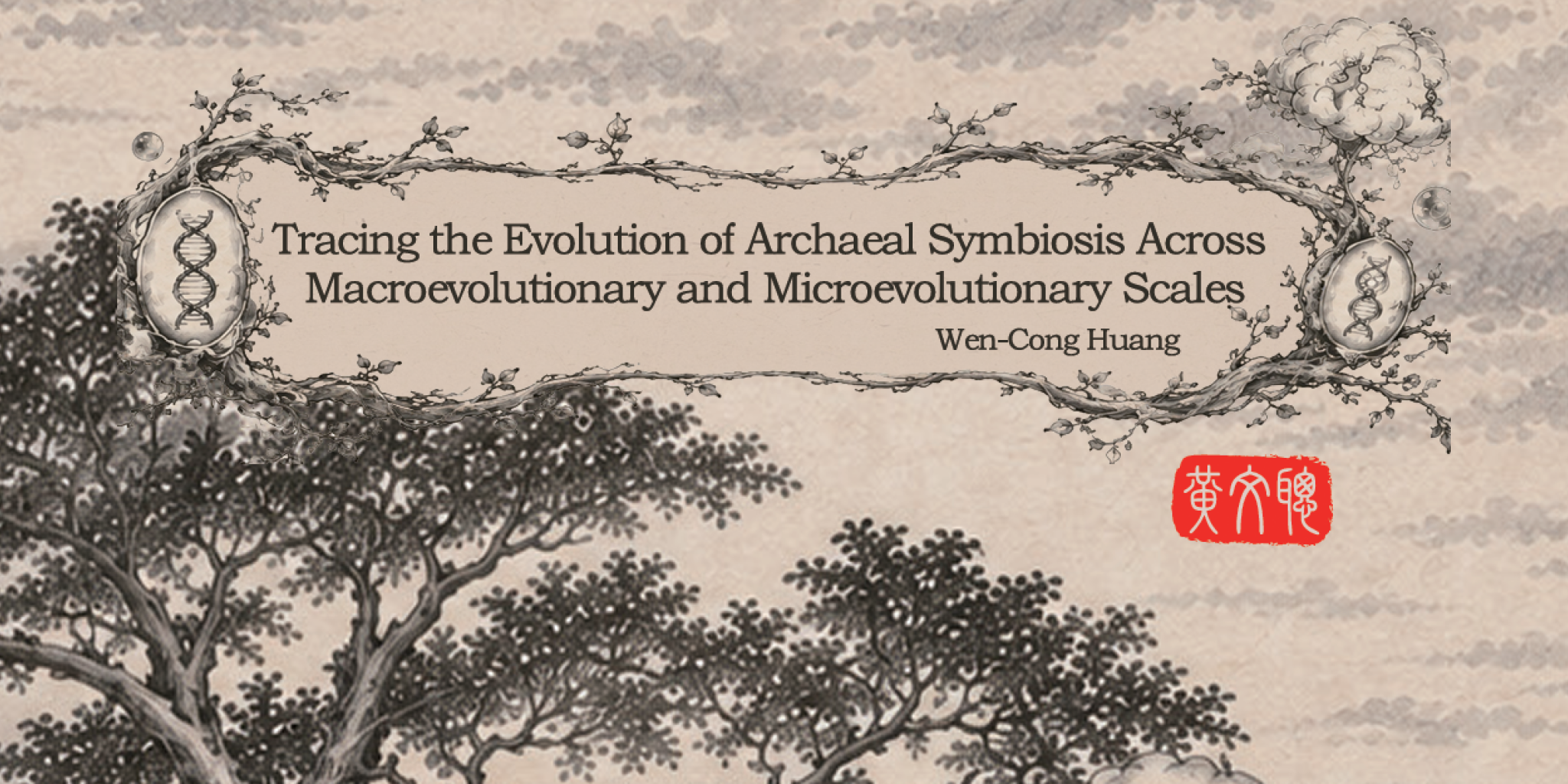
Thesis cover of Wen-Cong Huang
Single-celled archaea that depend on a host to survive evolve mainly by losing genes, research by NIOZ PhD candidate Wen-Cong Huang shows. Yet some symbionts also gain new abilities by acquiring genes from other organisms, for instance to adapt to extremely salty environments. Symbiosis shapes their genomes, can influence those of their hosts, and is a highly successful evolutionary strategy for archaea, the thesis concludes. Huang will defend his dissertation on 4 December at the University of Amsterdam.
Archaea are microorganisms that play important roles in global nutrient cycles and inhabit environments ranging from oceans to hot springs. Some (e.g. DPANN archaea) depend on close partnerships with other organisms to survive. Wen-Cong Huang studied how these partnerships shape the genomes of archaeal symbionts and their hosts, and how they evolve over short and long timescales. Understanding these relationships helps explain how organisms become dependent on one another and adapt to challenging environments.
The findings show that gene loss is the main way archaeal symbiont genomes evolve. However, some symbionts also acquire genes from other organisms, potentially helping them colonise extremely salty environments, and revealing that even small-genomed organisms can gain new capabilities. Laboratory evolution experiments showed that symbionts can influence their hosts’ genome evolution, and identified a candidate gene that may affect their interactions. Comparisons across archaeal groups suggested that genome reduction has evolved repeatedly alongside symbiosis. The analyses also supported an archaeal ancestor that produced methane and lived at high temperatures.
These findings are relevant to microbiologists and evolutionary biologists studying environmental microbial communities. They reveal how intimate
partnerships drive genetic change, helping explain the diversity, adaptability and evolutionary success of organisms that depend on others for their survival.
About this thesis
- Title: Tracing the evolution of archaeal symbiosis across macroevolutionary and microevolutionary scales
- Supervisor: Anja Spang
- Co-supervisor: Astrid Groot (UvA)
- Date and time of the defense ceremony: 4 December 2026, 14:00
- Location: Lutherse Kerk, University of Amsterdam
- Link to the livestreamOpens in a new tab
Linked staff
Anja Spang
Senior Research Leader

Practical information
Wen-Cong Huang will defend his thesis on 4 December 2026, at the University of Amsterdam.
Thesis cover of Wen-Cong Huang