Tidal marshes can better protect our coasts if we restore them in time
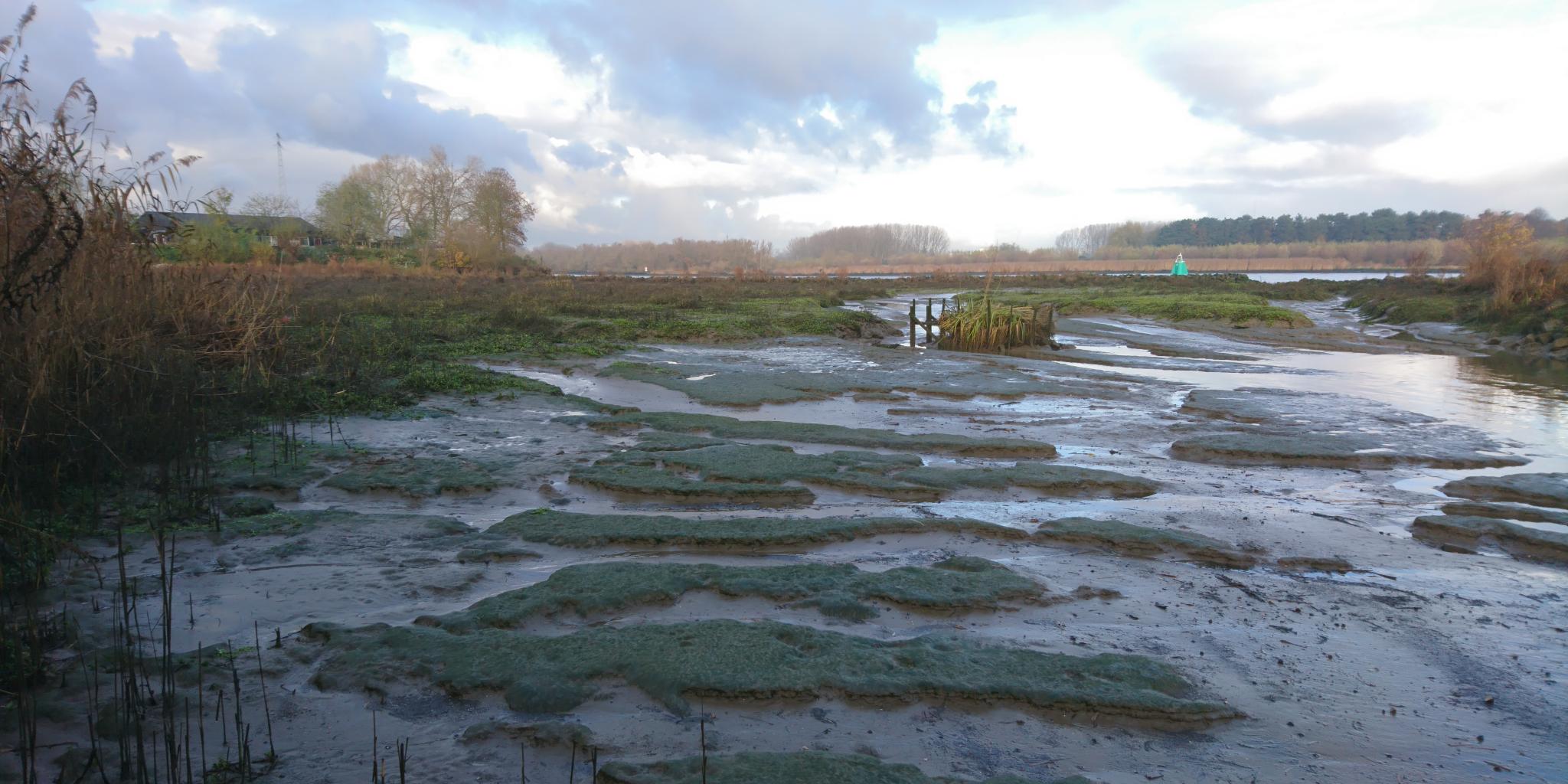
A tidal marsh landscape at low tide
Tidal marshes – areas of land outside the dykes that are regularly flooded by seawater – can protect us against sea level rise and erosion. PhD candidate Marte Stoorvogel discovered that for example dense vegetation is important in this regard. She defended her thesis at Utrecht University on 13 June 2025.
The effects of climate change, such as sea level rise, are leading to increased risks of flooding and erosion worldwide. Certain ecosystems can contribute to the natural reduction of flood and erosion risks. An example of such ecosystems are tidal marshes. These vegetated areas lie outside the dykes and are regularly flooded by seawater.
Tidal marshes dampen waves and reduce coastal erosion...
Tidal marshes can dampen waves and reduce coastal erosion. Sediment can also accumulate, allowing the surface to rise with the sea level. In the Netherlands, the United Kingdom and the United States, for example, there is therefore growing interest in restoring and creating tidal marshes as a nature-based solution to reduce flood risks.
...Except when they erode themselves
In order to reduce flood risks, tidal marshes must not be susceptible to erosion. If the sediment that settles in a tidal marsh erodes quickly, the area offers much less protection. Marte Stoorvogel investigated the conditions that influence the development of erosion resistance in a tidal marsh. She conducted fieldwork in Zeeland, Groningen and Belgium and used previously collected data from the NIOZ.
Dense vegetation with pioneer plants helps
She discovered that a tidal marsh can become erosion-resistant within six years if it becomes densely covered with pioneer plants. These are plant species that are the first to colonise a bare area, such as common cordgrass. Certain properties of the sediment also appear to have an influence, as do the speed at which sediment settles and how often and for how long an area is flooded.
We need to restore tidal marshes in good time
According to Stoorvogel, it is therefore crucial to assess in advance whether local conditions are suitable for the development of a tidal marsh and how this can best be achieved in that particular location before starting restoration or construction work. The system must also be given sufficient time to become erosion-resistant before it is actually needed to reduce flood risks. “That is why we must start now to restore tidal marshes that will be needed for coastal protection in the future.”
Linked staff
Tjeerd Bouma
Senior Research Leader

Johan van de Koppel
Research Leader
Dissertation Marte Stoorvogel
