Temperature effects on invasive parasites and their host populations
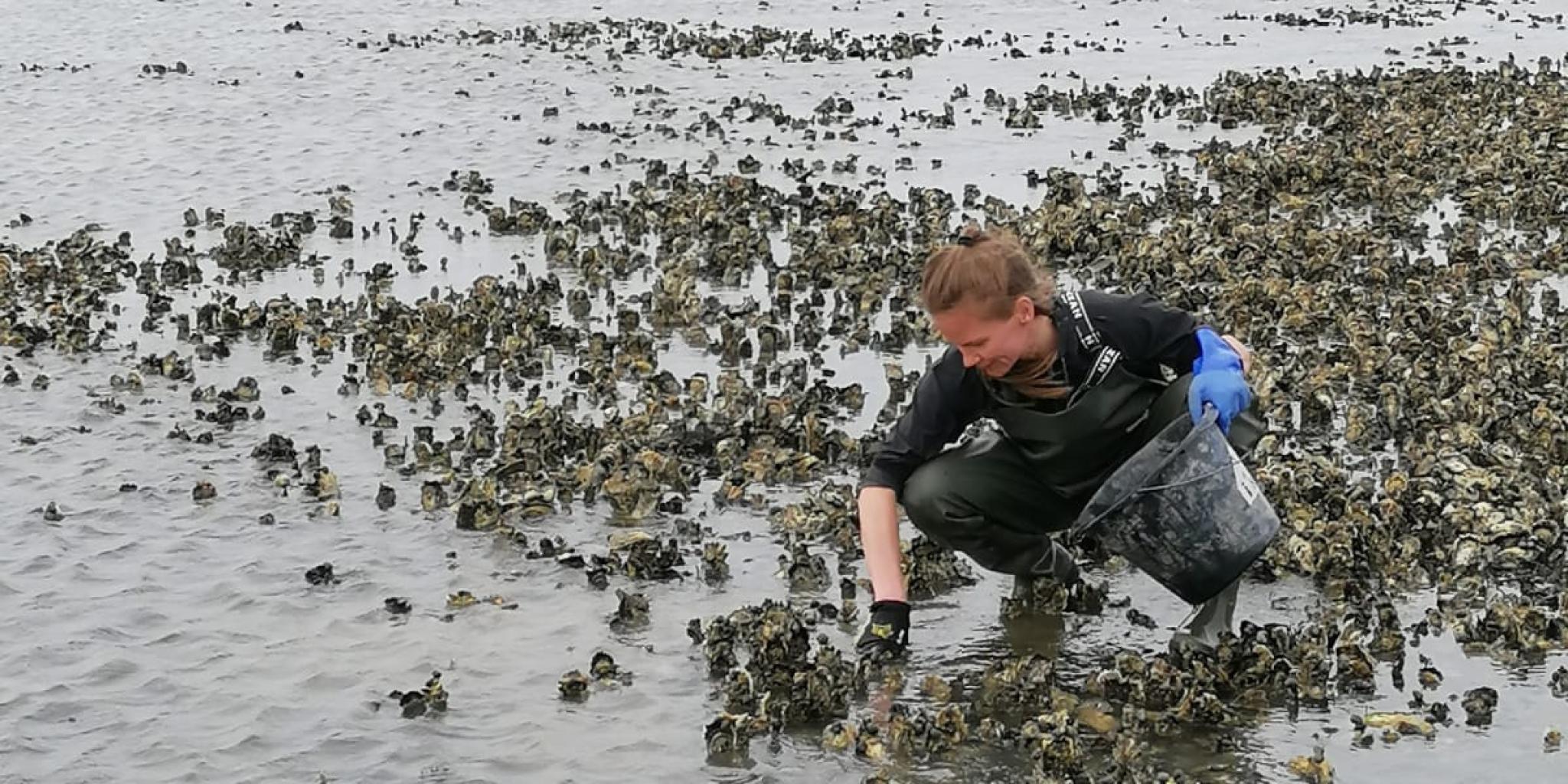
Rosa Jolma takes a closer look at an oyster population in the Wadden Sea. (Photo: Rosa Jolma)
What happens to invasive parasites and their hosts in a warming sea? In the Dutch Wadden Sea, two parasitic crustaceans tell a story about how climate change and invasive species reshape marine life. NIOZ PhD candidate Rosa Jolma will defend her thesis titled ‘Temperature effects on invasive parasites and their host populations; insights from copepods infecting bivalves’ on 26 October at Utrecht University.
The gut parasite Mytilicola intestinalis arrived alone almost a century ago to infect native blue mussels. Its close relative, Mytilicola orientalis, came more recently, hitchhiking in invasive Pacific oysters. Both parasites are relatively harmless: they don't kill their hosts, only take some host energy, leading to slower growth and skinnier mussels.
This dissertation investigated what happens when such relatively harmless invasive parasites meet a warming sea. Experiments revealed that higher temperatures sped up parasite development, letting them squeeze in more generations each year. Yet temperature did not change how parasites impact hosts, and only extreme long-term warmth (26°C) harmed both hosts and parasites. Intertidal organisms already endure scorching heatwave low tides, but reefs of invasive oysters provide shade, buffering the heat for all residents. The earlier invader, M. intestinalis, proved more heat-sensitive, yet even it suffered only during spring heatwaves. Since mussels suffer more from heat than their parasites, host deaths destroy more parasites than the heat directly.
Even relatively harmless parasites matter. Modelling shows they even out the spread of biomass across host sizes, preventing stunted adults from crowding out juveniles. Another model revealed how warming pushes the two parasites in opposite directions. As rising temperatures shrink the mussel population below the minimum population size the earlier invader needs, the newcomer thrives on mussels alone no longer requiring its original oyster host.
Linked staff
Rosa Jolma
Postdoc

David Thieltges
Senior Scientist

Anieke van Leeuwen
Senior Scientist

Practical information
Rosa Jolma will defend her thesis on 26 October 2026 at 12:30, at Utrecht University.

'Temperature effects on invasive parasites and their host populations', thesis cover Rosa Jolma.