Stirring in the deep
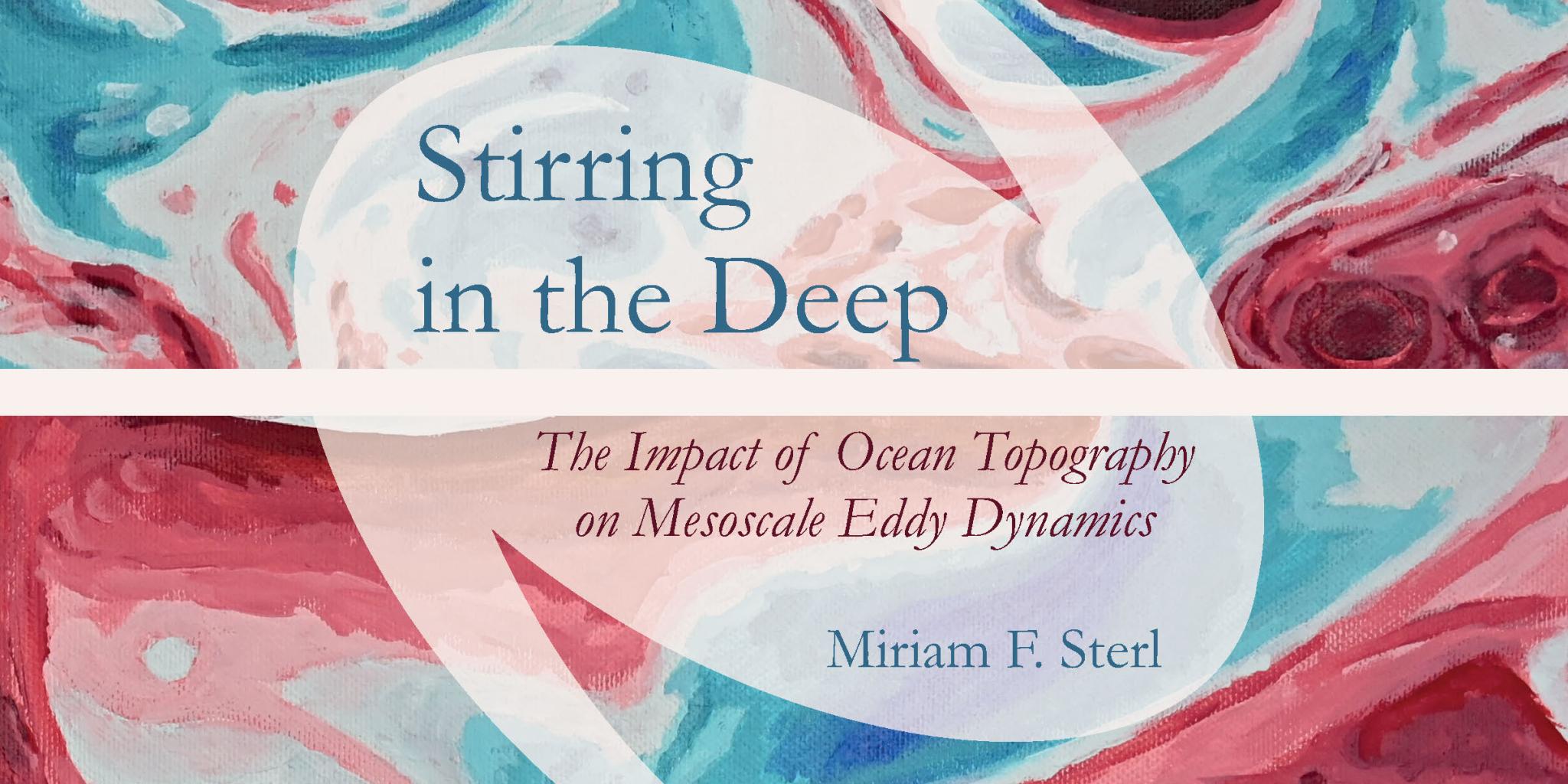
Thesis cover by Miriam Sterl
Mesoscale vortices or eddies are everywhere in the ocean, and play an important role in the ocean circulation, climate and ecosystem, because they contribute to mixing of oceanic tracers such as heat, salt, carbon and nutrients. In her PhD research, Miriam Sterl investigated the role of the sea floor on eddymixing, and she developed new measurement methods and analytical frameworks. This may help in better incorporating the role of eddies in ocean and climate models. PhD defense on 25 June at Utrecht University.
Short summary
Ocean processes span spatial scales from millimetres to tens of thousands of kilometres and temporal scales from seconds to centuries. Within this vast parameter space, more than half of the surface kinetic energy in the ocean is associated with the mesoscale, which encompasses processes on spatial scales of tens to hundreds of kilometres and temporal scales of weeks to months.
Mesoscale eddies (vortices) are ubiquitous in the ocean and have important impacts on the ocean circulation, climate and ecosystems, because they contribute to mixing of oceanic tracers such as heat, salt, carbon and nutrients. However, many global ocean and climate models do not have sufficient resolution to capture mesoscale eddies. Instead, they typically infer mixing caused by mesoscale eddies based on the larger-scale properties in the model. Understanding how eddy mixing varies throughout the ocean can thus be very important to improve climate models.
In this PhD research, Sterl focused on investigating the role of the shape of the seafloor on eddy mixing. Her research shows that the slope of the seafloor impacts both the formation and growth of mesoscale eddies as well as the strength of eddy mixing, and offers new analytical frameworks and measurement methods to study eddy mixing.
Linked staff
Gert-Jan Reichart
Head of Ocean Systems

Sjoerd Groeskamp
Senior Scientist

Practical information
Miriam Sterl will defend her PhD thesis, titled 'Stirring in the deep, The Impact of Ocean Topography on Mesoscale Eddy Dynamics' on 25 June 2026 at 14:00, at Utrecht University.

Thesis cover by Miriam Sterl