Science meets art: ocean darkening during the Dutch Design Week
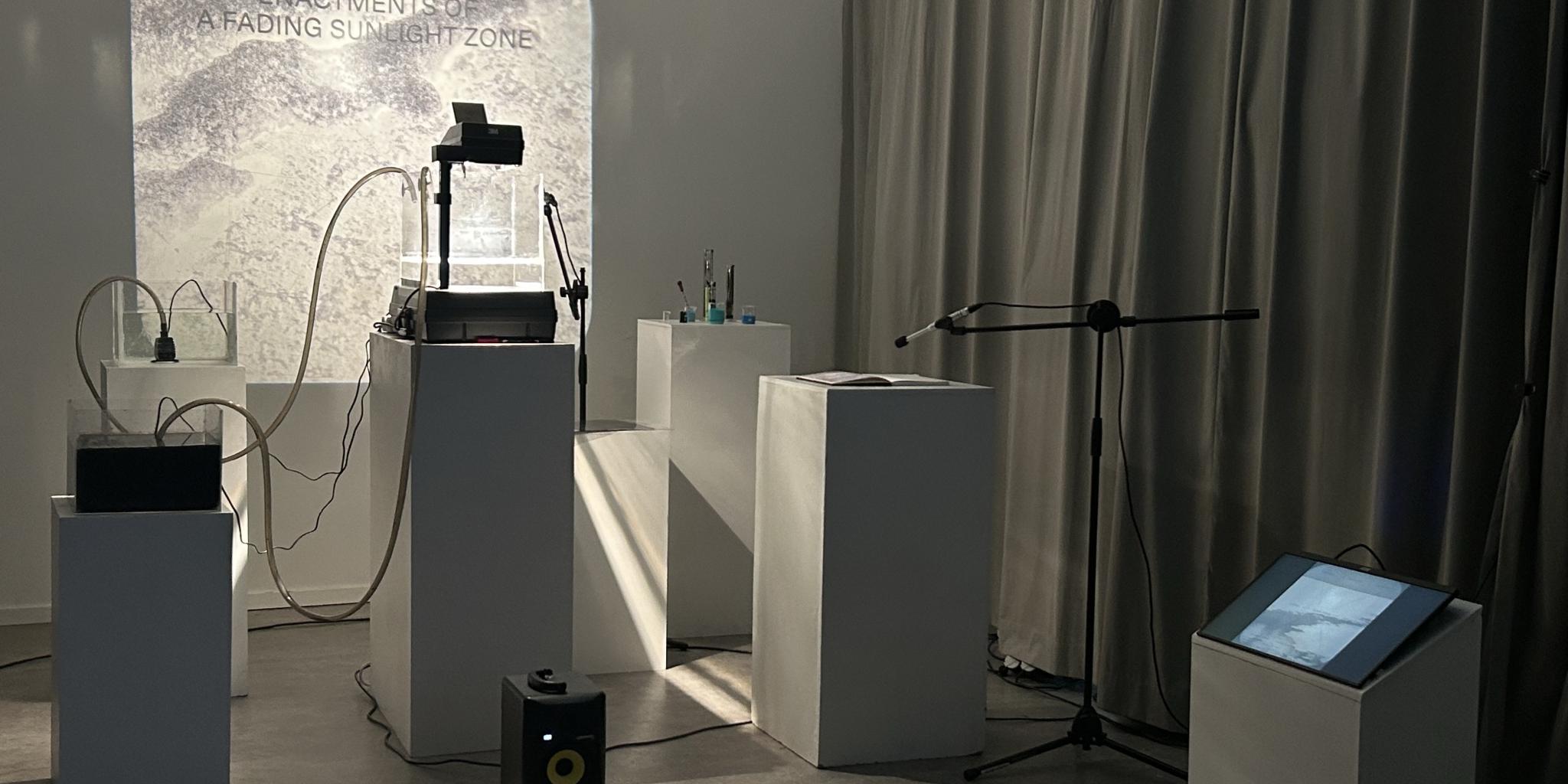
The installation Marina Bignotti made for the Dutch Design Week, based on the process of ocean darkening and inspired by the research of NIOZ scientist Lara Disselhoff. (photo: Martina Bignotti)
The collaboration between a marine researcher from NIOZ and an artist from Eindhoven culminated in an installation during the Dutch Design Week. In her work, artist Martina Bignotti tells the story of ocean darkening: how human activity is causing seawater to become increasingly darker — and where that is leading.
Second-year PhD candidate at NIOZ Lara Disselhoff studies the impact of microscopic particles floating in seawater on phytoplankton in the North Sea. Disselhoff: “The more suspended matter such as organic debris, loose grains of sand and clay and even phytoplankton itself, the less light can penetrate the water. As plant cells need light to grow, blocking sunlight generally means less phytoplankton in the water, but at the same time it leads to more free nutrients that fuel phytoplankton growth.”
Increasing human activity
A primary cause of suspended matter in seawater is the churning of the seafloor, originally driven by natural factors like the daily action of the tides, and storms. “In the Dutch part of the North Sea, the distance from the coast has always been one of the key factors determining the particle load and, consequently, the light restriction”, says Disselhoff.
But that has changed in recent decades. Disselhoff: “There is increasing human activity in the sea. Think of dredging, mining, and structures such as wind turbines being built at sea. As a result, more and more particles are blocking the light, causing the water in parts of the North Sea to grow increasingly darker.”
This phenomenon is called ocean darkening. Last year, it was reported that one-fifth of the world’s ocean water has become darker
Opens in a new tab over the past two decades. This poses a serious threat to ocean life.Catastrophic and yet unknown
The topic caught the attention of Martina Bignotti, a student at the Design Academy in Eindhoven. “In my master’s program in Information Design, we focus on exploring and questioning the production and dissemination of information. Following my personal interests, I mostly explored tools to visualize scientific events, from more traditional cartography to exhibition formats.”
“What really fascinates me about ocean darkening is that it’s actually so catastrophic, yet unknown to the general public. For me, it’s not just about science, but also about how we as humans think about the ocean and what we don’t yet know. I wanted to make that visible through an artistic visualization.”
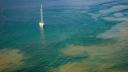
Phytoplankton bloom, visible from the sky (photo: Pexels/Arina Dmitrieva)
“What really fascinates me about ocean darkening is that it’s actually so catastrophic, yet unknown to the general public. For me, it’s not just about science, but also about how we as humans think about the ocean and what we don’t yet know. I wanted to make that visible through an artistic visualization.”
Bignotti contacted the NIOZ and visited Texel. Lara Disselhoff showed her how they measure the size and presence of particles aboard vessels and analyse the composition in the lab. Bignotti: “It was fascinating to see that what I’ve been researching through papers, articles and books, was actually physically studied at NIOZ. I now understood that the phenomenon was way more complex than I’d thought. As an artist, I should visualise and give voice to this complexity through metaphors and artistic representations. This would make it easier for the audience to connect to the topic, sice still many people don’t know about it and don’t know how it is affecting us, humans.”
Artistic contrast
Bignotti set to work on this. “The presentation has become a combination of a performance and an exhibition,” she explains. “Using an overhead projector, I simulate the process of ocean darkening. It starts with a tank of clean water. During the presentation, I add a dark liquid from another container. The light from the projector lets you see how the two mix and the water gradually darkens. Meanwhile, I tell the story of ocean darkening.” The result is truly intriguing: the beautiful and almost soothing image of fluid flow, combined with an increasingly disturbing story about human destruction. Together, they form an artistic contrast
Marine researcher Lara Disselhoff is impressed with the results. “What makes the news are mainly the Big Issues, such as climate change and sea-level rise. No one is really impressed by the dirt floating around in the water. Yet marine organisms are dying because the primary producers are no longer getting any light. I think it’s good that we’re using the North Sea, especially for renewable energy. But let’s use it responsibly. Think about the consequences and involve scientists.”
In total, the presentation will last about 15 minutes. During the Dutch Design Week, Martina Bignotti will perform once a day. But for those who can’t make it in person, don’t worry: “I’m working on a video-essay of the presentation, which will by the way also be shown at the NIOZ Open Day on Texel on the 3rd of October.
Linked staff
Lara Disselhoff
PhD student

NIOZ Open Day
Visit the NIOZ Open Day on Texel on 3 October
Deep sea experiences at the NIOZ Open Day (Photo: Evalien Weterings)