Patchwork pattern makes ecosystems as strong as steel
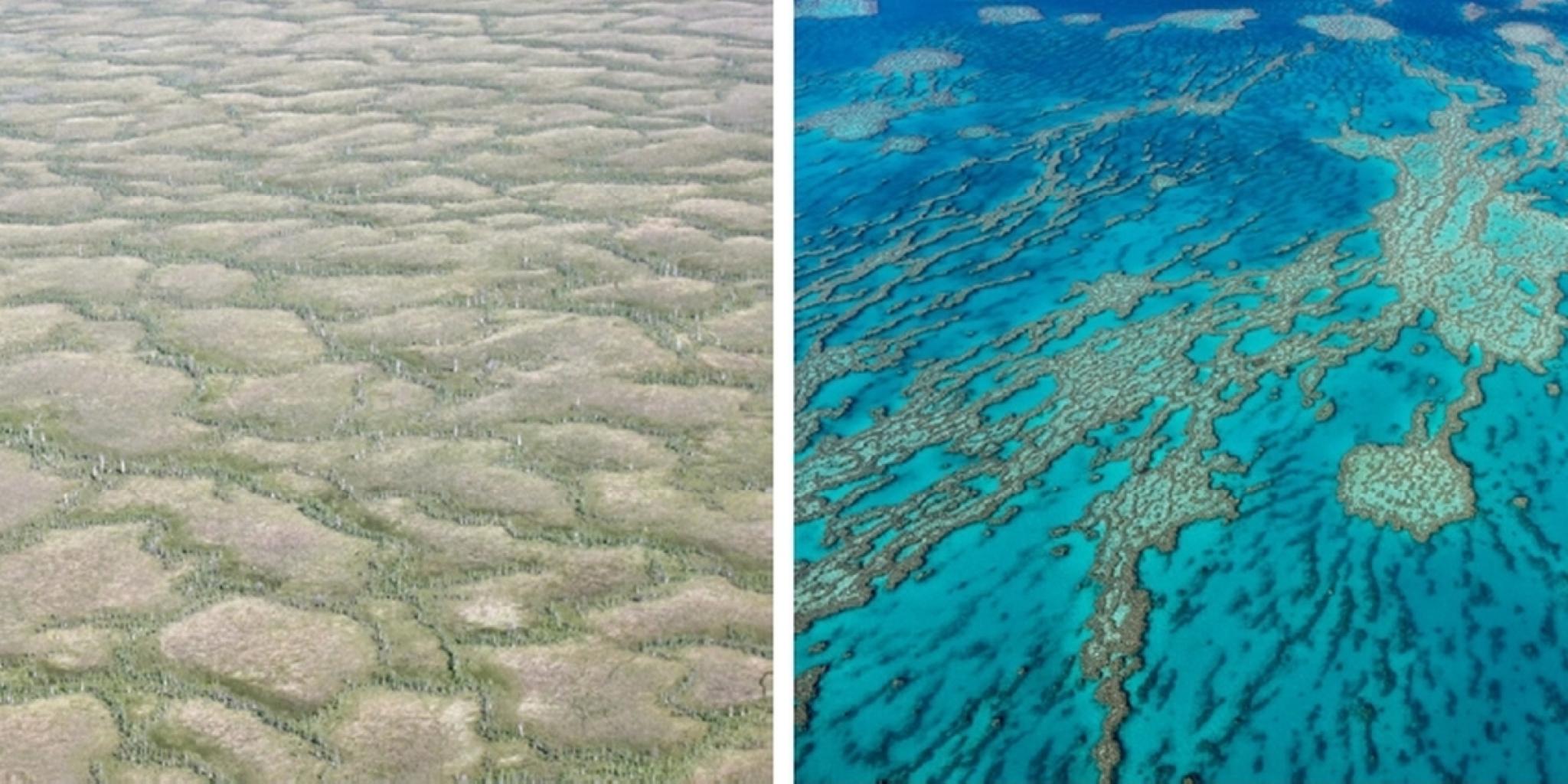
Two images side by side: patterns in shallow sediment on the left and an aerial view of a reef structure in clear blue water on the right.
What makes ecosystems resilient to climate change? A solid spatial structure. Researchers discovered a type of pattern forming in ecosystems that closely resembles the patchwork pattern that forms at very small scales in alloys such as steel. Such patterns do not only make steel sturdy, it makes ecosystems resilient. This insight can help in the management of natural areas. This is according to a study by an international team of ecologists, mathematicians and geoscientists led by NIOZ postdoc Koen Siteur in the leading scientific journal Proceedings of the National Academy of Sciences.

Vegetation patterns in Siberian peatlands and coral reefs. Photos: Maarten Eppinga and Alamy Stock Photo.
"We started with a model for patterns in seagrass beds," said Johan van de Koppel, professor of spatial ecology at the University of Groningen and working at NIOZ in Yerseke. "We modeled the emergence of patterns in seagrasses by describing the uptake of nutrients and sediment in seagrass vegetation. After all, concentration of nutrients and sediment in seagrass beds are important factors for seagrass growth. And what did we find? We saw that vegetation concentrates in a kind of patchwork pattern.”
From seaside sand dunes to the desert
Van de Koppel: " Soon we came to the conclusion that the model - in principle - could be applicable to a wide range of ecosystems: from nutrient-poor peatlands to grazed outer dike land (salt marshes) such as on Schiermonnikoog, from vegetated sand dunes on our coast to sand dunes in the desert."
Strong as steel
Analyzing the model was not easy. To do so, the researchers brought together an international team of ecologists, mathematicians and geo-environmental scientists. Together, they discovered that the processes of pattern formation in ecosystems that the model predicted gave similar results as the processes that make steel very strong. Steel is a mixture of iron and iron-carbide, among other things. By adding carbon to it in the molten state, both substances mix better and the steel becomes stronger. Patterns of alternating iron and iron carbide are formed during cooling. These patterns are well known - they are the patterns you see on "Valyrian steel," from the Game of Thrones series, or "Damascus steel" in the real world.

Damascus steel. Photo: Jasleen_kaur @Flickr.
What was interesting was that these reinforcing processes also apply to ecosystems: when natural patterning occurs in ecosystems, they are more resistant to change than when this patchwork structure has been disrupted by humans and has gaps.
Looking at nature management differently
The results of this study have important implications for how we manage ecosystems such as estuaries and deltas. Or when we want to repair human damage to ecosystems. Van de Koppel: "Instead of trying to restore every square meter of damaged ecosystem, we need to look at restoration on a much larger scale. We shouldn't be looking at separate dunes or seagrass beds. But with these new insights, we can better identify which places in an ecosystem make more sense to restore than others."

Dunes on Ameland and nebkhas near M'hamid, Morocco. Photos Bas Arens and Koen Siteur.
Linked staff
Johan van de Koppel
Research Leader

Tjisse van der Heide
Senior Research Leader

render2 plant density.png
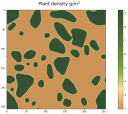
Computer renders derived from the developed model. Image: Johan van de Koppel.