Part II of the NIOZ 150 Colloquium Series: defining seascape connectivity to reimagine nature restoration ambitions with Prof. Joanne Preston
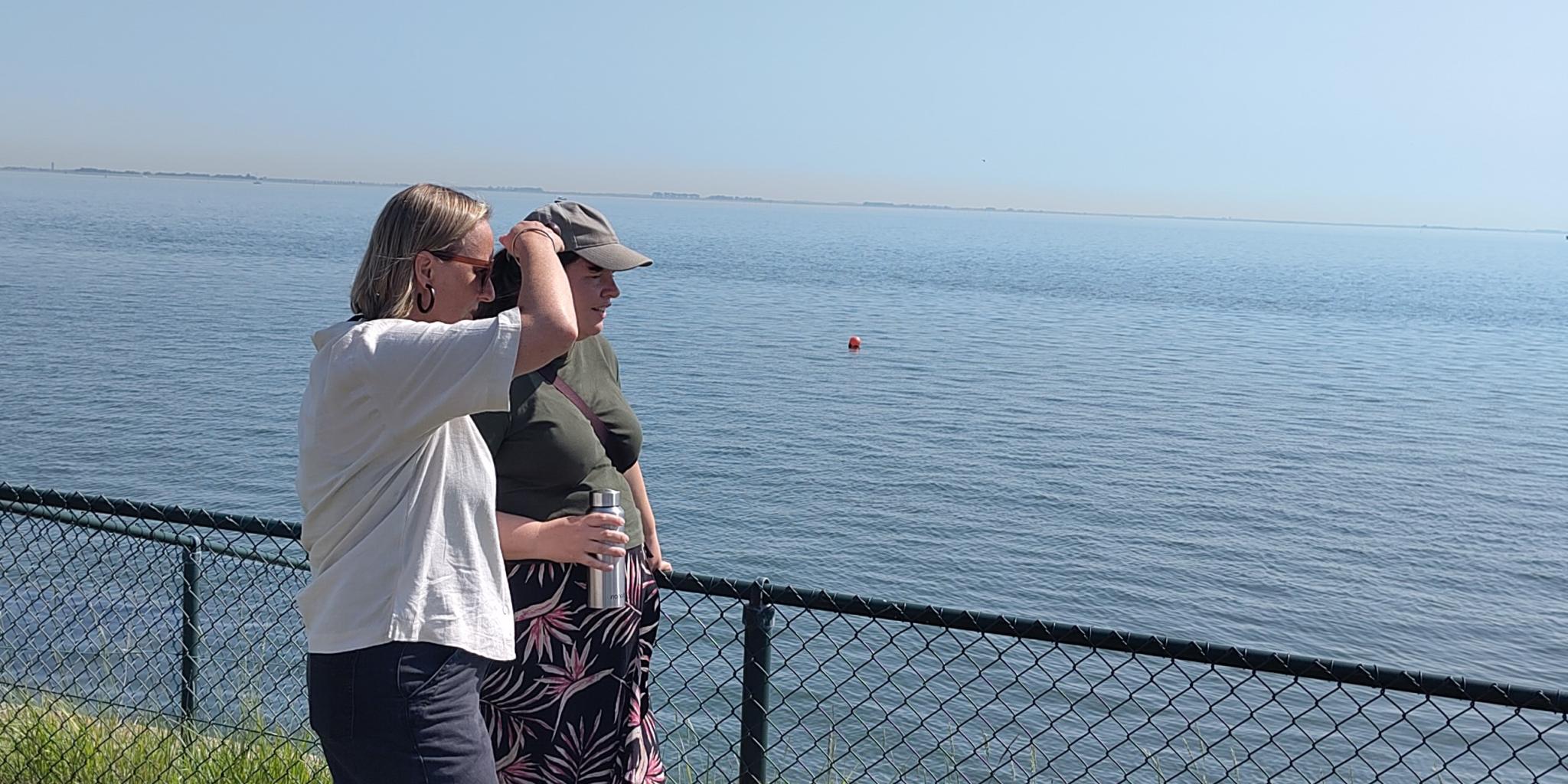
Professor Joanne Preston overlooking Easter Scheldt at NIOZ Yerseke
As part of a special lecture series for the 150th anniversary celebration, NIOZ organized a Colloquium on the 24th of June in Yerseke. This time around, Prof. Joanne Preston was the keynote speaker, a leading expert in coastal restoration ecology, based at the Institute of Marine Sciences, University of Portsmouth (UK).
Professor Preston is widely recognized within the marine science community and is one of the founders of the Native Oyster Network. Through her research and numerous scientific publications, she has contributed significantly to advancing knowledge on marine habitat restoration and biodiversity conservation.
Site visit ongoing projects
In the morning, we started with a tour of our research facilities and experiments, including ongoing projects focused on oyster beds, restoration and seaweed ecosystems, followed by a visit to NIOZ to learn more about our marine research activities.The day continued with Professor Peston’s lecture. Her inspiring talk explored the marine ecosystem shift occurring in the North Sea since the nineteenth century, where native oyster populations have seen a decline due to overexploitation and environmental pressures. This decline has led to the loss of extensive oyster reef ecosystems.
Why oyster reef restoration matters
A central theme of the talk was the ongoing degradation of biogenic coastal ecosystems and the urgent need for their restoration. Oyster reefs were highlighted as a priority habitat due to their ecological importance and their ability to improve the resilience of coastal environments.
Professor Preston also demonstrated how science is increasingly being translated into practical restoration efforts and policy initiatives. She discussed recent developments such as the European Nature Restoration Regulation and the UK's Environmental Improvement Plan 2025. In addition, she presented shellfish reef restoration suitability modelling, a tool used to assess the feasibility of restoration projects and identify priority locations where restoration efforts are likely to be most successful.
The colloquium provided an inspiring example of how scientific research can guide real-world conservation action. Combining ecological knowledge, restoration practice, and policy development, Professor Preston illustrated how the recovery of oyster reefs can contribute to healthier, more resilient coastal ecosystems for future generations.
NIOZ colleagues sharing about their research in this field
The programme continued with presentations on ecosystem restoration research conducted by NIOZ PhD and postdoctoral researchers, including Helene Bouras, Patrick Kut, and Conor Hunter.
Helene talked about how seagrass can benefit from oyster framing. The second speaker, Patrick Kut, a PhD researcher, talked about his current research, using oyster reef restoration to reduce nitrogen pollution and how we can use Nature-Based Solutions. The third speaker was Conor Hunter, talking about restoring tidal flats effects of drainage of soil formation.
The colloquium concluded with a networking session. This offered attendees the opportunity to meet and connect with Professor Preston and fellow researchers. The event provided an inspiring and insightful overview of contemporary oyster reef restoration efforts and the broader challenges of coastal ecosystem recovery. We would like to thank Professor Joanne Preston, the NIOZ organizers, and all contributing speakers for making this colloquium such an informative and inspiring event.
Coming up September 3rd: Colloquium part III, with Prof. Stefan Rahmstorf
This colloquium was the second in a series of five. Through these lectures, we aim to stimulate dialogue between disciplines, connect people and ideas, and strengthen the international scientific community surrounding NIOZ. The next lecture will be held on September 3 in Texel. Our guest will be Prof. Stefan Rahmstorf. He is Professor of Physics of the Oceans at the University of Potsdam and a senior scientist at the Potsdam Institute for Climate Impact Research (PIK). His research focuses on ocean circulation, sea-level rise, and abrupt climate change, with particular attention to tipping elements in the Earth system such as the Atlantic Meridional Overturning Circulation. Rahmstorf has contributed extensively to the assessments of the Intergovernmental Panel on Climate Change (IPCC) and is widely recognized for communicating climate science to both the scientific community and the public. You can register for attendance via the link below.
Linked staff
Rebecca Büring
PhD student

Brenda Walles
Senior Scientist

Hélène Bouras
Postdoc

Patrick Kut
PhD student
Conor Hunter
PhD student