NWO Open Technology Programme funds research on landscape restoration with biodegradable structures
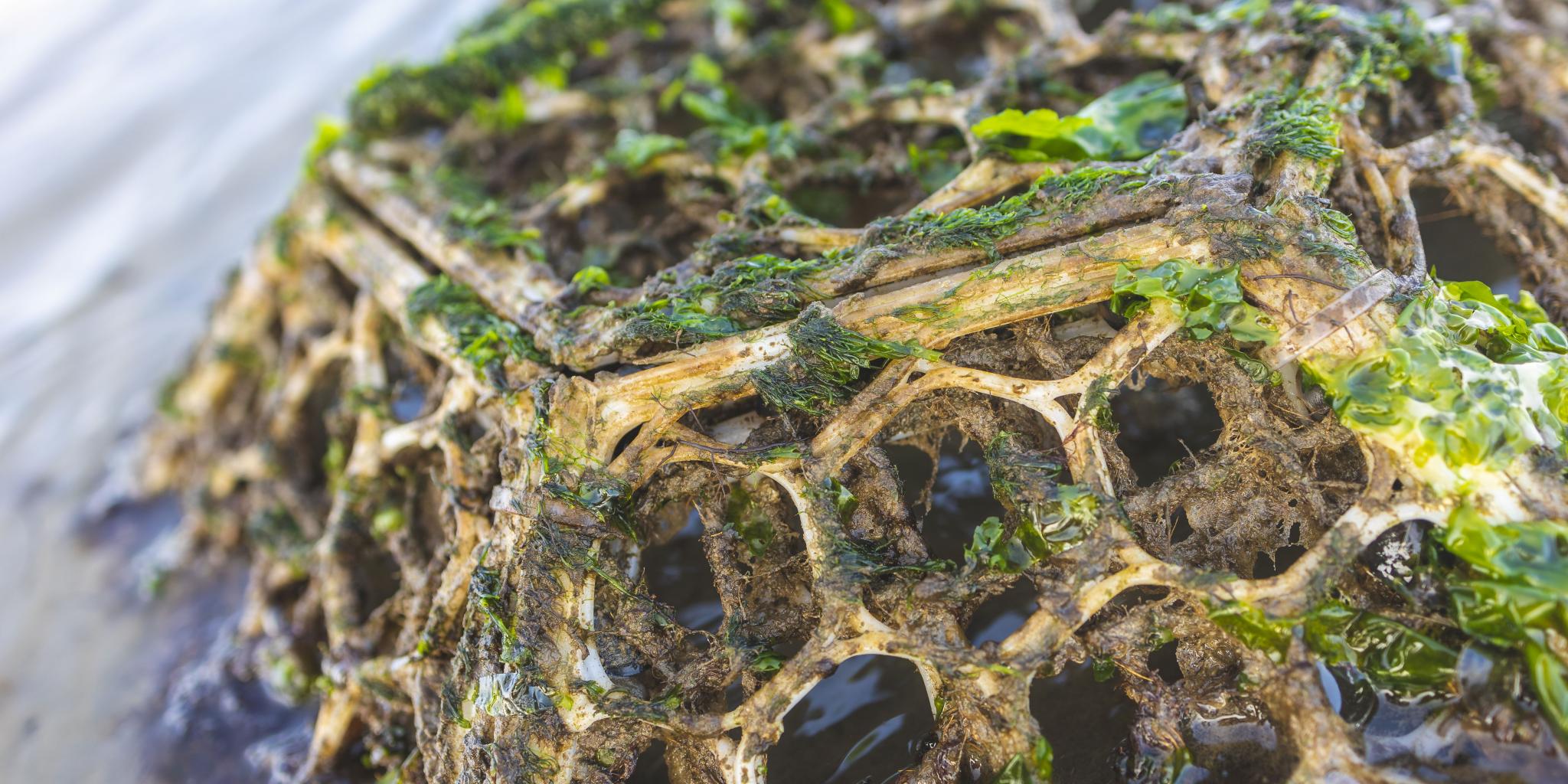
An artifical reef structure, which was 3D-printed from biobased materials, is overgrown with weeds after some time in the sea. (photo: Erik Hoekendijk)
Developing biodegradable structures that can restore important coastal ecosystems and peatlands. That is the goal of research project BIOPRIME, by NIOZ researchers Tjisse van der Heide and Tjeerd Bouma and Ralph Temmink of Utrecht University. It is one of six application-oriented projects that received funding from the NWO Open Technology Programme.
Seagrass beds, shellfish reefs, salt marshes as well as high and low moors: they are all formed by so-called biobuilders, which are plants and animals that build entire landscapes by working together. They do this, for example, by inhibiting waves and storing sand, silt and their own remains in the soil.
An artifical reef structure, which was 3D-printed from biobased materials, is overgrown with weeds after some time in the sea. (photo: Erik Hoekendijk)
Recovery is difficult
These landscapes are important for biodiversity, store a lot of CO2, and protect our coasts from flooding. Yet their surface area is declining rapidly worldwide. And restoring them is difficult because these ecosystems only function when enough biobuilders can work together to rebuild the landscape. As a result, large quantities of these plants or shellfish are often needed. This is expensive, as well as a threat to the “donor populations” from which those biobuilders are taken: will there be enough left for a healthy population?
Biodegradable structures as replacements
In the now-funded project BIOPRIME (“Applying Biomimicry to Produce Restoration desIgns for Multiple Ecosystems”), NIOZ researchers Tjeerd Bouma and Tjisse van der Heide are collaborating with Ralph Temmink of Utrecht University. Previous research by the three of them showed that biodegradable structures can mimic the landscape-building properties of cooperating biobuilders, temporarily taking over their role – which is why these structures are called mimics. This could facilitate landscape restoration by reducing the need for biobuilders from elsewhere, and by allowing the biobuilders that are already there to grow undisturbed until they are large enough to resume their role in landscape formation.
Development, testing and large-scale production
So whilst the concept has been proven to work, the currently available mimics are not yet suitable for large-scale application. This is where the BIOPRIME project comes in. The team will develop new species-specific mimics, test them and, if the results are positive, produce them on a large scale so that they can be used for ecosystem restoration. The project will be linked closely to Van der Heide's recently awarded NWO-Vici project, in which numerous new prototype mimics are being developed using 3D printing techniques. Successful prototypes from this project can be produced on a large scale within BIOPRIME to test them on a practical scale and enable rapid deployment. Thus, BIOPRIME will hopefully act as an accelerator for the deployment of biodegradable structures for ecosystem restoration.
About the NWO Open Technology Programme
The Open Technology Programme of the Dutch national science organisation NWO provides funding for application-oriented technical-scientific research that is free and unrestricted and is not hindered by disciplinary boundaries. The programme offers companies and other organizations an accessible way to participate in scientific research that is intended to lead to societal and/or scientific impact. This round of funding from NWO's Applied and Engineering Sciences domain will allow six application-oriented projects to get started. NWO is contributing 5.4 million euros to these application-oriented projects. The industry and other organizations are adding another amount of over 920,000 euros.
Linked staff
Tjisse van der Heide
Senior Research Leader

Tjeerd Bouma
Senior Research Leader
