House of Representatives round-table discussion on the Atlantic Meridional Overturning Circulation (AMOC)
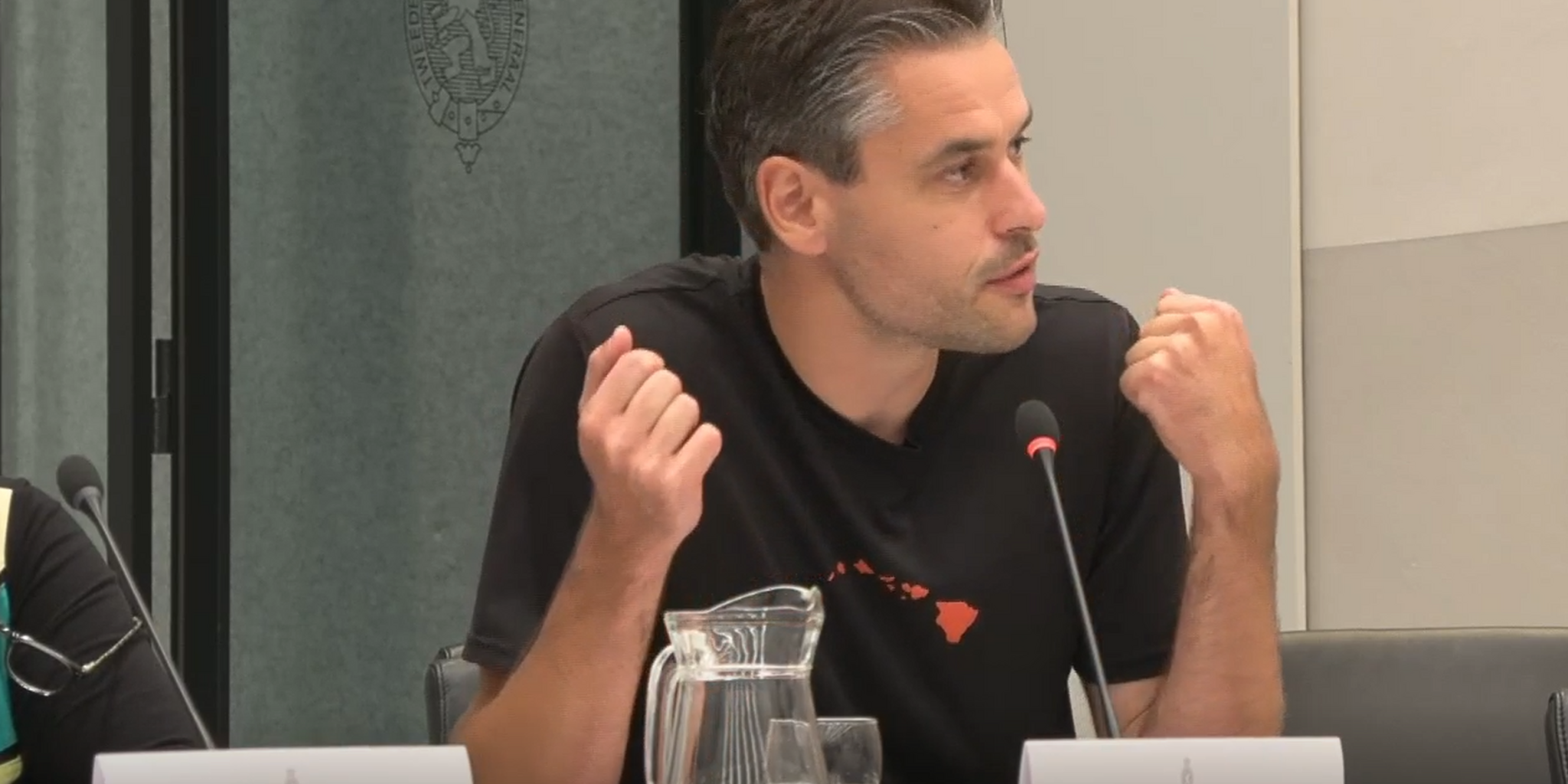
NIOZ oceanographer Sjoerd Groeskamp addresses the Dutch House of Representatives on the accelerating weakening of the Atlantic Meridional Overturning Circulation (AMOC) (photo: Debat Direct)
On 23 September, a round-table discussion took place in the House of Representatives on the accelerated weakening of the Atlantic Meridional Overturning Circulation (AMOC). Physical oceanographer Dr Sjoerd Groeskamp and AMOC-researcher Dr Femke de Jong of NIOZ explained why this is a matter of social and economic importance for the Netherlands, and what is needed to continue monitoring the AMOC, so that we know what to expect.
Below is the automatically translated text of the position paper that Members of the Dutch House of Representatives received in advance.
NIOZ oceanographer Sjoerd Groeskamp explains the importance of research into the Atlantic Meridional Overturning Circulation (AMOC) (photo: Dutch House of Representatives)
Dear members of the ‘Standing Committee on Climate Policy and Green Growth,’
The AMOC acts as Europe’s underfloor heating system
Opens in a new tab, something Canada, for example, does not have. The AMOC is the combined effect of many different ocean currents that together transport warm, salt water from south to north. There, the water releases its heat into the atmosphere. The prevailing westerly winds carry some of this heat towards Europe, contributing to our mild climate, in comparison with Canada at the same latitude. The cooled water sinks into the deep ocean and flows southwards again.When the AMOC weakens, less heat is transported northwards. The “underfloor heating” is “turned down” and Europe cools. Depending on the extent and speed of the weakening, the climate can change significantly within a short period, both globally and particularly in Europe. These changes may occur so rapidly that they have disruptive economic and societal consequences, affecting areas such as the economy, food security (through agriculture and fisheries), coastal protection, geopolitical relations, infrastructure, trade, energy security, maritime security and defence. The consequences for biogeochemistry and marine ecosystems also require attention.
How well prepared is the Netherlands for an accelerated weakening of the Atlantic Meridional Overturning Circulation (AMOC)?
KNMI, NIOZ and Deltares are conducting exploratory studies to assess these impacts.¹ There is not yet a clear picture of the precise consequences for the economy and society, nor is there a plan for preparing for those consequences. There is also no early-warning system. The Netherlands is therefore not prepared.
What are the possible consequences of an accelerated weakening of the Atlantic Meridional Overturning Circulation (AMOC) for the Netherlands?
The consequences depend on the extent of global warming and scale with the weakening of the AMOC: the stronger or faster the decline, the greater the consequences. With a rapidly weakening AMOC, the Netherlands could cool substantially within 50–100 years, with extremely cold
Opens in a new tab winter days compared with todayOpens in a new tab. Sea ice may form in the North Sea during winter. Sea level along the North Sea coast could rise by an additional 50 centimetres during that period and by up to one metre thereafter. Greater temperature differences between northern and southern Europe would lead to more storms and larger temperature fluctuations. We also expect more drought.To what extent are government bodies taking the accelerated weakening of the Atlantic Meridional Overturning Circulation (AMOC) into account?
As far as we know, the Netherlands has no national, interdepartmental programme for the AMOC or for ocean issues more broadly. Consequently, recognising the risks, investigating the consequences and preparing for the possible effects are still in their infancy. The Dutch reports published so far are mainly initial exploratory studies. The international climate report
Opens in a new tab, to which the Netherlands is contributing, will be published in March 2027.What would be the climatic consequences of an accelerated weakening of the Atlantic Meridional Overturning Circulation (AMOC)?
More heat would remain in the Southern Hemisphere, while northern Europe would become colder. This would increase the temperature contrast and drastically alter the weather in both regions. There would be major shifts in the areas experiencing rainfall or drought. The location and intensity of storms may also change. A weakening of the AMOC would also cause additional sea-level rise around the North Atlantic Ocean and could reduce
Opens in a new tab the ocean’s uptake of CO₂.What are the most recent conclusions about the weakening of the Atlantic Meridional Overturning Circulation (AMOC)?
Our knowledge of the AMOC is based on the laws of physics, observations, historical reconstructions and climate models. Based on this evidence, we can say with a high degree of confidence that climate change will weaken the AMOC. Conversely, if we emit fewer greenhouse gases, the weakening is also likely to be less severe.
There is also a high degree of confidence that internal feedback mechanisms can cause an AMOC weakening to develop into an AMOC collapse. By collapse, we mean a weakening of at least 80% within 50–100 years
Opens in a new tab. There is, however, considerable uncertainty about whether and when a tipping point towards collapse will be reached. Recent studiesOpens in a new tab indicate that this tipping point may be closer than previously thought, with a possibility that it could be reached this century.The uncertainty surrounding the precise weakening is partly due to the different factors that influence the AMOC, including meltwater from Greenland, precipitation patterns, heat exchange with the atmosphere, wind patterns, sea ice, and large-scale temperature and salinity gradients. These factors have different effects and can reinforce or weaken one another.
In particular, the limited observations of these processes and of the AMOC itself make it difficult to reduce these uncertainties. Models and historical reconstructions can only be verified and calibrated to a limited extent, leaving uncertainty about which model predicts the future most accurately. In addition to this scientific uncertainty, uncertainty about future greenhouse-gas emissions greatly increases the overall uncertainty. Together, these factors lead to differences in the predicted weakening of the AMOC. Because the observational time series are too short and reconstructions remain uncertain, we are currently unable either to confirm or rule out whether the AMOC has already weakened as a result of climate change.
Advice for the Netherlands
By combining long-term monitoring, targeted observations, reconstructions and climate models, we can reduce the uncertainty in projections of the weakening or possible shutdown of the AMOC. The Netherlands cannot do this alone. The following improvements are therefore necessary:
1. Establish a national Ocean Coordination Centre, with the AMOC as one of its areas of responsibility.
It is of fundamental strategic importance for the Netherlands to anticipate changes in the ocean and the AMOC. However, the ocean and the AMOC are too vast for the Netherlands to monitor and study alone. The Netherlands therefore depends on international cooperation in ocean research and monitoring.
With its knowledge, long-term datasets, research vessels and marine technology, the Netherlands can contribute to OceanEye
Opens in a new tab. Through this initiative, the EU aims to expand its ocean-observation capacity and reduce its dependence on other countries, particularly the United States.To speak with one voice internationally, the Netherlands needs a national Ocean Coordination Centre that connects the relevant ministries and represents Dutch interests. These should include, at a minimum, the ministries of Education, Culture and Science; Agriculture, Fisheries, Food Security and Nature; Infrastructure and Water Management; Economic Affairs; Justice and Security; Defence; and Foreign Affairs.
2. Provide permanent funding for AMOC monitoring.
Unlike weather and atmospheric measurements, which are organised on a structural basis, AMOC measurements are obtained
Opens in a new tab through short-term, competitive research funding secured by individual scientists in different countries. This method of organisation and funding is under severe pressure and highly uncertain.Moreover, the United States’ contribution, which currently accounts for more than 50% of the observations, will be halved, making the current system of AMOC monitoring impossible to maintain. AMOC observations are urgent and of essential strategic, economic and societal importance. They should therefore receive structural funding as essential permanent infrastructure.
The Netherlands must first put its own contribution on a firm footing and then negotiate internationally to ensure that other countries contribute as well. Only through international cooperation can the observation network across the entire Atlantic Ocean be maintained.
3. Establish a national AMOC research programme.
Through observations and research, NIOZ has been a leading international institute in AMOC research since the 1990s. KNMI, Delft University of Technology and Utrecht University also conduct internationally leading AMOC research. Together with Deltares, the Netherlands has the expertise required to connect observations with projections and research into the consequences, allowing the AMOC to be studied as an integrated system. Combined with international cooperation, this can help the Netherlands prepare more effectively for the consequences of changes in the AMOC.
Dr Sjoerd Groeskamp and Dr Femke de Jong, Senior Scientists, Royal Netherlands Institute for Sea Research (NIOZ)
¹ The Ministry of Infrastructure and Water Management will share the findings with the House of Representatives in a letter before the end of the year.
Linked staff
Sjoerd Groeskamp
Senior Scientist

Femke de Jong
Senior Scientist

Roundtable discussion on the weakening of the AMOC
On the accelerating weakening of the Atlantic Meridional Overturning Circulation (AMOC), featuring NIOZ oceanographer Sjoerd Groeskamp.
NIOZ oceanographer Sjoerd Groeskamp addresses the Dutch House of Representatives on the accelerating weakening of the Atlantic Meridional Overturning Circulation (AMOC) (photo: Debat Direct)
Podcast ''De Noord-Atlantische Oceaan: een riskant klimaatexperiment''
With AMOC specialist Dr Femke de Jong

NIOZ oceanographer Femke de Jong discusses the North Atlantic Ocean and the risky climate experiment unfolding there in the podcast Van Delta tot Diepzee (photo: Anneke Hymmen)