From bottom trawling to melting polar ice: Emil De Borger refines our understanding of the effects on food webs
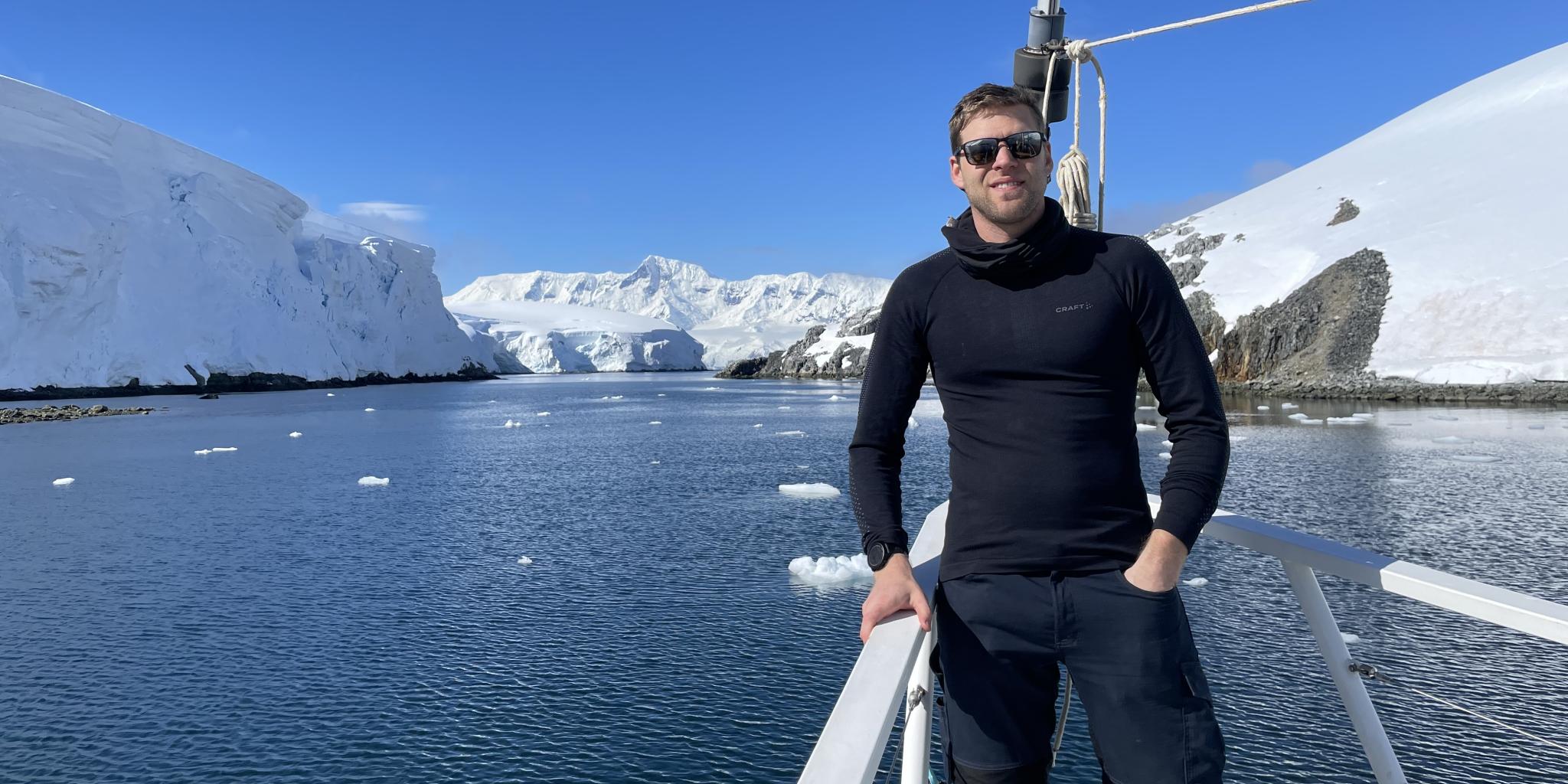
Emil de Borger during earlier field work (Photo: Emil de Borger)
The seabed is severely disrupted when bottom trawlers pass by. But how much CO2 is released in the process? Estimates vary. Just as they do regarding shifts in food webs in polar regions as the ice there melts. Biogeochemist Emil De Borger is working on measurements that will enable models to better predict these kinds of effects. As a new senior researcher at NIOZ, he hopes to make significant progress in this area.
An incredible number of processes determine the effects of changes in the seabed. Emil De Borger, who started in March 2026 as a Tenure track scientist at the Estuarine and Delta Systems department in Yerseke: ‘A lot of dead material ends up on the seabed. Animals and bacteria recycle the nutrients contained within it, after which these are available again for a new cycle. How that works has already been fairly well studied. But it is also important to know exactly how quickly that happens under different conditions.’
Better predictions
The more knowledge of this kind we have, the better researchers can predict what will happen with certain changes. Whether it’s a wind farm, the sea, or melting polar ice due to climate change – the effects are predicted using models. ‘In a model, you always make assumptions. Through experiments and field measurements, we can confirm those assumptions and thus strengthen the model.’
A recent example is bottom trawling, where fishermen severely disturb the seabed with trawl nets. De Borger: ‘It is said that a lot of extra CO2 is released due to this continuous disturbance. But the estimates of that amount produced by models vary widely.’ The researcher wants to go on an expedition to bring up samples of the seabed to measure all sorts of things in them. ‘And in climate chambers, we can conduct experiments where we artificially disturb sediments and measure the consequences. Do substances degrade differently or more quickly in disturbed sediment? The NIOZ offers plenty of opportunities to carry out such work.’
On expedition
De Borger is well acquainted with the NIOZ’s capabilities, having previously worked here for two years as a postdoctoral researcher on similar studies, such as the effects of wind farms. He also worked at Ghent University, where he studied. He sailed on the research vessel RV Pelagia, for example in the North Sea. ‘Wind turbines alter the hydrodynamics, and different substrates become available from which mussels and anemones can benefit. That has effects on the entire food web, right down to the fish we eat.’
Positive effects, surely? ‘It seems so, but if you compare it to a poor heathland area on land: that has great value in itself. There are species found nowhere else. But then you plant trees there and say: “Look, biodiversity has increased.” So yes certain metrics improve, but you’ve actually created a different system, so it depends what you want to achieve.’
The fjords of Greenland
Something similar may be happening in the polar regions. In the fjords of Greenland and Antarctica, De Borger is investigating the effects of rising temperatures. ‘We assume that as it gets warmer, there will be less ice to block light from reaching the marine life below. It will also get slightly warmer, so we generally expect a more productive system with increased algal growth. The rest of the ecosystem will also respond to this, and more carbon will be sequestered. But how much organic material will end up on the seabed? And which species will disappear because they had actually adapted to living with scarce resources?’
Apart from the measurements themselves, De Borger also wants to work on better measurement techniques. ‘How do you measure the rate of a particular conversion, for example.’ Plenty of questions and possibilities for De Borger to explore further.
Emil de Borger working on samples (photo: Emil de Borger)