Can building on water help combat the housing shortage?
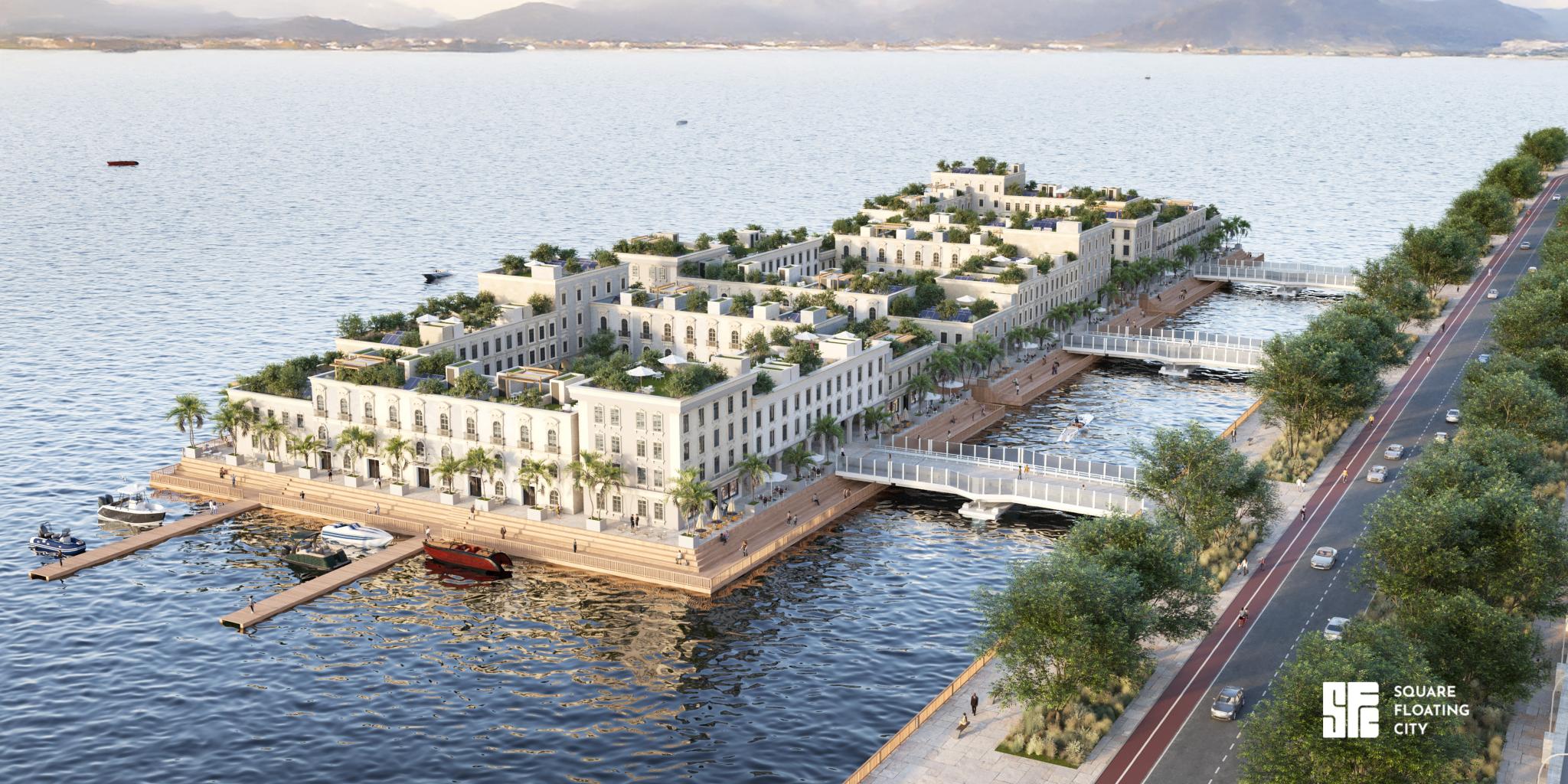
Is floating construction the solution to housing shortage? (image credit: Square Floating City)
The Netherlands urgently needs new homes, while climate change calls for more space for water. Scientists are therefore investigating how building on water can evolve from an innovative niche into a serious addition to housing construction. Researchers from the Faculty of Spatial Sciences, University of Groningen, together with partners from MARIN, NIOZ, and the Blue Revolution Foundation, have mapped out ten crucial questions that need to be answered to make this possible. Their research has been published in the international scientific journal Nature Communications.
The housing shortage presents the Netherlands with a complex spatial puzzle. Large numbers of homes must be built, while available land is scarce and climate change imposes new constraints. Rising sea levels, land subsidence, drought, and heavier rainfall require more space to collect and retain water. Does the solution lie in combining these two challenges?
Floating construction can create space for new homes without the need to reclaim land or lose space for water storage. Moreover, because floating structures can move with changing water levels, this technology offers opportunities to make construction more climate-resilient.
Science as a driver of new housing construction
The Netherlands has experience with houseboats and small-scale floating housing projects. The major scientific challenge now is to make the leap from these small-scale projects to large-scale application: floating neighbourhoods or areas where housing is combined with other functions.
In the Floating Future project
Opens in a new tab researchers are mapping out the knowledge and innovations needed to make that next step possible. In their publication in Nature CommunicationsOpens in a new tab, they identify ten crucial questions for the future of large-scale floating construction. In doing so, the project contributes to a broader search for innovative solutions to societal problems. Science does not simply provide a ready-made solution to the housing crisis, but investigates which new possibilities can be developed in a technically, ecologically, economically, and socially responsible manner.Why aren't we building on water on a massive scale yet?
Technically, floating construction is already possible, but building a complete floating neighbourhood is different from realizing a number of water homes. Where can this be done safely? How do you connect such a neighbourhood to energy, infrastructure, and amenities? What does large-scale development mean for nature and water quality? Who is responsible for the water on which construction takes place? And how do we ensure that floating living does not become available only to people with high incomes?
The ten questions formulated by the researchers fall into three main themes: viability, feasibility, and desirability.
Viability concerns, among other things, suitable locations, potential spatial functions, and sustainable business models. Feasibility revolves around the necessary technical innovations, the ecological consequences, and the way in which floating areas can be designed and organized. Desirability centers on society: how do people want to live there, how should such areas be designed, and how do you prevent new forms of inequality?
Living on water (image credit: Square Floating City)
From IJstad to the Green Heart
The fact that these questions are not merely theoretical is evident from various plans already being studied. For instance, the potential integration of floating homes or neighbourhoods in IJstad, situated between Amsterdam and Almere, is being examined. Floating living is also being investigated as a possible solution for vulnerable peatlands in the Green Heart, and there are plans for a floating multifunctional hub at sea.
The ambition is therefore greater than simply creating a new type of home. Floating construction can ultimately enable a different approach to spatial development: no longer solely attempting to keep water out of our living environment, but investigating where housing and water storage can be combined safely and sustainably.
From experiment to serious solution
It is not yet certain whether floating construction can make a substantial contribution to solving the housing shortage. The ten questions provide a research agenda to determine where floating development is promising, which innovations are still needed, and under what conditions large-scale application is justifiable.
Within Floating Future, the researchers answer these questions using a combination of interdisciplinary, creative, and participatory research and design methods. In doing so, scientists collaborate with societal parties and other stakeholders to make innovations not only technically feasible but also practically applicable and socially responsible.
In short
The Floating Future research project is funded by the Netherlands Organisation for Scientific Research (NWO). The consortium, consisting of more than forty partners, focuses on five case studies in the Netherlands. The case studies investigate the possibilities for scaling up floating living in Amsterdam, Rotterdam, and the Green Heart. In addition, the researchers study the challenges and opportunities of integrating industrial floating structures into the Port of Rotterdam and the possibilities for a floating, multifunctional platform in the North Sea.
Opens in a new tab' was published in Nature Communications in September 2026Linked staff
Tjeerd Bouma
Senior Research Leader

Ten critical questions for scaling up floating developments
Read the full publication in Nature Communications
Living on water (image credit: Square Floating City)