A perfect storm: how an almost disastrous research cruise yielded unexpected new insights
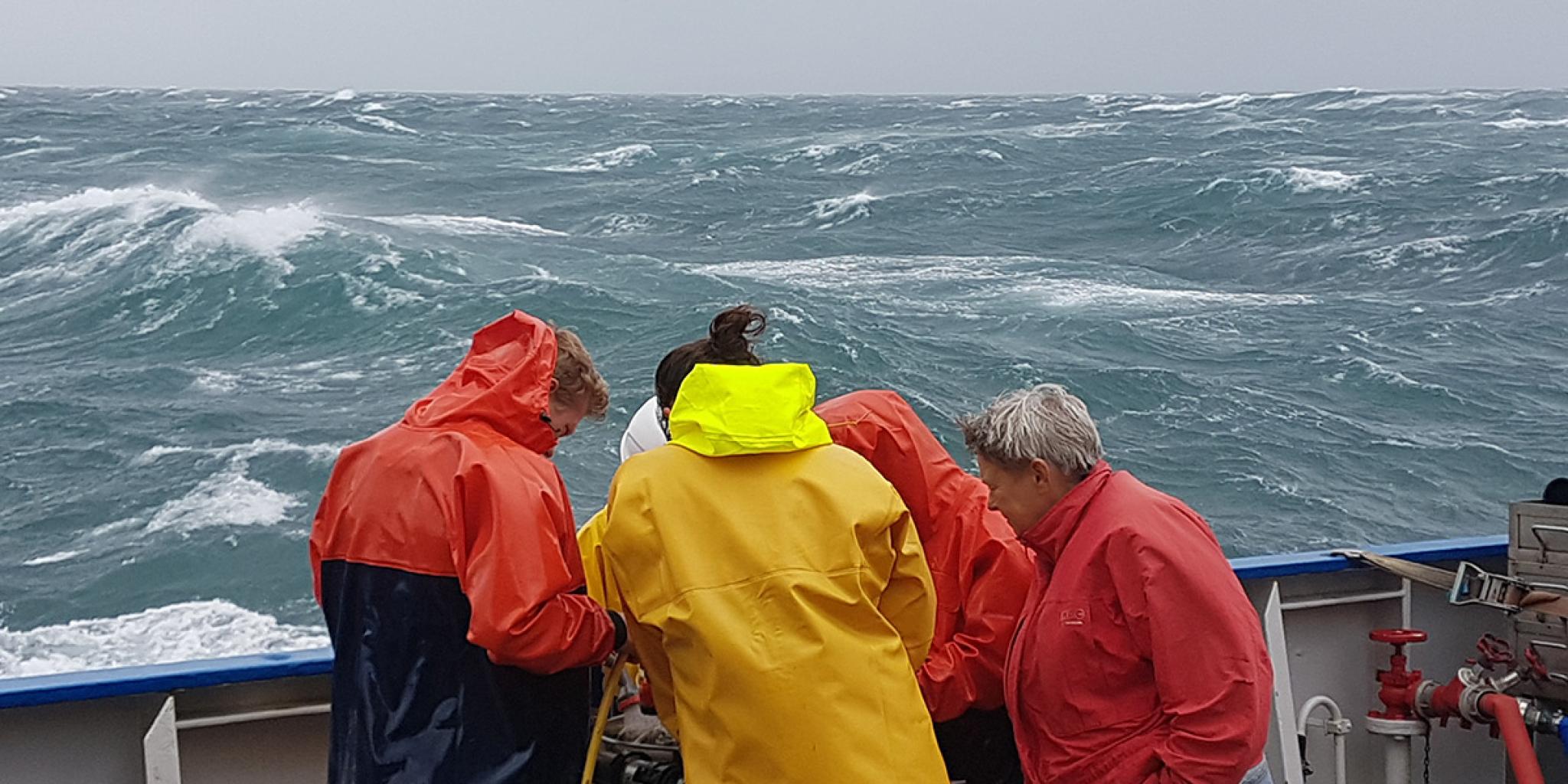
The crew of RV Pelagia working to get the equipment out, before the storm hits. (photo: Justin Tiano/NIOZ)
When a team of scientists on board the research vessel RV Pelagia on the North Sea ran into a violent storm, they feared that all their equipment was lost in the sea and a year of work had been in vain. But the opposite turned out to be true: after considerable effort, they got the devices back on board and discovered that they recorded unique data on the effect of a storm on the seabed. Researcher Justin Tiano shares how a possible disaster turned into a scientific publication.

The crew of RV Pelagia working to get the equipment out, before the storm hits. (photo: Justin Tiano/NIOZ)
“Anxiety gripped the room as we scrutinized the oncoming weather forecast. What had begun as a tranquil and sunny research cruise was quickly evolving into an unexpected summer storm. Alarmingly, the storm was predicted to coincide precisely with the scheduled trawling operations, which were anticipated to yield the most valuable data we sought to collect during the expedition. Almost a year of planning and a large portion of PhD research seemed to be put in jeopardy.
Dangerous conditions
Despite the storm looming, we decided to forge ahead with our field experiments, working in tandem with the skipper of a commercial fishing vessel. This turned into a race against time as all of the work needed to be finished before conditions became too dangerous on deck of the research vessel. We cheered as the last of our equipment, the second benthic lander, was deployed safely. What ensued was almost two days of mother nature’s fury.
Equipment entrenched in the mud
As the storm relented, our focus shifted to retrieving our valuable equipment from the sea. With great effort, the crane on board the vessel was able to lift the first lander from the seafloor. The second lander turned out to be deeply entrenched in mud, and nearly impossible to dig up. In a last-ditch effort, the Pelagia crew devised a bold plan to try and pull the lander out of the seafloor by hooking onto it with a thick metal wire, tilt it sideways to dislodge it from the from the muddy entrapment, and hope it would float to the surface. Anxious anticipation turned into sheer elation when the lander breached the surface.

The first lander being hauled back on board after the storm, missing one of it's feet. (photo: Justin Tiano/NIOZ)
Surprising measurements
Besides some structural damage sustained during the storm and subsequent retrieval, most of the measurement equipment remained intact. Upon inspection of the data, we were surprised to discover that not only had we successfully gathered information from the bottom trawl field experiments, but we had also effectively captured the effects of the storm.
Storm versus trawling
By comparing data on turbidity and oxygen in the water column, we found that sediment resuspension from bottom trawling coincided with declines in water column oxygen. However, the data recorded in the ensuing hours showed that turbidity from the storm quickly surpassed levels recorded during the bottom trawl experiments and eventually reaching an order of magnitude higher. Perhaps one of the most notable findings from our study was the seemingly large effect of the storm on sediment resuspension compared to the bottom trawl disturbance. However, it is crucial interpret these results within a broader context. In short, it means that a storm has a large impact on a wide region of the seabed compared to a single trawler, but that the localized impact from trawling on the seabed can be more substantial.
Unexpected discoveries
Ironically, these findings would not have been possible had we been able to continue with our original plan to retrieve our in-situ equipment shortly after the trawling experiments. What looked like a pending disaster when we saw the storm coming, turned out to be an unexpected and unique opportunity to compare the effects of natural and human forces at play. It is a textbook example of how sometimes in science, unforeseen events can lead to unexpected discoveries.”

One of the landers with some damage to the structure, caused by the storm (photo: Justin Tiano/NIOZ)
Portrait of Justin Tiano

Portrait of Justin Tiano looking at sediment. (photo: Justin Tiano)