The last NIOZ cruise of RV Pelagia
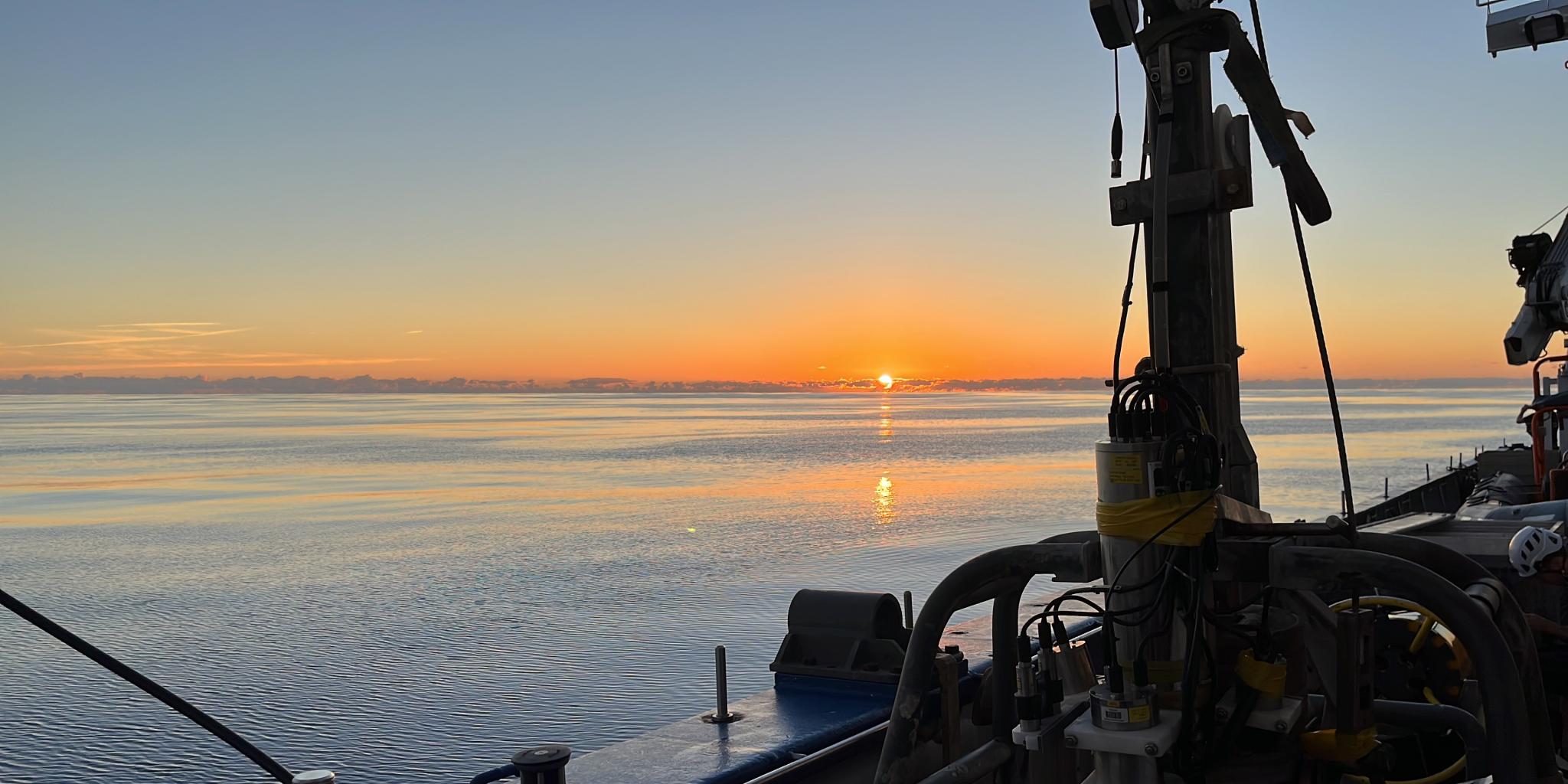
Sunset from the RV Pelagia (Photo: Helge Niemann)
Every expedition begins with anticipation, uncertainty, and a touch of chaos—and ours is no different. Aboard the RV Pelagia, we set out into the North Sea for two weeks of research that blends science with improvisation, routine with discovery. But this voyage is unlike any other. After more than three decades of service, the Pelagia embarks on her final journey, carrying not just instruments and data loggers, but decades of memories, breakthroughs, and stories etched into her steel decks. This blog follows that last expedition: the challenges we face, the science we pursue, and the farewell to a ship that has been both a tool and a home for generations of oceanographers.
29 September 2025 - Written by Helge Niemann (NIOZ)
The first days of our expedition have passed in a blur aboard the RV Pelagia. For the next two weeks, she is our home while we work in the North Sea. We are not the first science crew - far from it. For more than 30 years Pelagia has been the flagship of the Dutch research fleet, carrying countless scientists and being central to many discoveries and breakthroughs.
But this is her final voyage.
We started with a few technical headaches. Winches, hydraulics, instruments meant to measure autonomously at the seafloor - things did not always go as planned. They never do. An expedition is never just science out of the box, it is also improvisation at sea, in conditions where gear will eventually fail. The ship’s crew and our engineers pulled together, solved the problems, and got us moving again. That is how expeditions work: nothing runs perfectly, and progress depends on teamwork - more than on technology.
Our mission? Energy. Methane, to be precise. Large amounts of methane are buried in deep sediment layers of the North Sea and thousands of platforms exploit this gas. But nothing lasts forever: Once a reservoir is no longer viable, the boreholes are sealed. Yet recent findings suggest some of these old wells leak. This raises concerns, as methane is a potent greenhouse gas. At these abandoned wells, we measure whether they leak, how much methane escapes to the water column, and how much is consumed by microbes before it reaches the atmosphere.
For the coming two weeks, Pelagia will do what she always did best: bring scientists to sea, despite problems, despite weather, and make science happen. She has been my working home on seven expeditions across the Atlantic Ocean. I know her working deck, her labs, her bridge… The ship carries many of my scientific memories and leaving Pelagia behind feels a bit like losing a home.
For me, it is an honour to guide this last expedition of Pelagia as cruise leader. But every ending carries the seed of a beginning. Pelagia’s successor, the RV Anna Weber-van Bosse, is in the final stages of construction and will enter service next spring. I will leave Pelagia with one eye crying and the other laughing: farewell to a ship that carried us well, and forward to a new home at sea.
RV Pelagia leaving Texel
30 September 2025 - Written by Rosanne Huybens (TNO)
The day before we leave for the North Sea again, I see some familiar faces on the Pelagia. The people belonging to the faces are crew members that joined the previous Methane Expedition in 2024. They, and some others that make this last journey possible, have been a trustworthy crew that cared for the ship and the people and science on it. Now that I have been living with them for more than a week in a somewhat confined space, I notice that they are breathing the story of Pelagia. Countless expeditions have taken place in corners of all the world, and the stories are there to match. You will not quickly meet a sailor that won’t be able to fill a silent moment - whether all stories are true down to the last word? Perhaps that is up for debate.

Rosanne on deck (left) and in the galley (right)
So North Sea again. This time we shift our focus from shallow methane leakage to deep(er) sources. Most ‘conventional’ gas fields in the Dutch North Sea have a depth of roughly three kilometer, and many wells were drilled to explore and produce these fields. Previously, we found that some shallow gas wells were indeed leaking and our quest for this expedition is to investigate if this also applies to deeper gas wells. For Earth’s climate, it would be best if it doesn’t, as there are many more ‘deep’ wells (~2085) compared to ‘shallow’ wells (~55) in the offshore Netherlands. Luckily our Mining Law is very strict, requiring to seal a well when it’s not used anymore - so my hopes are up. Although less bubbles makes for a more boring trip.
Life at sea is different. I know that from last year, but this time I have encountered a new situation where this becomes even more obvious: When you tell the crew that one of your hobbies is baking, you have some free time on your hands, there are two birthdays and have a willing Cook… then you are bound to end up in the kitchen. Rosanne: win, all crew: win, ‘feestvarkens’: win. So, it starts with politely asking if the Cook is willing to share his holy ground with you. Next, you need to plan when you can do the galley-take-over, because you should not be in the way of regular cooking activities. Then, make sure that you have all the ingredients, such as flour, eggs, butter, lemon and poppy seeds. But make sure that there is enough left for next day’s breakfast and also check that no one has a poppy allergy. Work your way through the recipe, using unfamiliar tools and a professional oven. In the end, it is worth it: all people around you indulge in a sweet treat of lemon poppyseed cake. Mission accomplished!
Let’s see how accomplished our mission will be in eight days, after quite some heavy weather that is coming our way.
Follow updates
The RV Pelagia sailing off
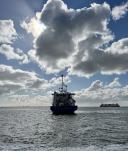
The RV Pelagia sailing off (Photo: Wim Jan Boon)