Shrimp sampling 2024
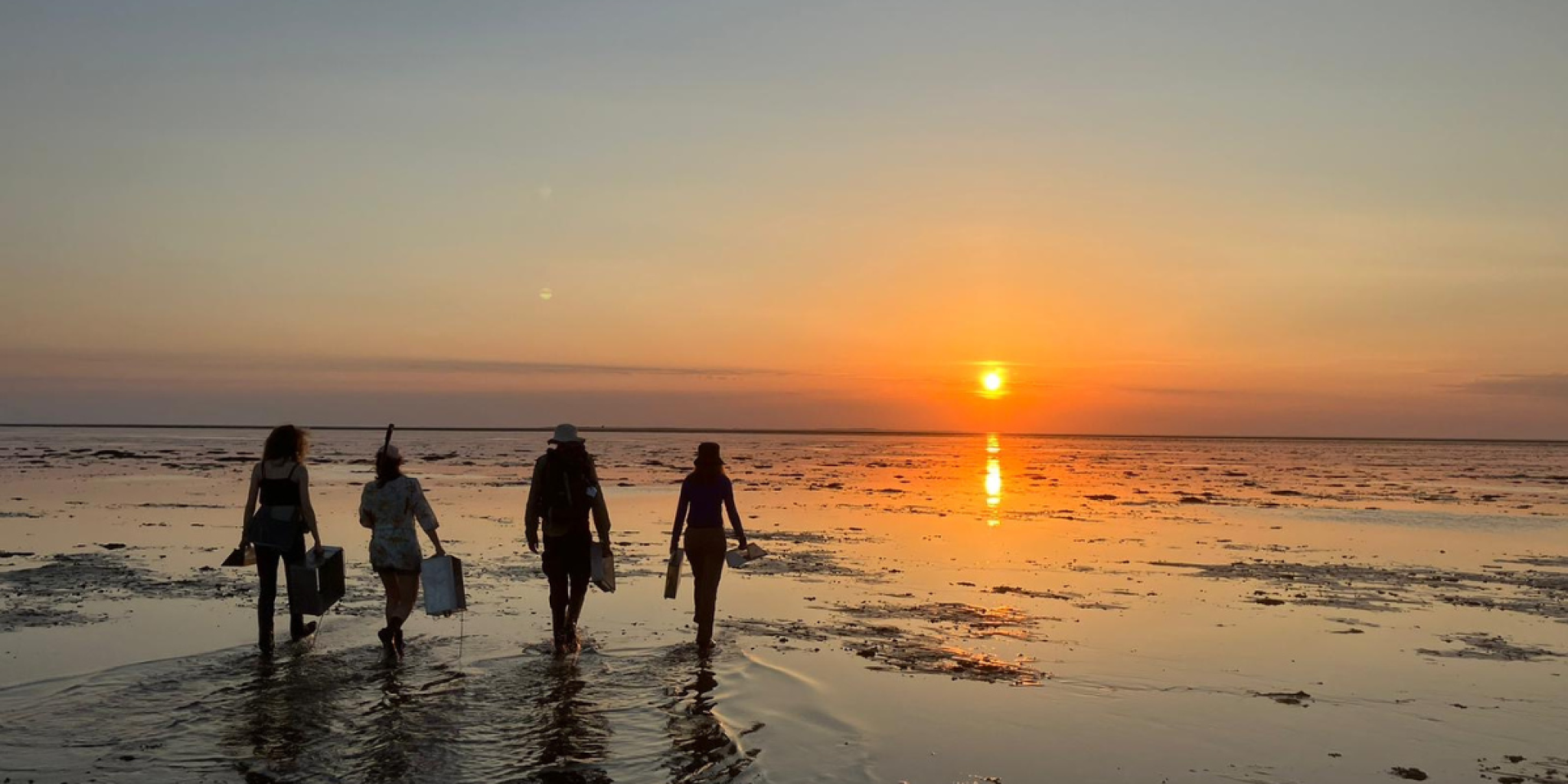
The walk back to the island after a very productive day. (photo: Johannes Krietsch)
A while ago, I was invited to join this year’s shrimp sampling and I have been looking forward to this trip ever since! My name is Nienke Zwaferink, I am currently studying Marine Biology at the University of Groningen. For my master’s, I am studying the effects of climate change on the sand mason worm (my project is unrelated to this fieldwork trip). This diary was inspired by Evy Gobben’s reports of her experiences on Griend, as a PhD candidate at NIOZ. It’s my pleasure to share the highlights of the shrimp sampling excursion to Griend from my viewpoint!
12th of August – Off we go!
It almost seems like a normal working day, when I arrive at NIOZ this Monday morning, although my wellies and outdoor clothing suggest I am up to something completely different. Instead of working on my thesis about the effect of climate change on tubeworms, I head to Paula’s office. Together we load her car with boxes full of nets, sieves, and groceries and make our way to the NIOZ-harbour. Here we find Farah and Timo, both prepared for the departure of our crossing with the ship the Adriaen Coenen. Of to Griend we go! We will spend a week on the little island, located in the Wadden sea just beneath the Wadden island Terschelling, to sample shrimps. Timo and I also joint the excursion last year, but my heart still skips a beat when we approach Griend (or maybe this is due to the high velocity of the speedboat, the vehicle that is used to cross the shallow water between the ship and the island.)
The house on Griend, our residence for the week. (photo: Nienke Zwaferink)
Dressed in waders we jump off the speedboat into the water and are welcomed by Hannes and Isla, who have already spent some time on the island to collect data for their research. They have brought a wadcart into the water, a very useful device for bringing our stuff on land through the water and transporting it over the loose sand. We take just a brief moment to install ourselves in the little wooden house on the island, before we start working on our task for the week. Low tide is a prerequisite for taking our samples and that’s why we need to start shortly after our arrival. In an attempt to refresh our memory, we go through the method together. Amongst others, the approach to sampling the shrimp is invented by Emma Penning: the idea is to catch the lightning-fast shrimp in some sort of ‘surprise-attack’. For this purpose, a metal frame was designed, that can be connected to a long pole by means of a piece of rope. The person that holds this pole deposits the frame on the intertidal flat, at a few meter distance. At this point, there is no possibility for the shrimp to escape anymore: they are trapped within the frame. The top 3 cm of sediment are scooped out of the frame and moved to a sieve, to remove most of the material out of the sample. What remains in the sieve (shrimp, but also snails, shells, small crabs, and sometimes some seagrass or seaweed) we put into a sampling container, for further analysis in the lab. By repeating this procedure about 150 times, a better insight into the whereabouts of shrimp on the intertidal flat is gained. This data can be linked to the current knowledge on the foraging sites of waders around Griend, to investigate the preferred prey species of the birds. It has already been found out that sanderlings include shrimp in their diet, but dunlins might also like to feed on shrimp.
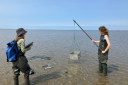
Shrimp sampling in action. (photo: Timo Keuning)
After dedicating some time to get familiar with the sampling method, we split up in a group of two and three, to navigate ourselves to the first sampling locations. Every now and then we stop to have a quick peak on the map to ensure we are heading towards to correct coordinates, but we make our way over the tidal flats pretty rapidly and we sample already quite some points on this first evening! We are pleased when we walk home beneath the beautiful evening sky towards the setting sun behind the island. I experience the same feeling as last year, when I first encountered the beauty and peace of Griend. I currently read a book by the Dutch author Jan Wolkers, who also spent some time alone on an uninhabited island in the Wadden Sea. Like me, he is amazed by the enormous flocks of birds that fly around the island and feels somewhat small and insignificant, by being exclusively surrounded by the forces of nature.

Griend at dusk, from the perspective of the mudflat. (photo:Johannes Krietsch)
13th of August – A day full of shrimp
Our alarm clocks go off early this morning: our goal is to be outside by half past 6, allowing us to optimally use the exposed mudflats and preventing the risk of having to skip some sampling points due to the incoming tide. Each team has assigned itself a number of sampling points: our routes are parallel to each other, but Timo and Farah are located about 500 meter south from Hannes, Paula, and me. We are working faster than lightning! We are able to sample all of our planned points and even manage to take a few extra samples. The weather is really nice and the coordination between the team members is highly efficient. The same evening, just before the second low tide of the day, we head out again and cross even more points of our lists. We are surprised by our own productivity!
The walk back to the island after a very productive day. (photo: Johannes Krietsch)
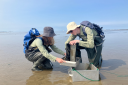
Farah and Timo transfer their sample into the sieve. (photo: Nienke Zwaferink)
15th of August – The gully
The weather forecast looks a lot better today, so we can safely resume our sampling efforts! Today we even have three teams: Isla has finished her exploration experiments on red knots and has now time to join us. Yesterday evening we have come up with a specific route for each team, based on the tides, weather conditions and individual physical conditions. Blisters are of course unpreventable, when walking about 15 to 20 kilometres a day, but we are determined to persevere. We focus on coordinates for sampling on the west of the island, the side where the notorious gully is located. Allegedly, this gully, officially “het Zwin” plays an important role in shaping the island: during storms, material is trapped within it and pushed towards the island from there. This sickle-shaped depression in the mudflat embraces the island and creates an obstacle for anyone that walks from the island in a western direction. Last year, a team tried to cross the gully during low tide, but the two of them had to desert when the water reached their shoulders. The only way to reach our sampling points, is by walking around the gully in a big circle. Our attempt to circumvent the gully turned out to be successful this year, saving us from an unplanned morning swim.
It is quite remarkable to notice the difference between the east and the west side of the island, although they are only about one and a halve kilometres apart. The mudflat on the east side is easily reachable: it is very flat and extensive. The west is somewhat harder to reach: the gully forms a hurdle, but also other areas of mudflat can surprise us by having unexpectedly high water levels. This becomes clear to us during our sampling trips: timing and weather conditions are way more important for getting as many points as possible done on the west side. There is also a distinction is the species diversity and abundance between the two sides of the island: the west can be characterized by heaps of mudsnails and every now and then a clump of seagrass. The eastern side is full of cockles and we run into various angry crabs, that lift their scissors up in fighters mode.

A freshly sampled shrimp, that will be transferred to NIOZ in a sampling jar. (photo: Nienke Zwaferink)
16th of august – Change of plans
We start this morning on the balcony, gazing through a telescope. We keep our eyes fixed on the only bush of the island, the place where migrating birds regularly dwell. Job points out two grey flycatchers and additionally we discover two juvenile wheatears and two willow warblers.
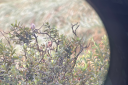
Two juvenile wheatears in the little bush next to the house. (photo: Nienke Zwaferink)
Unfortunately, our plans take an unexpected turn: two out of three of the teams are not able to sample the first point of their route to the water level being too high. Continuing to the next point is useless: the water level will not be low enough to sample any of their planned points this tidal cycle, because the points further on the mudflat will lay even deeper. Hannes and I have more luck: we work on the east side of the island and manage to finish a couple of points, and spot a group of resting seals along the way!
17th of August – Final time out on the mudflats
Low tide is a little bit more favourable today, so we hope to sample the points that were inaccessible yesterday. The water level still does not drop as much that it allows us to reach the furthest, deepest point, but still we succeed in sampling some of the points. A couple of times we have to wait a little bit for the water to become shallower, but luckily we can sit down on the mudflat in our watertight waders (although… they are supposed to be watertight). This already concludes the shrimp sampling for 2024! For one last time, we walk back to the island, while being amazed by the human activity around us. Griend might be one of the most remote places in the Netherlands, but still we find ourselves surrounded by sailing boats and other types of ships. We can follow the ferry between Harlingen and Terschelling or Vlieland from departure to destination. At night, we can see the flashing lights of lighthouses, each according to their own distinctive cycle.
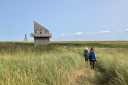
Back at the house after finishing our sampling efforts for the day. (photo: Nienke Zwaferink)
This evening we raise a toast to completing our field“work”, although spending a week on this beautiful island with nice people doesn’t feel like working to me at al. From the balcony we watch the beautiful red sun set. I regard the opportunity to join this week as an extraordinary experience, because we work and live together quite intensely, although most of us barely knew each other beforehand. I have gained a lot of ecological knowledge, by strolling over the island. Job has been working on the island for many years and tells beautiful stories from his own experience, as well as from others’. I also leave the island knowing a lot of other, not necessarily biology-related, things: I know now which sleeping bag is best to buy and what the typical Argentinian maté tastes like. Especially Isla is quite a chatterbox and makes a funny combination with Timo. Nice to learn so much about each other and nature on this small island!
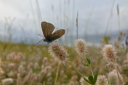
A Common Blue on Hare's foot clover in the salt marsh. (photo: Nienke Zwaferink)
18th of August – A day off
By working as hard as we can, we even finish the day before we are being picked up by the Adriaen Coenen. This means we have the day of to explore the island a little bit more. The salt marsh is a particularly nice place to determinate plant and insect species: we come across various butterfly and dragonfly species and find new plant species until the very last moments before our departure. Fluttering common blues around a meadow full of hare’s foot are a sight to behold to me. It is strange to realise that the other seasons are completely different on this place: apparently the entire island can flood in winter, making the highest floors of the tiny house the only place where one can seek refuge from the water. It makes me shiver to even think about the cold wind entering the house through the cracks in the wood.
Just like the other days, this last day flew by and before we know it is time for us to carry our stuff to the beach, where we wait for the ship to pick us up. Once we have boarded, Farah and Timo teach me a funny trick that allows me to enjoy the beautiful sunset for a little bit longer: by the time the sun has already disappeared behind the horizon, it is still possible to catch a glimpse of it by jumping in the air. It feels a bit weird to jump up and down on the deck like a frog, but indeed, I manage to see just a tiny stripe of red when I reach the highest point of my leap. Shipper Wim-Jan is kind enough to drop me off in the harbour of Harlingen, before making his way back to Texel. This way, I am back on the mainland in no time, and I even get the chance to wave goodbye to the others from the dock. It is a pretty sight to see the boat with my fellow shrimp catchers depart into the direction of the beautiful evening sky. In my head I thank Evy Gobbens for asking me to join the shrimp excursion last year and this year, and I secretly hope that I will someday return to this magical island.
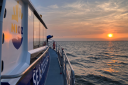
Sunset on our way back home aboard on the Adriaen Coenen. (photo: Nienke Zwaferink)
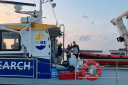
Waving goodbye to the shrimp crew (minus Isla and Johannes) in Harlingen. (photo: Nienke Zwaferink)
Linked staff
Evy Gobbens
Visiting PhD

Isla Botting
Visiting PhD
Johannes Krietsch
Postdoc