MedDust2025
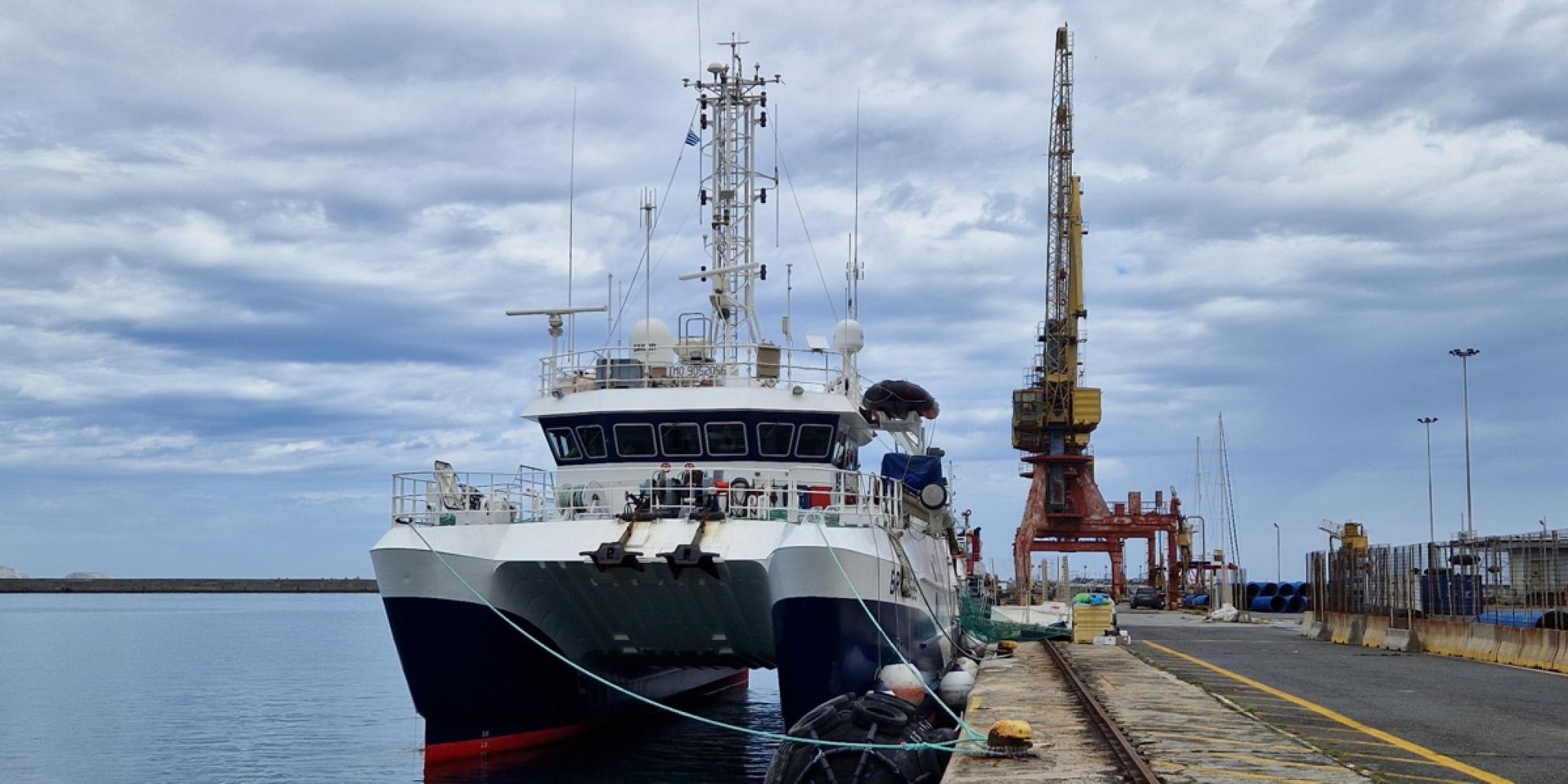
The N.O. l'Europe, in the harbour of Heraklion on Crete, Greece
Expedition MedDust2025 aims at servicing (recovering and re-deploying) the sediment trap that has been collecting Saharan-dust deposition and its marine-environmental effects since the late 1980's. Originally, it was positioned a tick further South than its present position in the southern tip of the Italian EEZ between Sicily and Crete. Since 2012 its main aim is to continue the work started by UU colleague Gert de Lange, so building a time series of already more than 30 years. For this trip two NIOZ colleagues will board the French N.O. l'Europe, to sail from Heraklion on Crete (Greece), to Toulon (France). Through this blog you can follow their adventures at sea.
The N.O. (Navire Océanographique) l'Europe is a catamaran, and has been in operation since 1993. Despite its relatively small size, it is very well equipped with all the instruments, cranes and winches that are required for oceanographic research.
In this blog you can follow our whereabouts and adventures at sea. Updates will be posted regularly below this line, the most recent one on top.
The end - thanks for following!
The picture below says it all; captain and crew of this little ship really made us feel at home in their friendly family. Merci beaucoup, we hope we will have the pleasure of working and sailing with you again!
....and we also hope for really smooth seas then....
Many thanks for following this blog.
#welstoffignietsaai
If you would like to know more about the many exciting aspects of desert dust and its marine-environmental effects, or simply wonder: "what's up with dust?"
The entire team l'Europe gathered in the mess. They made us feel really welcome in their family!
19 May - Tour de IFREMER
Before saying a final goodbye the ship and her nice crew, we are getting a tour around the IFREMER premises, foremost the workshops and the impressive amount of submersibles, ranging from ROVs (remotely operated vehicle) to AUVs (autonomous underwater vehicle) and the crewed underwater vehicle Nautile. This submersible has been in operation already since 1984 and fits three people. She can be lowered down to 6,000m water depth. Despite her age, we were told that new plans are to keep her in service for at least 10 more years.
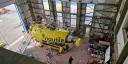
Submersible Nautile in the IFREMER workshop. See technician for scale.
18 May - Toulon harbour
Toulon is one of two main navy ports but also hosts many shipyards and ferry terminals. The harbour is really buzzing with activity and in between sail/race the blue floating buses. On the edge of all this activity is the marine research institute IFREMER - Institut Français de Recherche pour l'Exploitation de la Mer. Quite a nice working environment!
The post marking the entrance to Toulon harbour.
18 May - land ahoy!
In the early morning we are approaching the Mediterranean coast of France. Straight ahead lies the peninsula of Giens around which we will sail to reach the harbour of Toulon.
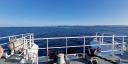
We are approaching the French south coast.
17 May - a dusty Mediterranean sunset
Every dusty blog should have at least one photo of an orange sky and a rising or setting sun. Here you are: a nice Mediterranean sunset towards which we are sailing.
And if you wonder why the skies are coloured orange, please see NIOZ' dustiest website
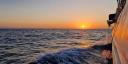
A nice orange Mediterranean sunset.
17 May - into the Strait of Bonifacio
Our transit is progressing nicely; a last 'hurdle' is the Strait of Bonifacio between the islands of Corsica and Sardinia. This strait is notorious for its bad weather and strong currents but we have none of that today. The officers on the bridge deftly avoid the shoals and other obstacles that the strait is also known for and we continue with the last ~170nm (~300km) stretch towards Toulon.
Cookies required
Analytics and Marketing cookies are required to display this content.
Watch video in a new tab16 May - sailing home
Today is spent entirely on our journey 'home': Toulon. The transit takes us through the Tyrrhenian Sea along the western Italian coast. As the wind and waves are coming in from an angle, the ship is dancing quite nicely and for those not-so used to these movements, it is sometimes hard to keep balance. In this youtube clip you see chief engineer Nicolas having no trouble at all staying on his feet on the aft.
Cookies required
Analytics and Marketing cookies are required to display this content.
Watch video in a new tab15 May - Stromboli
A nice sight for a geologist; a massive volcano sticking out from the ocean! This one is so typical that it makes it into a volcano-type: the Stromboli.
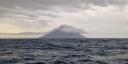
The typical volcano-shape of the Stromboli sticking out of the Tyrrhenian Sea.
15 May - entering Messina Strait
In this youtube clip one can see how we are surfing downwind and downwaves into Messina Strait; the narrow passage between the island of Sicily and the Italian mainland.
Cookies required
Analytics and Marketing cookies are required to display this content.
Watch video in a new tab15 May - not always sunny weather in the Mediterranée
After having re-deployed the sediment-trap mooring, we set course towards our end goal: Toulon. The ~900 nautical miles (1,600km) passage will lead us through the channel between Sicily and the Italian mainland: Messina Strait as well as the narrow gap between Corsica and Sardinia. Apparently, we were really lucky yesterday with the nice-and-calm conditions; today we encounter many a rain shower and thunder storm.
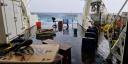
Not always good weather in the Mediterranée.
14 May - (almost) ready for more dust
Soon enough we have replaced the 'full' bottles with empty ones, replaced the malfunctioning motor unit, and exchanged batteries of control unit and beacon. Some new instruments were also installed, to get a better idea about temperature- and salinity changes at depth. In she goes again to extend the time series with yet another year. Happy sampling and see you next year!
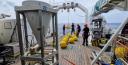
The sediment-trap mooring is re-deployed for another year of sampling.
14 May - trap on deck!
Through efficient teamwork, the trap is now safely standing on deck, and with good results! The lower carousel rotated perfectly so that all bottles contain 10-days worth of material. The upper carousel unfortunately got stuck at some point but all in all this is a very good 'harvest', to be sorted out further back home in the lab.
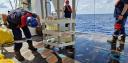
Trap on deck, the result is inspected by the upside-down technician.
14 May - trap recovered successfully
Through an acoustic signal, we can contact the releases at the bottom of the mooring and 'tell' them to let go of the anchor so that the floats can carry the trap to the surface of the ocean. Directly at the first attempt we have established contact and a swift release. 30 minutes later, the top floats reached the surface and were ready to be picked up.
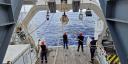
The captain maneuvered the ship such that the top can be picked up from the aft.
14 May - trap day
Today we are going to recover the sediment-trap mooring that has been collecting material (Saharan dust as well as plankton remains settling from the surface ocean towards the deep) since October 2023. Fortunately, the wind has slacked down considerably so that we really have calm seas today!
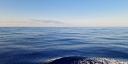
Calm seas as we like to see them; they will make our work a lot easier!
13 May - toolbox meeting
The crew on deck as well as on the bridge is very experienced in ocean-going work so the toolbox meeting is kept short. Yvo shortly explains how he imagines the procedure of recovering the mooring will go tomorrow. Given that the ship is well-equipped with powerful cranes and winches, we expect a smooth handling of all the equipment.
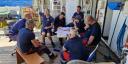
Toolbox meeting on deck in which Yvo explains the procedure of mooring recovery.
13 May - not-so calm seas
Despite the very nice and sunny weather, we now experience what it means when the wind and waves are not coming from a favourable direction relative to the ship's course; we are rocking and moving in all directions and since the ship is relatively small, those movements are relatively fast. We decide to not work too much at the laptop today.....
Cookies required
Analytics and Marketing cookies are required to display this content.
Watch video in a new tab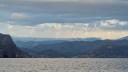
The beautiful coastline of western Crete
We are leaving the island of Crete behind us, next stop: the mooring site some 350nm westward.
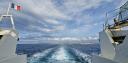
Looking back to the island of Crete
12 May - partir c'est mourir un peu
We are leaving the harbour of Heraklion on Crete with very nice weather and nice and calm sea. In addition, we have the wind and swell in our back; ideal conditions for our little ship!
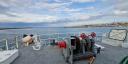
Sailing towards the end of the harbour of Heraklion.
12 May - getting to know the ship
The l'Europe is quite an intriguing ship with already a long (>30 years!) history of ocean-going expeditions. As a catamaran, it can ride 'over' the waves, basically surfing on them, when sailing in the right direction. The floats are quite deep and are used partly as cabin, engine room and storage.
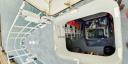
View into the starboard float of N.O. l'Europe
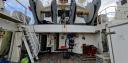
The --quite impressive-- winches are operated from the bridge of N.O. l'Europe
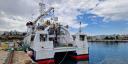
The aft of N.O. l'Europe, where the blocks are mounted on the A-frame
