MaMa Course 2026 - Marine Master Summer Course
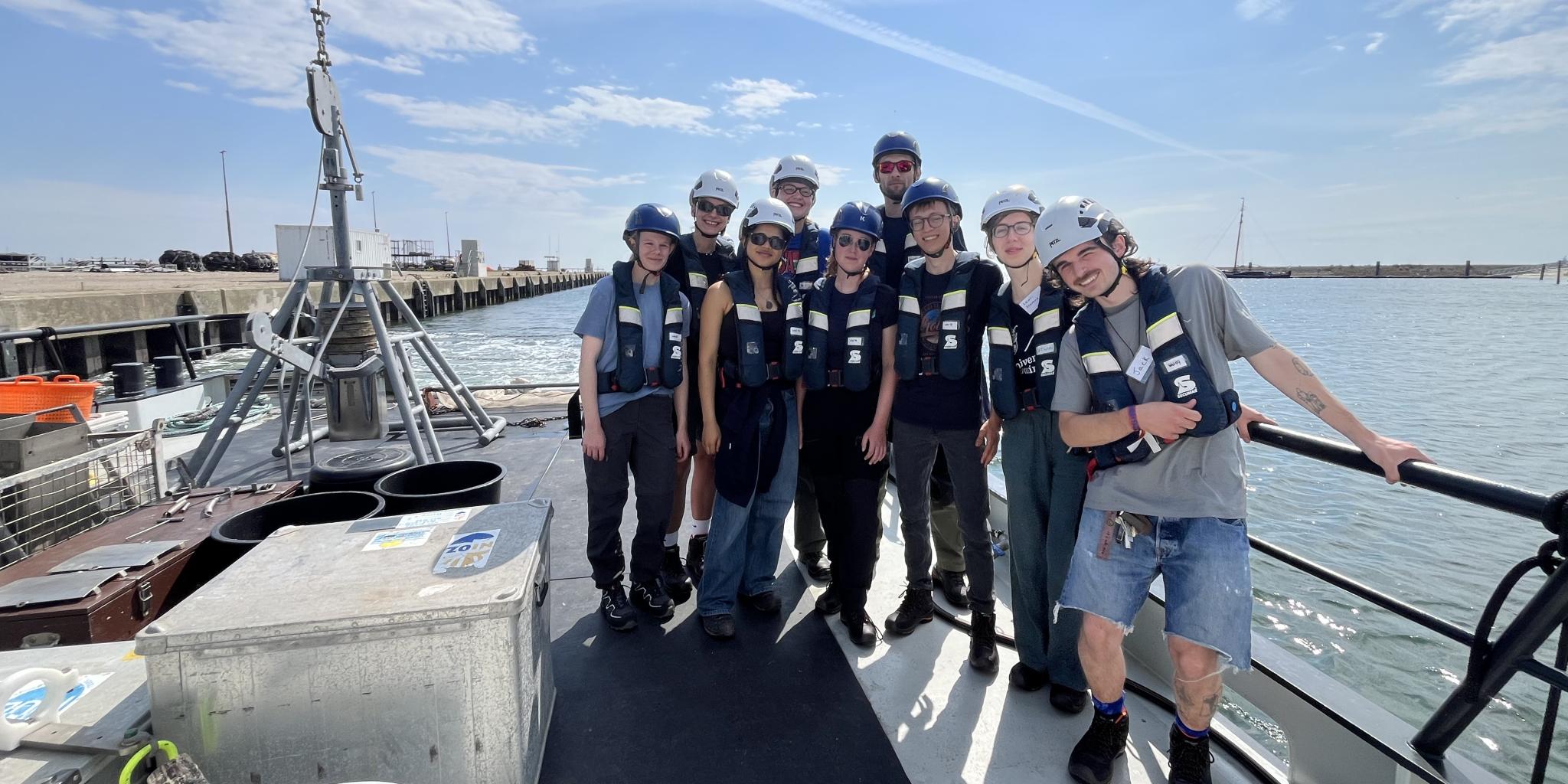
A project group of the MaMa course 2026 on the RV Wim Wolff (photo: Jack Silke)
NIOZ works closely together with Dutch universities to strengthen marine science in the Netherlands. The Marine Masters Summer Course contributes to this by giving students the opportunity to familiarise themselves with marine research, including the opportunity to experience working on research vessels. This introductory, multidisciplinary course is hosted at NIOZ Texel, with the western Wadden Sea as hands-on research area. Welcome to the blog!
17 July – The day of presentations and good-byes
Written by Dörte Poszig – NIOZ education coordinator
At breakfast, everyone looks very tired after the last 12 intense days, yet there is also a certain excitement in the air. Today is the day of the presentations that the six student groups have been working towards! It promises to be an interesting day, with a variety of talks on topics such as tidal dynamics and sediment transport in the Marsdiep (the deep tidal current between Den Helder and Texel), findings from the stable isotope analysis of the food web in the Wadden Sea, the influence of temperature on the mudflats’ sediments and, consequently, its animal inhabitants, the presence (or absence) of parasites in shrimps and crabs, and the role of the Wadden Sea in CO₂ uptake. A good mix of biological, chemical, geological and physical-oceanographic topics.
It strikes me once again that the course is essentially a mini-research project: collecting data and samples in the field, analyzing the samples in the laboratory and the data on the computer, compiling the results, and presenting, explaining and defending them in front of an audience (fellow students and supervisors). The students get a taste of what research at the NIOZ is like and have the chance to delve into a research topic that differs from what they are learning on their university degree programme. Every year, I enjoy seeing how the students structure their presentations. Some take them very seriously, whilst others have captured their funny field experiences of the last 1.5 weeks in photos and use them to make the audience laugh. A great atmosphere is guaranteed.
But then the lectures are over, and it’s time to leave the seriousness of the course behind over a few drinks and cookies and spend one last moment together before the NIOZ closes its doors. Whilst some students head straight home (surely having a good time together on the train to Amsterdam), a few students from abroad join their new Dutch friends to explore Utrecht. I’m delighted to see that the MaMa course isn’t just about training the next generation of marine scientists and emphasizing the need for interdisciplinarity in marine sciences, but that the social aspect is just as important.
I ponder on that after the NIOZ has emptied while checking all rooms we used for the course. Luckily, after the MaMa course is always before the MaMa course, at least for my colleague Henko and me. The next edition of the course is already looming at the horizon.
16 July - A quiescent farewell night
Written by Aleksander Andreas - Earth System Sciences, WUR
Being the last day before the final presentation tomorrow, the breakfast at NIOZ canteen was a bit swifter than usually. With people centred, one could sense a notion of anticipation.
Likewise, my lovely team of physicists and hydrologists got down to our project on dynamics a.k.a. what drives water movement in Marsdiep. Trying to get most of our plots and models, the last stretch on clarity of the presentation owing to our dedicated coordinators: Sonja and Johan. At some point even my Python environment has had enough, so I needed to finish coding on a teammate’s computer :).
Personally, I started coming down to earth at dinner with Henko’s farewell. So it’s already it, the last supper as they call it. Swung by nostalgia, a few of us signed out ~10 pm and headed to dormitories, joking and trying to conceal our sadness.
Approaching our accomodation boat, the omnipresent silence was strucking a bypasser. Sheep were serene, no sound or touch of wind. The tilted roof harbour buildings with smoking chimneys were there, quiet sunset sky above them. I entered. Yes, everything was in place - once again and forever. The poster with Dutch fish species, the marine odour, the table we’ve been partying at not half a week ago.
As I was falling asleep back on gently swinging Texelstroom, even a familiar sound of a co-boat’s little engine sung one more time. Everything is as it should have been, ready for MaMa course attendants the next year. Last thought: one should get off a bike sometimes to look at the world through the lenses of a poet.
12 July 2026
Written by Alysha Blömker - Climate Physics, UU
Today something magical happened at the NIOZ harbor: The Texelstroom transformed into a pancake boat! After spending the weekend cycling around Texel, exploring tranquil little villages and grand dune landscapes we decided to indulge in a well-deserved treat.
With all hands-on deck we (the temporary inhabitants of the Tesselstroom) went into full pancake production mode. Some of us went foraging for ingredients (in the grocery store) others stood by the stove flipping one pancake after the other. In no time our pancake stack grew into a tower – plain, apple, banana, cheese.
Nothing tastes sweeter than a powdered sugar covered pancake eaten on deck of a ship, in the company of lovely people!
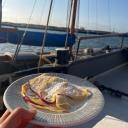
An assortment of pancakes (photo: Alysha Blömker)
10 July 2026
Written by Anna de Bever - Maritime Technology, Tu Delft
This morning I got up early as we were leaving with the HA1-Wantij at 7. Once we sailed out the harbour we got straight into it. For our project we had to take a sample of surface water using the Niskin bottle. From the bottle we then had to fill 10 different small bottles and vials to be able to run different tests later. The first stop took a while as we were learning the different processes but by the 12th stop on our transect we were working like a well-oiled machine. Before we knew it we had arrived in Den Oever where we (and our samples) got off the boat. While there, we also walked to the IJselmeer to take our last set of samples. No Niskin bottle this time, but just wading into the water as far as we dared before our shorts got wet. After this we got on the bus to go back to NIOZ , with a pitstop for kibbeling as lunch.
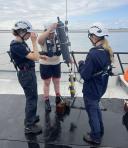
Students collect surface water samples with a Niskin bottle aboard the HA1-Wantij (photo: NIOZ)
Our day wasn’t over yet though. We took all our samples back to the lab and talked through everything we would do tomorrow. We got a small head start as we measured the salinity of our samples using a refractometer and we brought the CTD to Eric (tech wizard) to get the data off it. We spent some time before dinner getting started on the post processing; in my case this involved some python frustration in trying to get the mapping library to work.
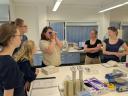
Back in the lab, students measure the salinity of their water samples using a refractometer (photo: NIOZ)
I am now back on the Texelstroom, writing this after a really nice gado-gado as dinner. The Texelstroom is a historic ship we are sleeping on with 12 of us. It’s nice and cosy and gives us ample opportunity to see the “zeevonk” (bioluminescent algae). Hopefully we’ll get another chance tonight!
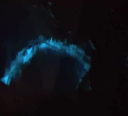
Bioluminescent algae light up the water around the Texelstroom at night (photo: NIOZ)
9 July - Mudflats in the morning, sediment samples in the afternoon
Written by Susanne Triedwindt - Future Planet Studies, UvA
Today was the first day we worked on our projects. In our case, this meant going to the mudflats in the morning, placing sensors in the sediment, taking sediment core samples, and identifying benthos on site. The sensors will be picked up next week again and are measuring temperatures in the sediment within the next 4 days.
In the lab, we continued working with the sediment samples by splitting them up into different layers, and determining the grain size and density of the sediment - though getting it out of the sediment core can require quite a lot of muscle work, as we experienced first-hand!
Nonetheless, we managed to retrieve and use all samples, and these measurements will help us to research how climate change will affect the ecosystem and its inhabitants of the Wadden Sea.
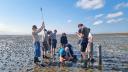
Our group working in the Wadden Sea, taking location data and measurements (photo: Tamas Szecseni)
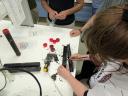
Processing the sediment samples (photo: NIOZ)
8 July – The first days of “island life”
Written by Jack Silke - Climate Physics, UU
Mudflats, crabs and seaweed labs – it feels like we’ve seen it all since landing on the island just a couple of days ago. As much as I hate getting up before 7am, the early morning starts have definitely been worth it. I managed to fulfil my childhood dream of being Jack Sparrow, when we went out on the Wadden Sea aboard the research vessel HA1 Wantij. “Island life” has been super varied so far, with time at sea, visits to the tidal mudflats, as well tours of the NIOZ facilities.
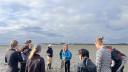
Anne giving us a morning tour of the tidal mudflats (photo: NIOZ)
Coming from a physics background myself, it has been super interesting to spend time with people from other disciplines, such as marine science and ecology. Whilst I was completely out of my depth trying to pick up a crab to examine it for parasites, my more-experienced groupmates were able to guide me on how best to do it. It seemed much more straightforward in my head …
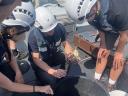
Examining crabs for parasites aboard the RV-HA1 Wantij (photo: NIOZ)
The cherry on top (so far) has been the free ice cream in celebration of 150 years of NIOZ. A well-deserved treat after exploring the tidal flats that morning!
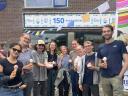
Our group sneaking in a quick ice-cream break, in between tours of the NIOZ facilities (photo: NIOZ)