A triptych of Griend
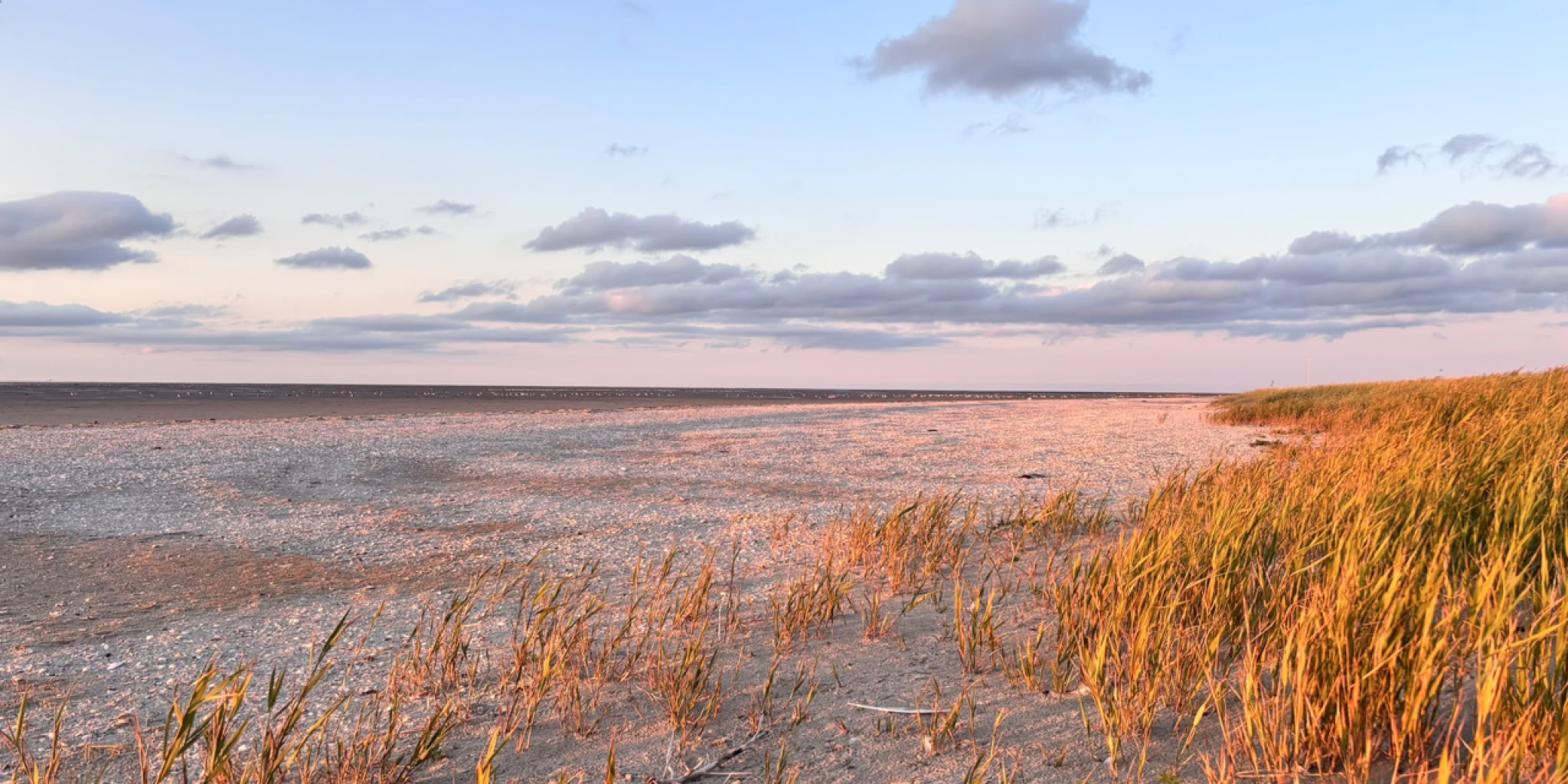
The beach of Griend (photo: Mette de Boer)
Griend sees a constant coming and going of temporary visitors. For instance, migratory waders spend only a few weeks there each year on their way to their breeding and wintering grounds; young shrimp find their nursery there before moving on to deeper waters; and people stay for short periods to carry out research, maintenance or monitoring. This year, I was lucky enough to visit the island three times and, together with other researchers and students, delve into the world of birds and shrimps. My name is Nienke Zwaferink, a student assistant at the NIOZ (Netherlands Institute for Sea Research), and in this blog I describe the ins and outs of three expeditions to Griend in August 2026.
Part one - Shrimps
In the Wadden Sea, shrimps are an important food source for various waders. For sanderlings, they are in fact the most important prey, but dunlins and redshanks also hunt these small crustaceans. Anyone who has ever tried to catch a shrimp knows that these small, agile creatures do not give themselves away easily. Emma Penning, a researcher at the NIOZ, was not to be put off. She devised an ingenious method to sample these elusive creatures and, over the years, has collected a wealth of data as a result. In a recently published article, she demonstrated that shrimps show a high degree of site fidelity on the mudflats around Griend. That’s good news for birds: if shrimps keep returning to the same spots, waders know better where to find their prey. Having taken part in this expedition as a volunteer for three years running, this year I’m leading the field sampling work myself.
A unique method
In early August, together with five other biologists, I set off for Griend, an ideal location for this fieldwork. There is little human disturbance, both for the shrimp and for their predators: the birds. Anyone who’d inspected our luggage might have raised an eyebrow and wondered: what on earth are you going to do with a steel frame attached to a rope and an extendable pole that you’d normally use to water the garden? Upon arrival on the island, I explain how this unusual combination of objects is used. By attaching the pole to the frame with a rope, we create a sort of fishing rod. We’ll take these ‘fishing rods’ out onto the mudflats in pairs, where we’ll use a GPS to locate the sampling points. Once there, one person takes hold of the extended pole with the frame and flings the frame onto the mudflats. That’s quite an art in itself: you have to act quickly whilst ensuring the frame makes a soft landing, so that the shrimp can’t slip away due to a bouncing motion. Whilst one person in the pair records the time and searches their rucksack for a jar and a label with the location details, the other uses a hybrid scoop/sieve to scoop the top layer of mud from the frame. This is then sieved into a nearby pool of water. What remains in the sieve varies greatly from one location to another.
Sometimes we find a mass of cockles, monkey’s hair (a type of seaweed) or tube worms, whilst in other places hardly anything remains. The presence of the animals we’re interested in, shrimps, also varies. Yet it’s always a little surprise to come across a brown shrimp (Crangon crangon) the size of our little finger and add it to the sample.
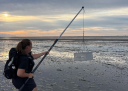
Femke Vermeulen puts the shrimp-sampling method into practice (photo: Lucas Norrie)
A productive week
After the briefing, we’re ready to put the method into practice at 163 points on the mudflats around Griend. The sampling sites are 500 metres apart, so anyone who’s quick at maths will soon realise that there’s quite a lot of walking involved. Fortunately, we have five days for this fieldwork. In theory, that’s exactly enough, provided the tides are favourable, the weather cooperates and the samplers’ physical condition allows it. All the conditions — with the exception of the blisters, though these were offset by a strong character — are on our side this year! Highlights, such as a mudflat teeming with seals, beautiful sunsets and a sky full of stars, alternate with low points: blisters upon blisters, deep gullies in the mudflats and the lack of a hot shower after a strenuous day’s work. Exactly why remains unclear, but we’re racing across the mudflats at the speed of light. We’re unstoppable! As the days go by, the pile of jars containing samples grows at least as fast as the layer of salt and sand on our skin. After successfully sampling 110 sites, spread over four low-tide periods, it begins to dawn on us: it turns out we don’t need five days at all to complete the work. Just one more day’s hard work will suffice. That very same day, we slip our aching feet into our mudflat boots and set off one last time. Huge flocks of birds against a stunning orange-pink sky accompany us on the return journey to the island. We take one last look at the immense beauty around us, before we’ll all be sleeping in our familiar homes again the following day. Strangely enough, our aching feet are suddenly no longer a nuisance, but a reminder of a pleasant and productive time on the exceptionally beautiful Griend.
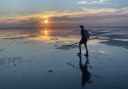
Sunset on the final evening of the sampling (photo: Nienke Zwaferink)
Part two - Birds
For our second trip to Griend, we move up a step in the food chain: whilst the shrimp stole the show during the first expedition, it is now time for their predators: the birds. This, too, was a week to remember. Literally, as it turns out weeks later, because whilst writing this blog I’m still finding feathers in my socks, my bag and on my laptop keyboard.
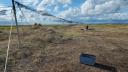
The nets are set up to catch wading birds (photo: Hans Linssen)
Not a 9-to-5 job
The period around the new moon in August is kept free by the NIOZ’s bird researchers months in advance. It is only during these darkest nights that birds can easily overlook a mist net and end up in it unexpectedly. During this expedition, Allert Bijleveld, a research leader in behavioural ecology at the NIOZ, leads a team of 16 people, including seasoned researchers who have been studying birds for years. Among them are a few novices, like me. For me, this is actually the first time I’ve gone bird-catching on Griend! Our group is spending the night on the flat-bottomed boat de Ideaal, which is moored in a channel close to the island. As soon as dusk begins to fall, it’s time to get ready for ‘the working day’. We take small boats from the ship to Griend, where we quietly take up our positions in the dunes. Earlier that day, the nets around the island had already been set up and opened. So now all we have to do is wait for the birds. Using night vision goggles (binoculars that convert the residual light from the moon and stars into electrons, suddenly making the darkness visible), we keep a close watch on the nets. As soon as the signal is given, it’s time for me to grab a crate filled with hemp bedding and get moving. Those authorised to do so carefully remove the birds from the nets. Meanwhile, the crate-carriers stand ready: they open the lid and make a mental note of the number and species of birds in the crate. And so the process repeats itself until the small hours. Carrying crates to the net, taking the birds out, waiting, and so on. Eventually, we gather on the beach to walk back to the boats together with the full crates. Ahead of me, I can see the silhouettes of the others moving along. Just like me, they’re careful with the birds, but at the same time they’re trying to keep up a brisk pace so as not to be overtaken by the rising tide.
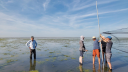
The nets are prepared for that night’s catch (photo: Hans Linssen)
A unique insight
After a few hours’ sleep, we start early in the morning (admittedly, after a cup of coffee) by processing the birds. That means measuring, weighing and fitting a unique combination of rings to their legs. Some of them also have a small transmitter attached, which allows us to track their exact locations within the Wadden Sea. These birds thus provide a wealth of information that anyone can follow live via the WATLAS website (https://maps.nioz.nl/watlas/
Opens in a new tab).By gaining a better understanding of how birds use the Wadden Sea, well-informed decisions can be made regarding nature conservation. For example, we can link the movements of birds to data from the SIBES project, which annually maps the benthic fauna of the mudflats that fall dry. This helps us identify the areas birds prefer to use when searching for prey. Policy-makers and managers can use the information from WATLAS and SIBES to assess which areas are important and, in some cases, decide to close them to human visitors. Space and tranquillity are, in fact, incredibly important for the birds on the mudflats: this enables them to find sufficient food, rest and, in the case of migratory birds, prepare for their long journey. In addition to the WATLAS project, GPS transmitters have recently been deployed, enabling birds to be tracked not only within the Wadden Sea, but throughout their entire migration: from southern Africa to the far reaches of the Arctic tundra. These birds can be tracked at www.globalflywaynetwork.org
Opens in a new tab. The information provided by these transmitters adds yet another piece to the jigsaw of our understanding of the ecology of these enigmatic waders.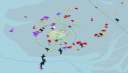
Map showing birds fitted with a WATLAS transmitter around Griend at a random point in time (maps.nioz.nl/watlas). Each species has its own colour and icon (image: NIOZ)
Life on deck
Whilst processing the birds on board the ship, I am given the honour of joining researcher Theunis Piersma in measuring and ringing the pied sandpipers. Quite a few of these little birds have been caught, so Theunis and I are kept busy for a while. Thanks to his long career as a bird researcher, Theunis can chat away non-stop whilst handling the birds with care. So, as well as a flood of measurement data, I’m also treated to a whole collection of wonderful stories from his working life. Although the long days are taking their toll, the atmosphere on board remains just as good. During the long-awaited solar eclipse, for instance, we all gather on deck to watch it, armed for safety’s sake with a single pair of eclipse glasses — which are passed round carefully — and two welding helmets, which prove to be just as effective against the blinding light. We also have lovely neighbours. Right next to the ship where we sleep, eat and work lies the houseboat belonging to Anne and Anita, who both work at the NIOZ and are taking part in the fishing trip with their children. Together with PhD student Evy Gobbens, I can enjoy a lovely chat on deck during the spare moments, with a view of Griend. At the same time, we know only too well that it’s wise to catch a few more hours’ sleep before we head into another fitful night… And so the days fly by and, before we know it, after a successful trapping week, it’s already time to sail back to Texel. But not for long…
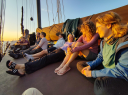
An evening on board the ship De Ideaal (photo: Hans Linssen)
Part three – Birds revisited
Our third and final stay on Griend revolves once again around birds, but this time we’re studying them from a distance. Together with Job ten Horn, a senior research assistant at the NIOZ, I head out onto the mudflats with a telescope and a stool. Our mission: to find and read as many ringed birds as possible. The seemingly small rings can, in fact, tell a surprisingly big story.
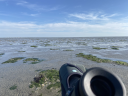
A large group of red knots at an ideal distance for reading their colour rings (photo: Nienke Zwaferink)
Even more birds
After most of the trapping team has headed home, a select few remain to carry out measurements on the red knots caught in the previous days. This involves researchers releasing the birds into a sort of tent (the ‘unit’), after which they film their behaviour for ten minutes. It has become apparent that red knots differ from one another in their degree of exploratory behaviour. Once the birds have undergone the exploratory behaviour assessments, they are released again fitted with a small transmitter. This allows the behaviour observed in the unit to be compared with the behaviour exhibited by the same individual in the wild. The behaviour that red knots display within the 4 square metres of the unit corresponds to migration patterns on a global scale. The exploratory birds take longer to complete their migration than the non-exploratory birds. Researchers at the NIOZ hope to use the exploration measurements to answer a range of questions: What causes the differences in migration duration? Why do birds differ at all? What is already known from previous research is that exploratory birds are good at finding food, whilst non-exploratory birds can exploit this. There are even indications that, due to the variation in exploratory behaviour, the group as a whole is able to adapt more quickly to changing circumstances, such as climate and food availability.
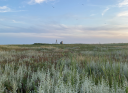
The cottage on Griend, with wonderfully fragrant sea wormwood in the foreground (photo: Nienke Zwaferink)
In search of colourful little feet
Whilst work is still in full swing on Griend, I join skipper Wim-Jan on board for the last time. Once there, almost all the remaining researchers climb aboard to sail back to Texel. For my part, I jump into the dinghy with my kit and a fresh load of groceries to sail to the islet together with Job, the last of the Griend Mohicans. As soon as we arrive, we discuss a plan of action for the purpose of our stay: reading the colour rings on waders. In the days that follow, at low tide, armed with a telescope and a folding stool, we head out onto the mudflats. There, working separately, we begin the search for groups of birds and, more specifically, individuals with rings on their legs. As soon as we spot such a bird, we record the unique colour combination: Job does this using a voice recorder, whilst I note it down in my notebook. This search is repeated until the rising tide pushes us back towards the island.
We focus mainly on red knots and bar-tailed godwits, the key species for this type of research. By tracking individual birds over a longer period using their rings, researchers can learn more about the demography of a population. For instance, ring recovery data can provide insights into the survival and average lifespan of birds. In addition, the locations where ringed birds are sighted reveal a great deal about their migratory behaviour. By combining sightings from different areas and years, a picture emerges of the routes birds take and the areas they use along the way.
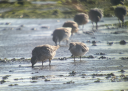
A group of red knots photographed through a telescope. The bird on the far left has a yellow ring with a flag on its left leg (photo: Nienke Zwaferink)
An archive full of bird stories
Thanks to the efforts of researchers and nature lovers, ringed birds are being found at numerous locations along their migration routes, and their unique combination of coloured rings is being recorded. As the manager of the database for black-tailed godwits and red knots, Job receives sightings of ringed individuals of these species. Over the years, he has thus built up a vast archive, which allows the life history of countless birds to be tracked, from the moment they were ringed right through to the most recent sighting. After long days on the mudflats, we sit down at the laptop to add that day’s sightings to the archive. I only recently started reading rings, but from the very first time I went through a bird’s life history, I was captivated. Through their rings, the birds tell us fantastic stories about their long journeys. For instance, one of the red knots I observed in the summer of 2024 turned out to have been ringed on Schiermonnikoog. That same winter, it was reported back at De Richel, a sandbank in the Wadden Sea, only to turn up all the way in Mauritania a year later! And now, another year on, that very same bird is, impressively enough, right in front of me once again in the Dutch Wadden Sea. We also see other birds that were last recorded in their wintering grounds in Mauritania or Guinea-Bissau, birds that were recently observed in fjords in northern Norway, and birds that have been spotted in countless locations but make a stopover at Griend every year during their migration. The fact that a relatively small animal can cover such impressive distances continues to capture my imagination immensely.
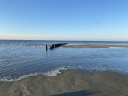
“De Palenrij” south of the island, where species such as Eurasian oystercatchers, bar-tailed godwits, ruddy turnstones and sanderlings gather at high tide (photo: Nienke Zwaferink)
Bustle on the mudflats
Due to the repetitive nature of the work, the days on the mudflats seem to slowly blend into one another. Rain showers and dark clouds alternate with clear skies and bright rays of sunshine, which quickly warm the air as they reflect off the mudflats. Keeping track of the flocks of birds is quite a challenging task. As the tide continues to ebb, more and more space becomes available for the birds to settle, which they gratefully make use of. On several occasions, I’ve only just settled onto my stool only to find a completely empty view the moment I look through my telescope. At the same time, a dark shadow falls over me. When I look up, I see a cloud of birds disappearing into the distance, like a single moving mass forming the most beautiful patterns in the sky. Often, I cannot immediately explain the commotion within a flock, but at other times a low-flying helicopter or a low-flying bird of prey provides a clear cause for the disturbance.
A large group of red knots at an ideal distance for reading their colour rings (photo: Nienke Zwaferink)
Farewell to Griend
Job and I recorded around a thousand colour-ring combinations over the course of five days. Although I cannot even come close to keeping up with the gruelling pace at which Job has been doing this for years, we can be very pleased with the result of our joint effort. The changing of the seasons is also becoming evident on Griend this week. The horseflies, with their painful bites, have all but disappeared; the days are growing shorter and colder; and the island’s only copse is filling with migratory songbirds. As autumn slowly sets in, it is time for us to leave the island once again. From the ship, I watch as the cottage gradually grows smaller, until it is ultimately no more than a pinhead on the horizon. My thoughts turn to the animals I have had the privilege of studying over the past few weeks. Where will the ringed birds turn up next? How many offspring will the shrimp produce, and where will they be on the mudflats next summer? And what will this mean for the food supply for the little stints, which are preparing for their long journey to southern Africa? Griend disappears behind the horizon, but the stories of its inhabitants travel with the seasons, the tides and the distant winds.

Enjoying a spectacular sunset (photo: Mette de Boer)
Linked staff
Nienke Zwaferink
Research Assistant

Emma Penning
Postdoc

Femke Vermeulen
Laboratory Assistant

Hans Linssen
Postdoc

Allert Bijleveld
Research Leader

Evy Gobbens
Visiting PhD
Job ten Horn
Senior Research Assistant