Autonomy and robotics
To facilitate highly detailed research in ocean waters over longer periods, NIOZ is acquiring autonomous and remote-controlled equipment for the Dutch marine research community. This advanced research equipment is funded via NWO-GWI funding for large-scale scientific infrastructure.
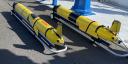
Three NIOZ gliders wait for deployment on RV Pelagia (photo: NIOZ)
For more information or enquiries:
Gliders
NIOZ obtained 3 Slocum long range gliders from Teledyne Webb research. With a minimum use of energy, gliders can change their buoancy by pumping oil in and out of a bladder. In this way they sink and rise through the water column. During this process the wings of gliders generate forward thrust. Every now and then, these gliders will surface and transmit data on temperature, oxygen, salinity, etcetera through satellites to their home base.
Specifications
- Satellite contact
- Pitch control by movable battery pack
- Steering by rudder
- Max endurance: 2 to 18 months
- Max range: 1,300 – 13,800 km
- Max depth: 1,000 m
- Average speed: 0.25 m/s

NIOZ glider Mola on deck during the NoSE expedition (photo: NIOZ)
Possibilities
The system enables efficient collection of water column data. Data are available almost in real time via satellite telemetry. It can be controlled remotely and offers long range and long endurance. It features a wide array of exchangeable sensors. The system is capable of diving down to 1,000 meters.
Autonomous Underwater Vehicle
The new, medium-sized Autonomous Underwater Vehicle (AUV) of the Osprey model is being built by the Icelandic company Teledyne Gavia and will become available by mid-2026. Unlike the gliders, the AUV will have its own propulsion, enabling it to go places where the gliders cannot come, and can also take water samples. The device can be deployed autonomously and flexibly for precise measurements and high-resolution visualization.
Specifications
- Mid depth AUV
- Depth rating: 2,000 m
- Subsea scanning at a close distance
- High-resolution measurements
- Endurance up to 48h
- Wide array of sensors

Example of a Osprey AUV in the water (Photo: Teledyne)
Possibilities
The system can be used in physical oceanography, for example in ocean observatories, studies on climate change, and research under ice. It also supports marine biology, including fisheries research, habitat mapping, and aquaculture. In addition, it is suitable for environmental monitoring such as offshore wind and offshore oil and gas. Also, it can be applied in seafloor investigation, including marine archaeology, deep-sea ecology, and sea bottom investigation of bedforms.
Remotely Operated Vehicle (ROV)
A Remotely Operated Vehicle (ROV) is an advanced robot that can perform tasks on the ocean floor. NIOZ has contracted the Norwegian technology firm Kystdesign to build the 'Supporter 6000’
Opens in a new tab type ROV, which will become available by the end of 2026. An ROV is unmanned, like a glider and an AUV, but it is not pre-programmed like the other two types of systems. Operators are located on board of the research vessel and control the ROV via a long cable, the umbilical. The NIOZ ROV has a depth range of 6000 metres. With its six high-resolution cameras, strong gripping arms, scientific sensors, sampling skid, multibeam echosounder and a suction sampler, it forms our eyes and arms underwater.Specifications:
- Deep ROV
- Depth rating: 6,000 m
- Our eyes and arms underwater
- Subsea scanning at a close distance
- High-resolution measurements
- Long endurance
- Wide array of sensors
Includes: launch and recovery system, umbilical winch, control room.
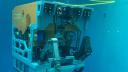
Example of a ROV ordered by NIOZ (photo: Kystdesgin)
Possibilities
The system can be used in physical oceanography, including ocean observatories, climate change studies, and under-ice research. It also supports marine biology through fisheries research, habitat mapping, and aquaculture. In also has applications for marine geology, marine archaeology, deep-sea ecology, and sea bottom investigation/bedforms. And it is suitable for environmental monitoring in studies related to for instance offshore wind parks and offshore oil and gas production.