Movements and connectivity of species
We study the movements and migrations of all kinds of marine species, plankton, invertebrates, fish, birds, reptiles and marine mammals. How does their movement connect different levels in the food web, different habitats, and even ecosystems?
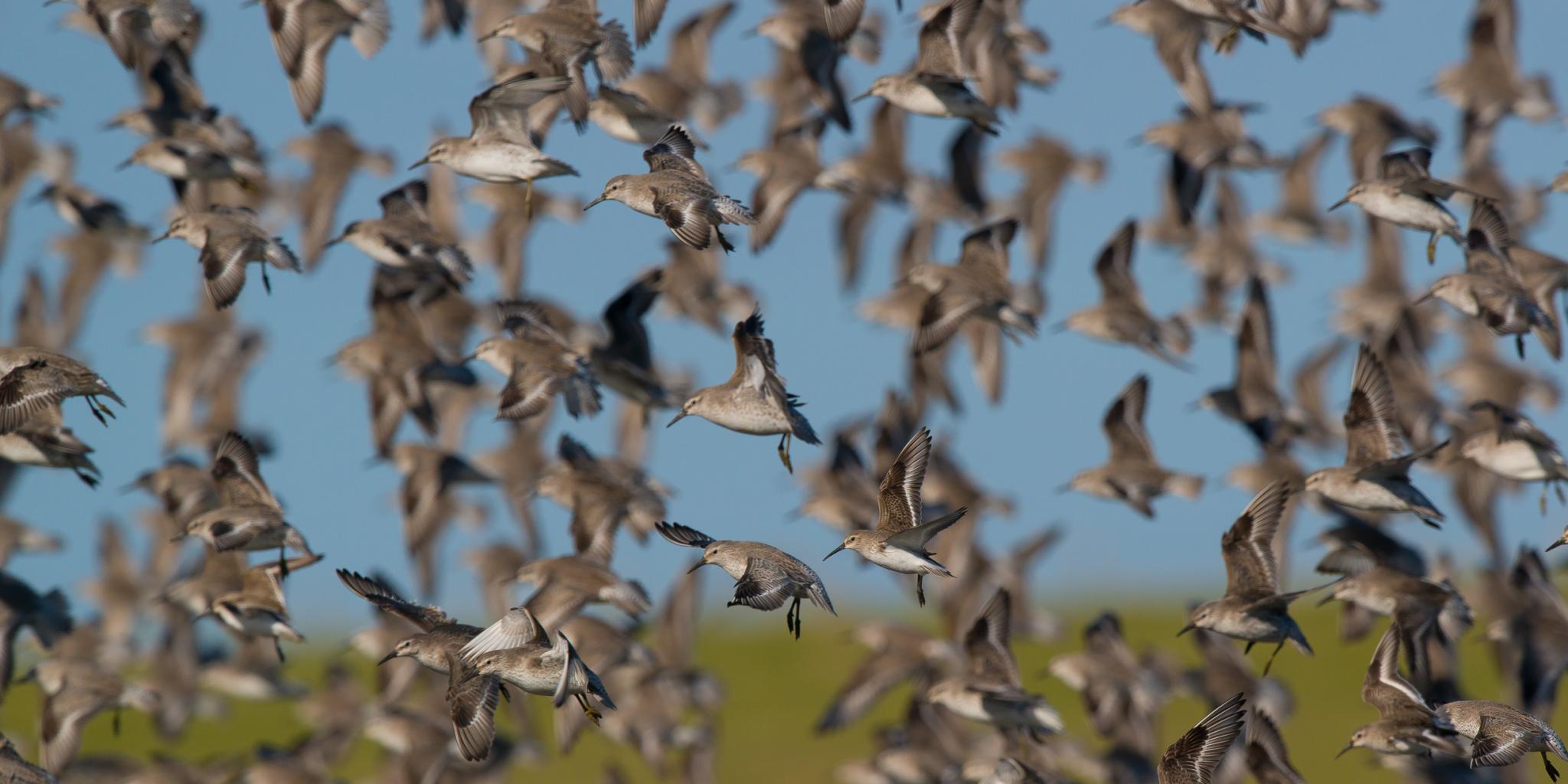
A flight of red knots (photo: Gerard Bos)
Bird movement
Coastal areas are important for many birds. Since the distribution of birds is highly dynamic in time and space, monitoring of bird movements over vast areas is a major challenge. We follow the birds with traditional colour-ring programs, but also with advanced GPS bird tracking technology in our flagship project WATLAS.
Contact persons
Fish Movement
The Wadden Sea harbours more than hundred fish species. Many young flatfish and other species spend their first month in the rich and shallow nursery of the Wadden Sea. We study fish species, their movements and migration within the Wadden Sea and in connection with other seas. With our NIOZ fyke, in use since 1960, we have one of the longest running fish monitoring programmes in the world, also yielding very high resolution data. This monitoring programme enables us to discover trends in the past, to develop models for the future and to use these predictions for management of the Wadden Sea to enhance fish populations and ecosystem resilience.
Contact persons
Plankton movement
Plankton forms the basis of the marine foodweb, especially phytoplankton (basically tiny plants). This means that any changes in plankton presence, or their absence, can have major consequences in the subsequent food chain. Since the early 1970s, developments in phytoplankton in the Wadden Sea have been closely followed by NIOZ scientists, by taking weekly water samples from the NIOZ jetty.