SANDCAT
SahAraN Dust and its role in a Changing climATe
Mineral dust particles are transported through the atmosphere from the world’s deserts, deposited over the oceans, and affect climate and global warming in many different ways. Changing winds and rain determine how much and how far dust is transported, but the exact relations and feedbacks between dust and climate are unclear. Dust from the Sahara Desert that blows over the Atlantic Ocean will be collected, its particle size, shape and composition will be studied, and climate models will reveal how dust and climate affect each other. This knowledge is fundamental to make more accurate predictions for our future climate.
Duration
Project description
Global climate change is one of the biggest challenges of our time. Mineral dust plays a key role in the Earth’s climate, through impacts on the atmospheric radiation budget, greenhouse-gas (methane) removal, mineral ballasting, and ocean fertilisation. In return, ongoing climate change has large impacts on dust generation and emission from the sources, (long-distance) transport and deposition of dust. Hence, there are several feedback mechanisms between dust and climate, and the sign and magnitude of their impacts remain unclear. This necessitates timeseries of dust transport and a detailed understanding of deposition pathways, especially over remote areas such as the open ocean, and linking these to climate observations.
The project will exploit a unique transect in the Atlantic Ocean, where mineral dust has been collected for more than a decade with a temporal resolution up to 2 days, down-wind of the world’s largest dust source, the Sahara Desert. This allows studying the effects of a changing climate on the dust cycle on interannual timescales, while novel upgrades to the collectors allow to, for the first time, decipher the various forms of dust deposition (dry deposition by gravitation and wet deposition with precipitation) over the ocean, and to unravel their different impacts on the carbon cycle.
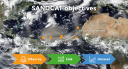
SANDCAT aims to reveal the role of mineral dust in a changing climate, by (1) characterising and quantifying dust transport and exposing differences between wet and dry deposition over the ocean, (2) relating this to current climate variables, and (3) improving model simulations and future climate predictions.
The unique multi-year record with the quantification of dry and wet dust deposition over the Atlantic Ocean, together with a thorough particle characterisation and the implementation in state-of-the-art climate models, will lead SANDCAT to determine the two-way interactions between dust and climate, ultimately contributing to improved climate projections.
The global route on the ocean where samples will be taken for the SANDCAT project (photo: NIOZ)
More about NIOZ dust research
Desert dust transported over large distances through the atmosphere is a potential fertilizer of the ocean. Since 2012 NIOZ monitors ocean dust originating from the Sahara Desert using an array of moored dust-collecting buoys at the surface and sediment traps in the ocean below it.
Project leader
Michèlle van der Does
Postdoc
