PHYVIR
Resolving marine phytoplankton – virus interactions from local to global scales
Phytoplankton (tiny ocean plants) produce half the Earth’s oxygen and feed the seas but are infected by viruses. Although we have all experienced the massive effect viruses can have at local and global scales, very little is still known about their impact on phytoplankton in the oceans. The PHYVIR research project aims to fill this knowledge gap, by investigating virus-phytoplankton interactions in the laboratory and during oceanic expeditions, and by building advanced computer models to predict how marine viruses affect carbon and nutrient cycling in the ocean and, thus, our planet's health.
Duration
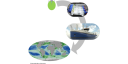
Viruses are key drivers of selective marine phytoplankton mortality, yet translating their ecological impacts across different scales remains a major knowledge gap.
Project description
Despite their minute size, marine phytoplankton are responsible for ca. 50% of the global oxygen production and sequester vast amounts of anthropogenic CO2. They are vital for marine ecosystem productivity and play a key role in global carbon and nutrient cycling. However, like all life on Earth, phytoplankton are susceptible to viral infections. Viral induced mortality (viral lysis) of phytoplankton cells redirects the flow of energy and elements with expected far reaching consequences for ocean ecosystem structure and functioning.
Still, phytoplankton viral lysis rates are poorly constrained, to what extent viral infections affect phytoplankton host elemental composition (i.e., ecological stoichiometry) and functional characteristics (i.e., traits) remains to be elucidated, the effects of (global climate change induced) environmental stressors on virus-host interactions are understudied, and a comprehensive understanding of the geographical distribution of virus and phytoplankton host traits is lacking. Moreover, virus-host dynamics in global ecosystem and biogeochemical models is generally missing, merely implicitly included, or assumed to be equal for all phytoplankton groups. Only by integration of complementary expertise, ranging from viral ecology, phytoplankton ecophysiology, molecular biology, and biological oceanography, to large scale bioinformatic data analysis and mathematical modelling, can we effectively bridge the knowledge gaps that limit our current understanding and predictive power of how viral infections impact phytoplankton composition and biogeochemical fluxes.
Project objectives
The PHYVIR project aims to elucidate phytoplankton-virus interactions, from the sub-cellular level to the biosphere, and from local to global scales. The research spans from genetic analysis and controlled experiments to oceanic expeditions and global ecosystem models. The five interlinked objectives center around:
- Single host-virus system experiments that will provide detailed trait characterization of virus and infected host, elemental stoichiometry and patterns of gene expression for the major phytoplankton groups, which will be used to evaluate the mechanistic trait-based model.
- Lab-based multi-host experimental systems will determine the impact of viral infection on competitive interactions, particularly under nutrient limitations and shifts in temperature.
- Manipulation of semi-natural phytoplankton communities to characterize the impact of viral infections on host gene expression and trait distribution under similar environmental stressors.
- Oceanic fieldwork in the Atlantic Ocean, which is of global importance for ocean circulation and climate, to assess phytoplankton and virus biogeography from the tropics to sub-polar waters. Along these large-scale environmental gradients, notably in nutrients and temperature, phytoplankton population specific viral lysis rates will be quantified and the active viral infections causing these will be identified by cell sorting in combination with targeted omics approaches.
- Phytoplankton-virus interactions will be integrated into state-of-the art global marine ecosystem models, which will build on the empirical traits, elemental stoichiometry and rate quantification and be validated against large-scale patterns of viral lysis rates and viral biogeography.
The synergistic approach and methodologies applied are at the forefront of current advances in marine microbial ecology and oceanography. Collectively, the new insights obtained from the PHYVIR project will yield data-informed projections on the quantitative impact of viral lysis on phytoplankton communities and associated impacts on global carbon and nutrient cycling of the future ocean.
Project members
- Dr. Hisham Shaikh (postdoc) - NIOZ
- Li Zhao (NIOZ)
- Prof. Dedmer Van de Waal (Netherlands Institute of Ecology NIOO-KNAWOpens in a new tab)
- Xiaonan Cai (PhD student, NIOO)
- Dr. Thomas Hackl (University of GroningenOpens in a new tab)
- Lea Simon (PhD student, University of GroningenOpens in a new tab)
- Dr. Susanne Wilken (University of Amsterdam-IBEDOpens in a new tab)
- Naomi Bakken (PhD student, University of Amsterdam-IBEDOpens in a new tab)
- Prof. Jef Huisman (University of Amsterdam-IBEDOpens in a new tab)
- Melle Versluis (PhD student, University of Amsterdam-IBEDOpens in a new tab)
- Dr. Cara Nissen (University of Amsterdam-IBEDOpens in a new tab)
Consortium members
- Dr. Daniel Mende (Keio University, Tokyo, Japan)
- Dr. Stephanie Dutkiewicz (MIT, USA)
- Prof. Mick Follows (MIT, USA)
- Dr. David Talmy (University of Tennessee, USA)
- Prof. Elizabeth Borer (University of Minnesota, USA)
- Dr. Yael Artzy-Randrup (UvA)
- Dr. Paula Dalcin Martins (UvA)
- Prof. Mathieu Odijk (University of Twente)
- Tycho. Malmberg (NIBI - The Netherlands Institute of Biology)
- Dr. Guy Schlyer (collaborator, NIOZ)
- Dr. Rob Middag (collaborator)
Project interns and guests
- Amelie Wittig (UvA, MSc student 2026 at NIOZ)
- Jitske Luttikholt (HBO student 2026 at NIOZ, Hogeschool Saxion, Deventer)
- Liam Mills (UU MSc student 2026 at NIOZ)
- Thomas Cupido (RUG MSc student 2026 at NIOZ/RUG)
- Emma Hynes (UvA MSc student 2026 at UvA)
- Eva Hekma (UvA MSc student 2026 at UvA)
- Karlein van Bijssum (RUG MSc student 2026 at RUG)
- Dr Jasmin Stimpfle (Guest joining cruise PHYVIR-1; AWI, Germany)
Related scientific publications
- Kristina D.A. Mojica, Corina P.D. Brussaard. 2026. Marine Viruses and Their Role in Marine Ecosystems and Carbon Cycling. Annual Review Marine Science. 18:351-380. https://doi.org/10.1146/annurev-marine-040324-020244Opens in a new tab
Project leader
Corina Brussaard
Senior Research Leader

Project team
Li Zhao
PhD student

Hisham Shaikh
Postdoc

External project members and interns
prof.dr. Dedmer van der Waal
Professor, NIOO-KNAW
Xiaonan Cai
PhD student, NIOO-KNAW
Thomas Hackl
Assistent professor, University of Groningen
Lea Simon
PhD student, University of Groningen
Susanne Wilken
Associate professor, University of Amsterdam
Naomi Bakken
PhD student, University of Amsterdam
Jef Huisman
Professor, University of Amsterdam
Melle Versluis
PhD student, University of Amsterdam
Dr. Cara Nissen
University of Amsterdam