Student found the first Pacific barnacles in the Wadden Sea
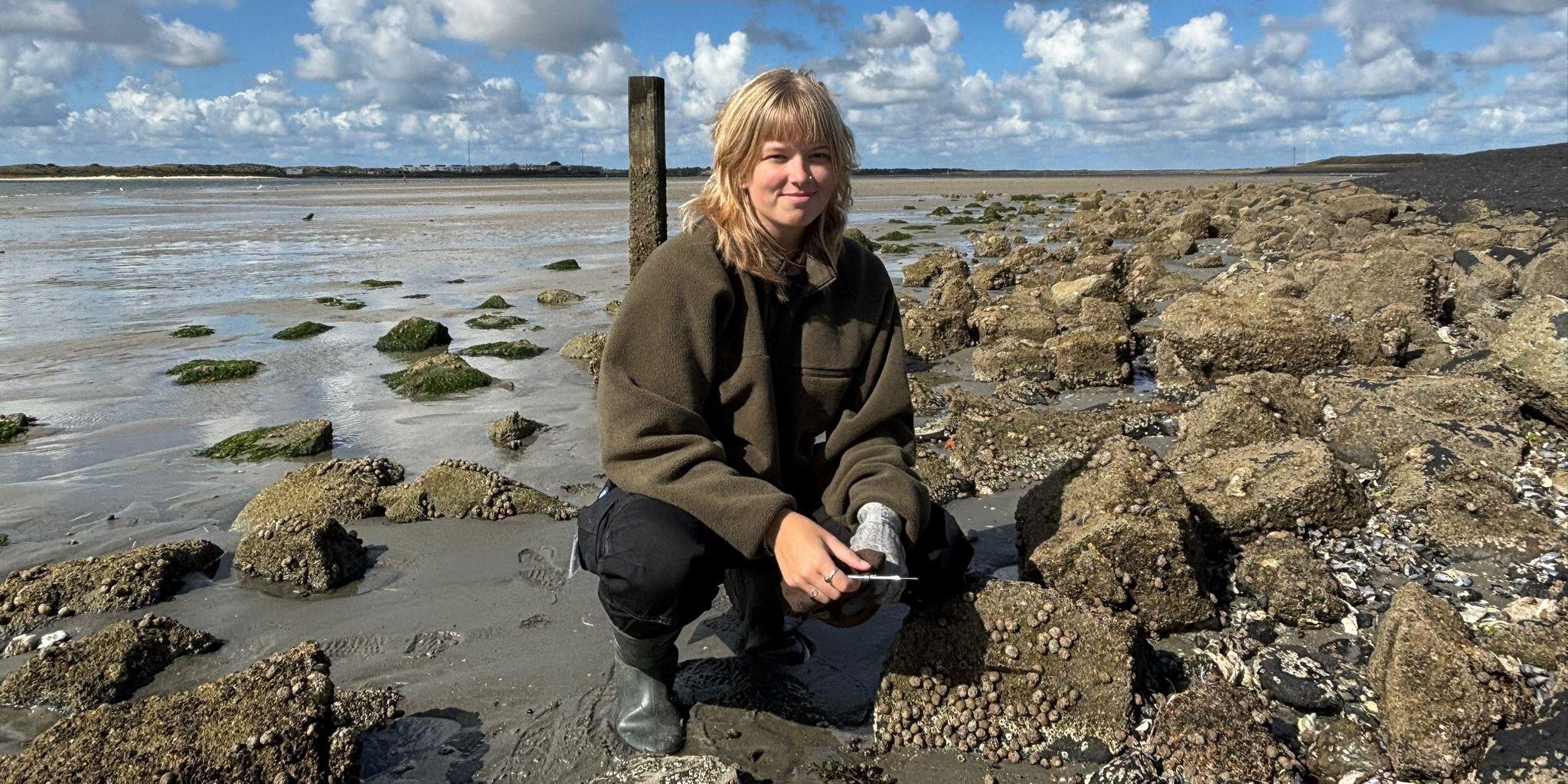
Rosalinde van Ooijen among barnacles during field work.
NIOZ researchers have found the Pacific barnacle Balanus glandula in the Wadden Sea for the first time. Until now, this species was only known to exist in European waters in Belgium and on the south coast of the Western Scheldt. It probably travels in the ballast water tanks of large ships and as fouling on ship hulls.
Master's student in Freshwater and Marine Biology Rosalinde van Ooijen from the University of Amsterdam did her Master's research at NIOZ and spent last spring searching for barnacles and their parasites in the Dutch and German Wadden Sea. ‘Research assistant Loran Kleine Schaars advised me to keep an eye out for the Pacific barnacle Balanus glandula. Its numbers have been increasing significantly for decades in countries such as Japan and South Africa, and since 2015 we know that it also occurs in Belgium and Zeeland.’
Charles Darwin
The species was first described by Charles Darwin and originates from the Pacific coast of North America, but has spread to the coasts of Argentina, Japan and South Africa. It probably travels in the ballast water tanks of large ships and as fouling on ship hulls. In its original range, the barnacle lives in the middle to upper tidal zone of rocky coasts.
Wall plates and a white chalk base
Barnacles are very similar to each other. Van Ooijen: ‘I took them to the lab for identification under a microscope or stereomicroscope. You then, for example, must count whether they have four or six wall plates: the parts that make up their rounded cone shape. In the middle is an opening, closed off by plates that also differ per species. And when you remove them from their substrate, some species leave behind a calcified white base plate. After email contact with researcher Francis Kerckhof, who discovered this barnacle in Belgium, we could confirm it was really the Pacific barnacle.’ The student found Pacific barnacles around the island of Texel and along the Frisian coast near Lauwersoog. She did not find them around the German island of Sylt, suggesting the species has not yet spread throughout the Wadden Sea.
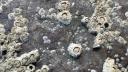
Barnacles in the Wadden Sea
Six pairs of long legs
Barnacles are crustaceans that attach themselves to hard substrates such as rocks and shells. When submerged, they open their “shell” and move six pairs of long legs outwards. As they swirl, plankton, their main food source, is drawn towards them. It is not known whether the Pacific barnacle has the potential to displace the species that already live in the Wadden Sea. Van Ooijen: ‘In Japan and South Africa, the new species is very invasive and has displaced other species. In the Wadden Sea, I found only small numbers compared to the other species. We do not yet know whether and how there is competition between the different barnacles. That will become clear if we continue to monitor the numbers.’
The Wadden Sea is getting warmer
NIOZ research by Sonja van Leeuwen shows that the water temperature in the Wadden Sea has risen rapidly since 2000. This temperature has been measured regularly since 1860, and since 2001 even every 10 seconds. It is not yet known whether the barnacle now found is more resistant to warmer water than native species. The concept of “native species” is relative, however. The barnacle species that Van Ooijen found most frequently in many places actually is an invasive exotic species from New Zealand and Australia. Its numbers have increased rapidly in recent decades. This probably has to do with climate change. Van Ooijen's supervisor, ecologist David Thieltges: ‘Our colleagues at the Alfred Wegener Institute in Germany, which has a Wadden Sea station on the island of Sylt, have observed a sharp increase in this exotic species in their long-term time series and were able to establish a link with a long series of mild winters and warm summers.’
Is it a problem if one species of barnacle displaces another? Van Ooijen: ‘That's difficult to say. In any case, it's a change in a sea that is a world heritage site.’
Linked staff
David Thieltges
Senior Scientist

Loran Kleine Schaars
Research Assistant

Cyril Hammoud
Postdoc