Strong currents supply food towards deep-sea reefs
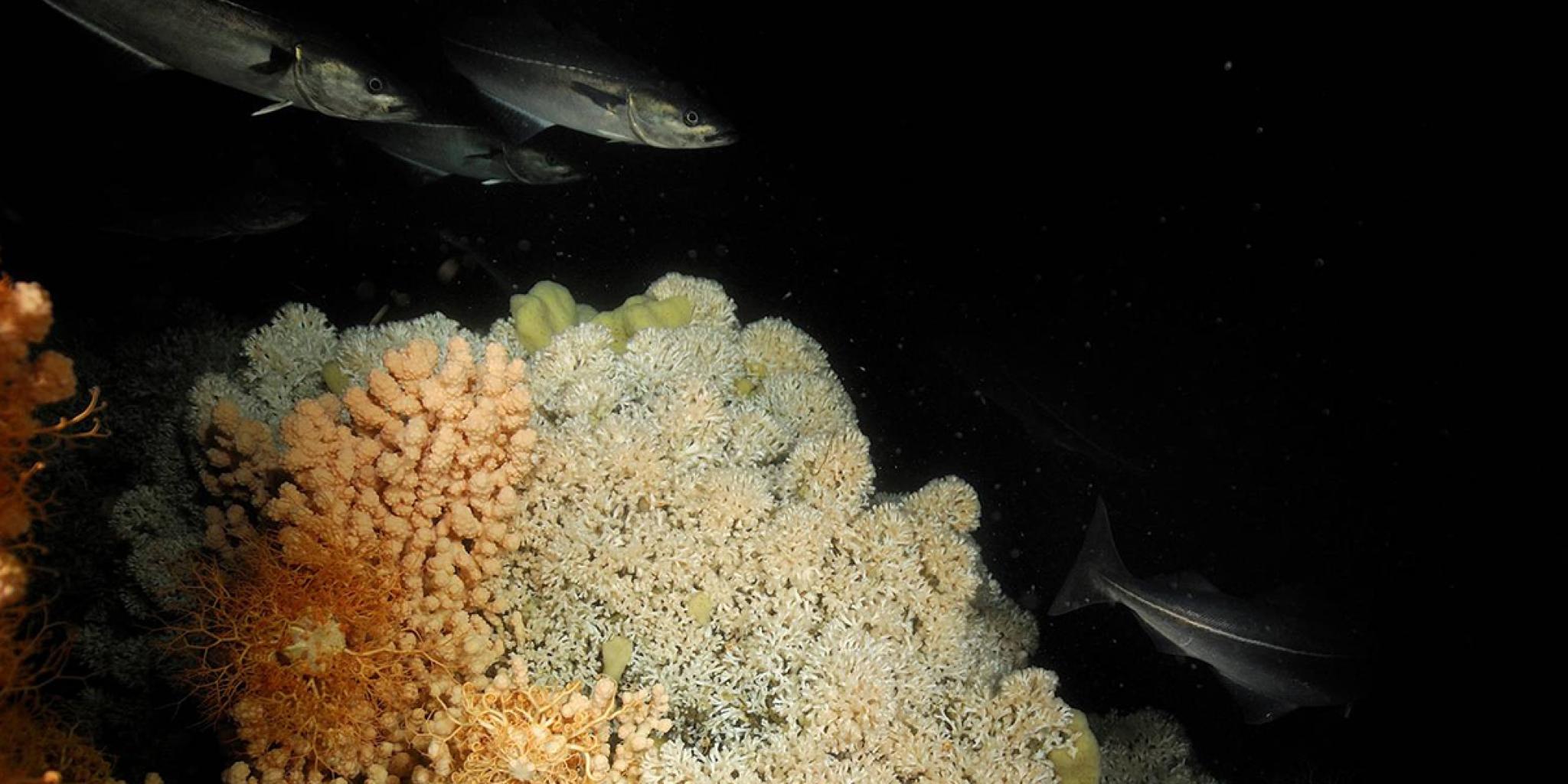
Cold-water coral reef in the deep sea. The deep sea is all water deeper than 200 meters. Sunlight cannot penetrate to this depth (photo: Dick van Oevelen)
Marine biologist Evert de Froe discovered how cold-water corals and sponges can make thriving reefs in the deep, dark and cold sea: ocean currents ensure the supply of sufficient food to the ocean floor. Using a simulation model, De Froe can now predict the presence of deep-sea reefs. On Monday 13 March, he will defend his thesis at Utrecht University.
Cold water coral reef in the deep sea. They play a key role in the ocean carbon cycle. Photo: Solvin Zänkl.
Underwater tropical rainforest
"Cold-water corals and sponges in the deep sea," says PhD candidate at the Royal Netherlands Institute for Sea Research (NIOZ) Evert de Froe, "are known as the underwater equivalents of tropical rainforest. They are tremendously diverse: all kinds of fish, lobsters and crabs live there." The deep-sea ecosystems play a key role in the ocean carbon cycle but are under pressure of amongst other fishing activities and ocean acidification. This is why NIOZ has been researching cold-water corals and sponges for years.
The question for NIOZ researchers has long been how it is possible that there are such hotspots of biodiversity in the deep sea, because on the ocean floor it is pitch black and cold. "We also thought that there was little food available," said Dick van Oevelen, De Froe's supervisor and senior researcher at NIOZ. "But now we know better."
During this research, De Froe and Van Oevelen's team discovered how it is possible that some places in the deep sea are not at all as food-poor as scientists long thought, but that there is enough food available to support the coral reefs. To do so, he joined two expeditions with the research vessel Pelagia to Rockall Bank, an area 400 kilometers northwest of Ireland. At a depth of 700 meters, cold-water coral reefs can be found there on the ocean floor.
For the first time the exact metabolism measured of deep-sea corals
Firstly, the ocean currents at that site were investigated. De Froe: "In this area, water masses with different densities flow past one another. This creates underwater waves that can sometimes be 200 to 300 meters high. When these so-called internal waves come into contact with a coral mountain on the sea floor, a relatively strong downward current can be created that causes fresh food particles to reach the coral reefs at a depth of 700 meters."
In addition, De Froe measured a process that hadn’t been measured for cold-water coral reefs before. To do so, he sampled a quarter square meter of coral reef, with live corals, sponges and crabs in it, with a sealable box, a box core. "In such a cube with a diameter of 50 cm, the coral lives on,” explains the researcher. “We measured the inorganic nitrogen concentration, such as nitrate and ammonium in the water – before and after 24 hours. This allowed us to determine the release of inorganic nitrogen by the reef."
These measurements showed that a cold-water coral reef is a hotspot of carbon and nitrogen cycling in the deep sea. "On average, a coral reef converts five times more carbon than a sediment-only area, and therefore also needs a higher food supply to do so," he said. The inorganic nitrogen that the coral reef emits, can in turn can be used by bacteria in the water.”
Predicting presence of deep-sea reefs
After all this De Froe wanted to answer whether he can predict on what locations deep-water reefs can be found elsewhere. Validated by the measurements, De Froe was able to develop a simulation model of food particle transport above the reef. "We don't yet know where in the worldwide oceans those deep-sea coral reefs occur and this computer model is a start to being able to predict that. If you can predict many corals in a specific area, then you can agree to protect that spot in the deep sea from human influence such as bottom-intensive fishing, oil drilling, or seismic surveys."
Deep sea coral reefs are hotspots of biodiversity. Photo: NIOZ
Linked staff
Dick van Oevelen
Research Leader

Cover_portrait.jpg