Sponges create the right conditions for a complete deep-sea ecosystem
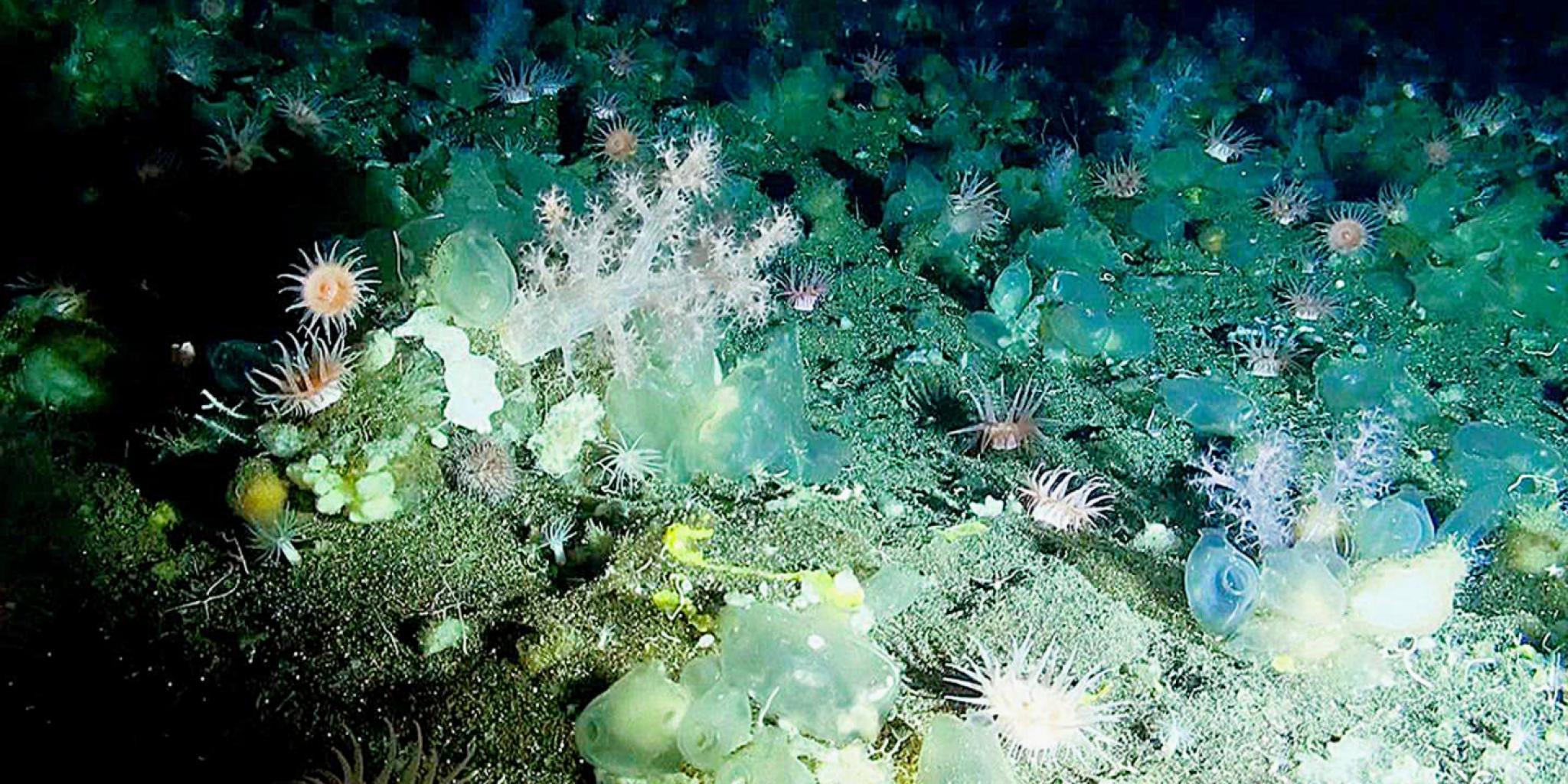
Deep-sea sponge grounds are hotspots of marine biodiversity (photo: NIOZ)
Deep-sea sponges in Arctic waters respire oxygen and turn over nutrients at an unexpected high rate. That is shown by unique in situ monitoring, almost six hundred meters deep, in the waters between Greenland and northern Norway. The results were published recently in Nature Scientific Reports. “It shows once again how crucial sponges are in many aquatic ecosystems”, NIOZ’s marine ecologist Furu Mienis says.
Robots placed an incubation chamber
For this monitoring, a so-called incubation chamber was specially designed at NIOZ. In this box that is closed at all but one side, the in- and outflux of water and all dissolved matter are analyzed automatically. It was placed on the ridge of the Schulz Bank, a sea mount that rises up to – 580 m depth in the Mid Atlantic Ridge. The open bottom was placed over a sponge reef by a remotely operated underwater vehicle, an ROV. This was done aboard from the Norwegian research vessel GO Sars, as part of a scientific cooperation within the EU-SponGES project.
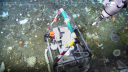
One of the incubation chambers is placed over a sponge reef on a ridge of the Schulz bank (photo: University of Bergen)
High consumption of oxygen
Over the course of four to six hours, the uptake and excretion of oxygen and nutrients were carefully measured. This monitoring showed that the sponges take up substantial amounts of oxygen, up to 0.93 mmol O₂ per square meter per hour, while living at temperatures around 0 oC. That is comparable to the respiration rate of dense cold-water coral reefs and is an order of magnitude higher than typical rates reported for the deep seafloor. “This shows that sponges take up carbon at a rate that cannot be explained by the amount of organic material that descents from surface waters”, first author and former NIOZ PhD-candidate Ulrike Hanz says. In other words: sponges must eat a lot of additional resources dissolved in the surrounding water that are normally not available to marine animals.
Fish benefit
“Moreover”, Hanz says, “the sponges take up a lot of dissolved nutrients, like nitrogen and phosphorous as well. Because they assimilate and subsequently excrete part of these nutrients as particulate matter, they make these nutrients available for other organisms such as fish. These other organisms usually cannot benefit from dissolved nutrients in the way the sponges do.”

Some local interest in the deployment of the incubation chamber (photo: University of Bergen)
Ancient and crucial
The coordinator of this research project, NIOZ’s marine ecologist Furu Mienis, is thrilled with the results. “It shows once again how little we still know about the life of sponges. More importantly it shows how crucial these ancient organisms are to life in the deep sea. They could almost be seen as the ‘primary producers of the deep-sea’, like algae and plants are on the surface, but in this case: without sunlight.”
New ROV
The deployment of the respiration chambers in the ice-cold waters of the Greenland Sea would not have been possible without an underwater robot. Later this year, NIOZ’s brand-new, ocean-going research vessel RV Anna Weber-van Bosse will be fitted with a similar ROV. “This will further increase our possibilities to do research and carry out in situ experiments in these extreme environments”, Mienis says.
Need to know
Mienis stresses that knowledge about sponges exceeds the level of nice-to-know. “Without the metabolism of sponges, many marine ecosystems would collapse, making the life of other organisms, including commercially fished animals, impossible. The amount of oxygen consumption also shows that sponges take their share in carbon sequestration. This makes them a significant player in the climate puzzle as well.”
Linked staff
Furu Mienis
Senior Scientist

Gert-Jan Reichart
Head of Ocean Systems