Spatial self-organized patterns as living infrastructure
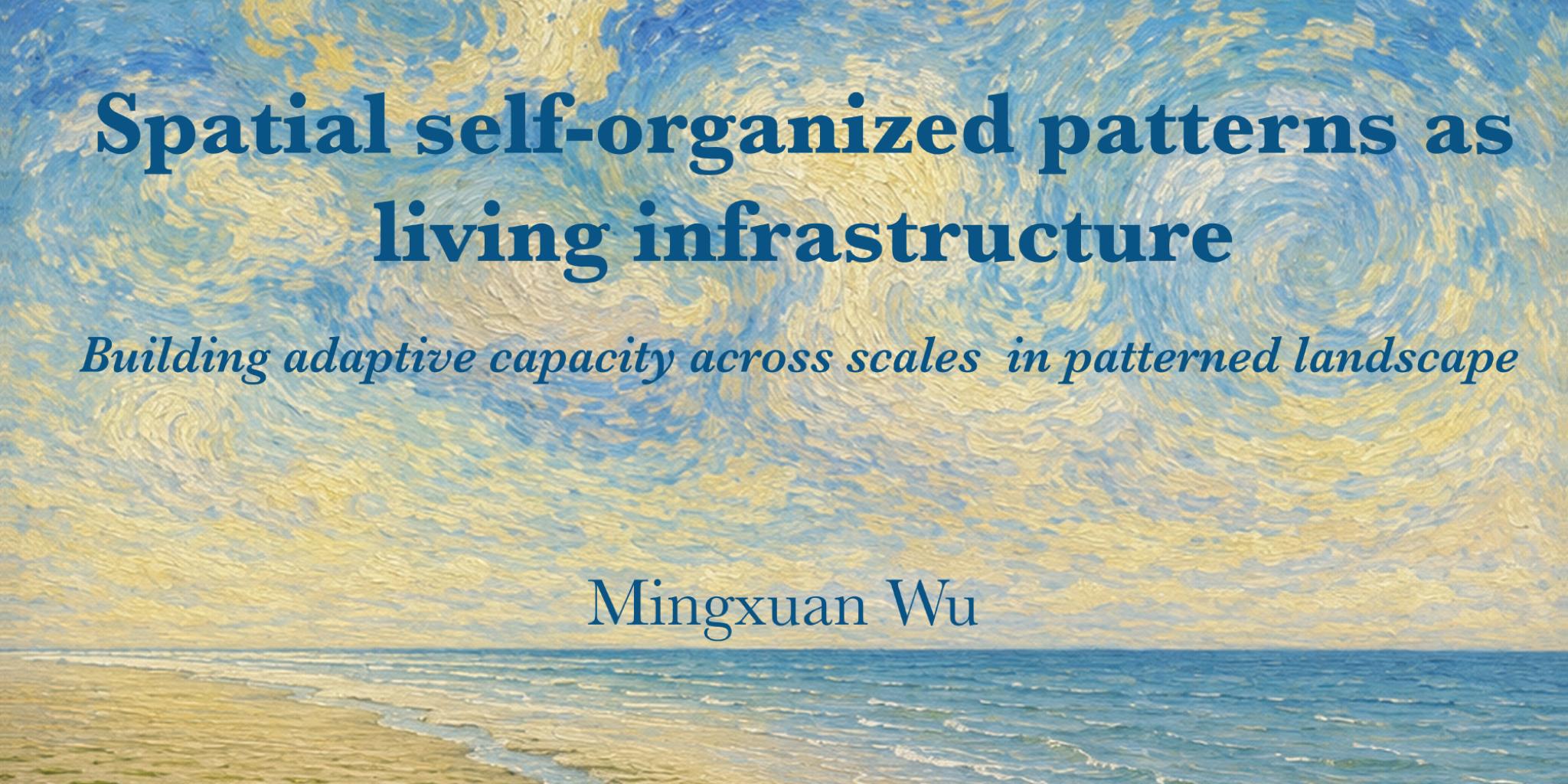
'Spatial self-organized patterns as living infrastructure', thesis cover Mingxuan Wu (image: Mingxuan Wu)
Coastal ecosystems like tidal flats, salt marshes and low-lying meadows protect our shores, store carbon and harbour biodiversity, but they are also among the first to feel sea-level rise, subsidence and salt intrusion. Seen from above, many of them are strikingly patterned. In his PhD research, Mingxuan Wu showed that these self-organized patterns act as living infrastructure: they route water, salt and disturbance, and keep recovery pathways open under stress. This may help make restoration and conservation more effective. Wu is defending his PhD at the University of Groningen on September 8th.

The Paardenschor tidal flat and algae patterns (photo: Mingxuan Wu).
Short summary
Spatial self-organized patterns are widespread across ecosystems. As climate change puts ecosystems under increasing stress, these patterns are often seen as warning signs of decline or even collapse. Beyond what spatial patterns can signal, this thesis investigates what these patterns can do.
The thesis first traces how simple photosynthetic life, in the form of microbial mats found in estuaries, can organize itself into complex, nested patterns across spatial scales. In tidal microbial mats, each additional level of spatial organization increased water retention and recovery after disturbance. It then provides field-based evidence that such spatial structure can actively mediate environmental stress: in salt-affected meadows, hummock–hollow patterns redistributed salt, sustaining plant productivity and reproduction under stressful conditions. Finally, by experimentally creating creek networks in young salt marshes, the thesis shows how deliberately introduced spatial structures can act as footholds for pioneer plants, increasing their survival, reproduction and chances of successful establishment.
Together, these studies trace a progression from how self-organized patterns are built, to how they support ecosystem functioning, and finally to how their underlying logic can be used in restoration. They reveal self-organization as a form of “living infrastructure” that helps ecosystems persist, recover and establish under changing conditions.
A meadow of contrasting landscape in Yerseke (photo: Mingxuan Wu).
Linked staff
Johan van de Koppel
Research Leader

Tjeerd Bouma
Senior Research Leader
Practical information
Mingxuan Wu will defend his PhD thesis, titled 'Spatial self-organized patterns as living infrastructure: Building adaptive capacity across scales in patterned landscape' on 8 September 2026 at 14:30, at the University of Groningen
'Spatial self-organized patterns as living infrastructure', thesis cover Mingxuan Wu (image: Mingxuan Wu)