Sea level rise after the last ice age: more knowledge
New geological data has given more insight into the rate and magnitude of global sea level rise following the last ice age, about 11,700 years ago. This information is of great importance to understand the impact global warming has had on the ice caps and on sea level rise. The findings have been published in the scientific journal Nature by researchers from Deltares, Utrecht University, TNO Netherlands Geological Service, Delft University of Technology, the Netherlands Institute for Sea Research (NIOZ), University of Leeds, University of Sheffield, University of Amsterdam, LIAG and BGR.
Better understanding of sea level rise
The new knowledge into the rate of sea level rise during the early Holocene offers an important point of reference for scientists and policymakers, especially as we are now faced with a similar situation with rapidly melting ice sheets due to global warming. The research provides valuable new insights for the future.
As a result of the current rise in greenhouse gas concentrations, climate models by the Intergovernmental Panel on Climate Change (IPCC) expect sea levels to rise by several metres by 2300. Some scenarios indicate a rise of more than one metre per century. An important difference with the early Holocene is that the consequences of sea level rise are far greater today and in the future. This is due to a growth in population and the current presence of infrastructure, cities and economic activity.
Unique dataset in the North Sea region
Global sea level rose quickly following the last ice age. This was as a result of global warming and the melting of enormous ice caps that covered North America and Europe. Until now, the rate and extent of sea level rise during the early Holocene were not known due to a lack of sound geological data from this period. Using a unique dataset for the North Sea region, the researchers have now been able to make highly accurate calculations for the first time. They analysed a range of boreholes from the area in the North Sea that was once Doggerland, a land bridge between Great Britain and mainland Europe. This area flooded as sea level rose.
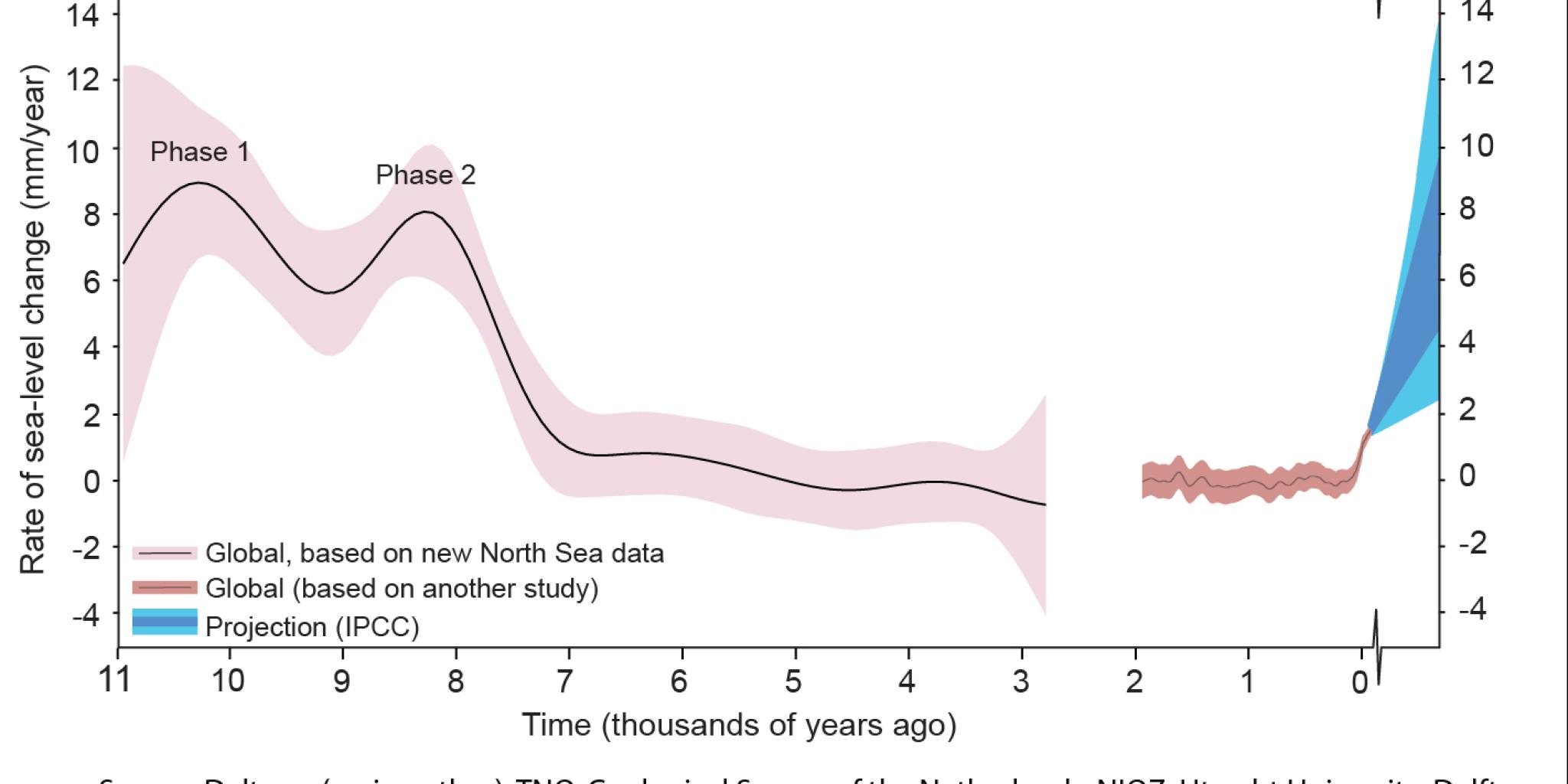
By analysing the submerged peat layers from this area, dating them and applying modelling techniques, researchers showed that, during two phases in the early Holocene, rates of global sea level rise briefly peaked at more than a metre per century. By comparison, the current rate of sea level rise in the Netherlands is about 3 mm annually, the equivalent of 30 centimetres per century, and is expected to increase.
Furthermore, until now there has been considerable uncertainty about the total rise between 11,000 and 3,000 years ago. Estimates varied between 32 and 55 metres. The new study has eliminated that uncertainty and it shows that the total rise was around 38 metres.
Groundbreaking research
Marc Hijma, a geologist at Deltares and the lead author of the study: “With this groundbreaking research, we have taken an important step towards a better understanding of sea level rise after the last ice age. By drawing on detailed data for the North Sea region, we can now better unravel the complex interaction between ice sheets, climate, and sea level. This provides insights for both scientists and policymakers, so that we can prepare better for the impacts of current climate change, for example by focusing on climate adaptation.”
NIOZ researcher Gert-Jan Reichart is one of the initiators of this interdisciplinary research project. Together with Sytze van Heteren (TNO) they launched the data collection campaigns aboard the RV Pelagia held in 2017 and 2018. Over time, this effort expanded and ultimately led to the study now published. The chemical analysis of the drilled cores, which assisted in determining at which point in time the North Sea flooded , was mainly executed by Rick Hennekam (NIOZ). This underscores the interdisciplinary nature of the study. Reichart emphasized the importance of such collaborations: “Collaborations like this, where each institution brings their unique expertise and knowledge, are essential to help us understand the complex processes of climate changes in the past.”
Opens in a new tab, was published on 19 March in leading scientific journal Nature.
Global sea level may rise by over 1 metre this century due to increasing greenhouse gases (IPCC) (figure: Deltares)
The above figure illustrates that global sea level will rise rapidly in the coming century; perhaps by more than 1 metre. This is primarily caused by increasing concentrations of greenhouse gases (source: IPCC). Submerged peat layers from the North Sea show that these rates were seen in two earlier phases: 10,300 and 8,300 years ago. Ice sheets melted then due to rapid warming after the last ice age.
Linked staff
Gert-Jan Reichart
Head of Ocean Systems

Rick Hennekam
Senior Scientist

Core photo of drilling from the North Sea

Drilling from the North Sea. In the center you can clearly see how a layer of brown peat is covered by a layer of gray clay, the moment (8700 years ago) that this part of the North Sea was flooded.