Salt marshes are proving to be powerful allies in building a climate-resilient coastline
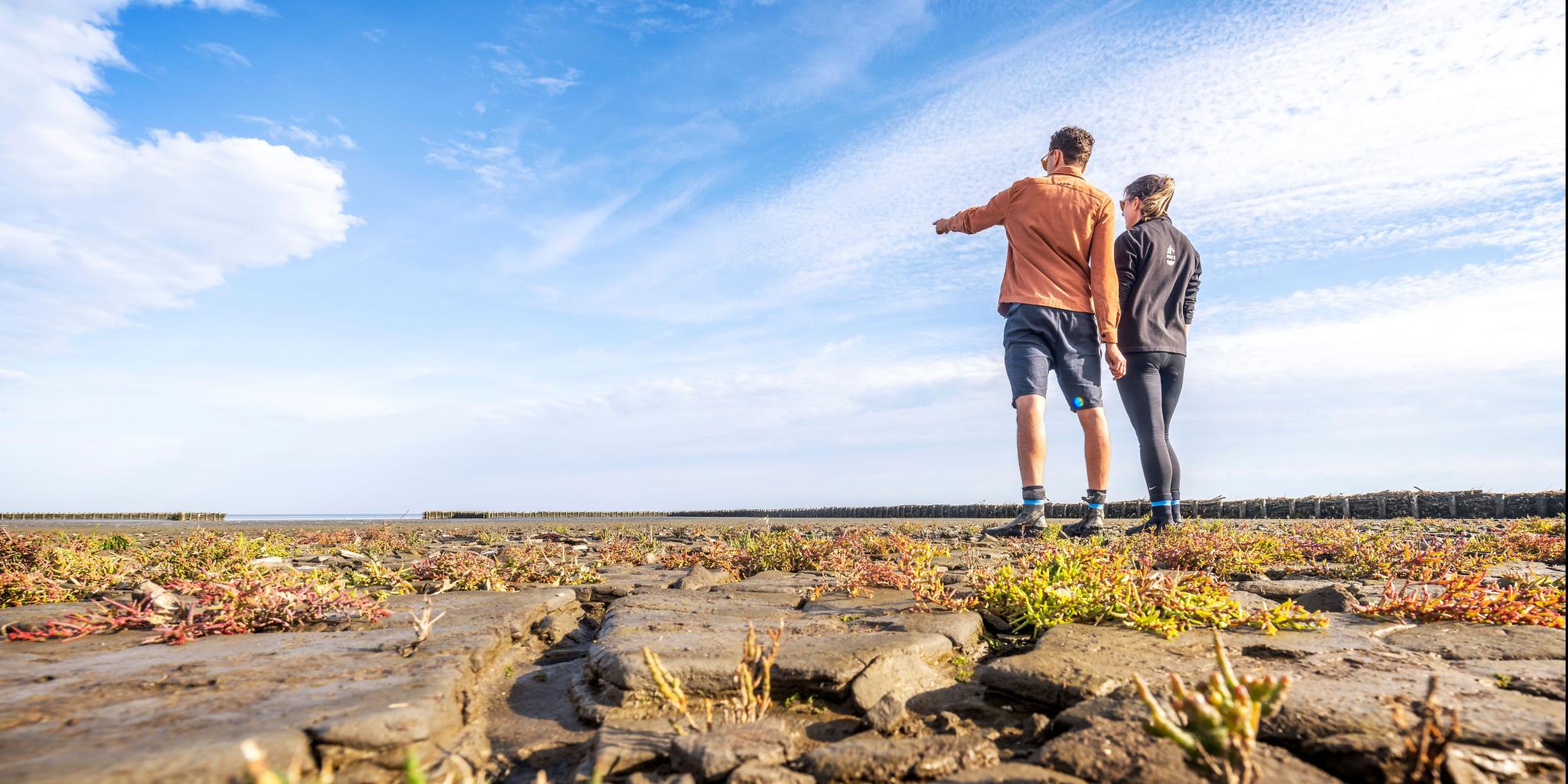
Pim Willemsen (WUR) and Victoria Mason (NIOZ) in one of the salt marshes they studied (photo: Guus Schoonewille for Deltares)
Salt marsh sediment and vegetation can remain largely intact even during extreme storm surges. This was demonstrated in a large-scale experiment in which researchers transported sections of salt marsh from the Wadden Sea to the Delta Flume - an experimental facility capable of producing the world’s largest artificial waves. The results show how salt marshes can contribute to natural coastal protection, both in the Netherlands and beyond. The results will soon be published in the prestigious scientific journal Nature and Nature Communications Sustainability.
Is it possible to move an entire section of coastal landscape and then expose it to an extreme storm? That is exactly what researchers from Deltares, Wageningen University & Research, NIOZ, University of Twente, Delft University of Technology and other institutions have done. Sections of intact salt marsh from the Peazemerlannen nature reserve on the Frisian Wadden Sea coast were transported to Delft and installed in Deltares’ Delta Flume.
There, a full-scale salt marsh covering more than 300 square meters was created. The researchers then subjected it to increasingly higher waves, with significant wave heights reaching up to two meters. In total, the salt marsh was exposed to waves for approximately 29 hours. The experiment answered a key question for future coastal protection: do salt marshes continue to function as natural breakwaters even during extreme storms, and can the plants that make up the marsh survive such extreme conditions?
The seabed and plants remain surprisingly stable
The stability of the salt marsh seabed was particularly striking. After 21 hours of wave action, the surface had dropped by an average of only seven millimeters. The seabed thus remained virtually intact, even with waves up to two meters high. This is important for coastal protection. The elevated salt marsh seabed itself helps to slow down the waves. The plants provide additional wave attenuation on top of that, but are gradually damaged during a storm. With waves of 75 centimeters, the vegetation in the experiment provided 6 to 22 percent additional attenuation; with waves of two meters, that was a maximum of 6 percent. Testing different species representative of typical marsh settings around the world, surprisingly little plant material was lost - on average only 30%, and at least one third of the plants remained even after the most extreme conditions. This means that the marsh has the potential to keep protecting our coastlines, even if more than one large storm occurs over winter.
“Firstly, it surprised us how strong the salt marsh was under these extreme waves, with almost no erosion appeared during the experiment”, Pim Willemsen (researcher at Wageningen University & Research and Deltares) emphasizes, Victoria Mason (researcher at NIOZ) agrees: “The marsh plants were able to withstand the waves and broke surprisingly little, enabling them to consistently contribute to wave attenuation".
Significance on a global scale
To investigate what this means outside the Netherlands, the researchers combined the results from the Delta Flume with global data on salt marshes and extreme storm surges. Especially on coasts where waves over the salt marsh do not exceed about one meter, the vegetation appears to make a significant difference: there, the additional wave attenuation typically exceeds 10 percent and can reach up to 50 percent. With higher waves, the contribution of the vegetation decreases.
Using the physical traits, like flexibility, of marsh plants like those tested in the experiment, the researchers aimed to ‘forecast’ how much plant material is lost in large storms, as well as forecasting the storm itself. This helps to be less uncertain about what will happen during storms and to understand how much marshes can help to protect coastlines under extreme conditions.
The results thus show where salt marshes can contribute most to coastal protection, as a form of Nature-based Solutions, a problemsolver based employing nature. They may not replace traditional seawalls or dikes, but they can be combined with them. Because a salt marsh slows down the waves before they reach the sea defence, the load on the sea defence can be reduced. This offers opportunities to combine nature conservation with coastal safety and can also save on coastal protection costs.
“The proven erosion resistance and wave-attenuation properties of the salt marshes, which have historically been part of our coastline, have led to savings in the Koehool–Lauwersmeer dike reinforcement project. Part of the dike revetment does not need to be replaced, or it can be constructed to a lower strength, resulting in savings of millions of euros,” said Paul Buring (Wetterskip Fryslân, water authority Northwest Netherlands).
"Until now, salt marshes barely counted when assessing the safety of a dike. Nobody could say for certain whether a marsh would survive an extreme storm. This full-scale experiment provides that evidence. It means we can start designing the marsh and the dike as one system," says Bas Borsje, Associate Professor of Nature-based Flood Protection at the University of Twente, who led the experiment.
Protecting what already exists
This makes the conservation and restoration of salt marshes especially important. In addition to providing coastal protection, they offer habitats for plants and animals and store carbon. Salt marshes can also grow along with rising sea levels through sediment deposition, though this is not unlimited. If there is insufficient sediment supply or erosion at the edges, salt marshes may actually retreat or disappear. Globally, 719 square kilometers of salt marshes were lost between 2000 and 2019*.
“Conserving salt marshes, and restoring them in areas where they have been lost, is a priority not just for protecting coastlines but also to slow the rapid decline in global biodiversity”, says Victoria Mason (researcher at NIOZ). Pim Willemsen (researcher at Deltares and Wageningen University & Research) emphasizes: “Marsh ecosystems typically grow with a range of plants which each have their own strength for climate change adaptation. Protecting this natural diversity, in marshes and in other ecosystems, is a valuable tool in maintaining their natural climate resilience.”
Collaboration
The research was conducted as part of initiatives including “LIVING DIKES – Realising Resilient and Climate-Proof Coastal Protection
Opens in a new tab” and “Salt Marshes: Where Climate Change Adaptation Meets Climate Change MitigationOpens in a new tab”. The experiment in the Deltagoot was commissioned by Wetterskip Fryslân and funded by the High Water Protection Program (HWBP). WUR, Deltares, the University of Twente, NIOZ, TU Delft, Utrecht University, and Leibniz University Hannover were involved in the research.
Victoria Mason and Pim Willemsen inspecting plant growth in the salt marshes (photo: Guus Schoonewille for Deltares)