Part V of the NIOZ 150 Colloquium Series: Enigmatic Processes in the Marine Nitrogen Cycle
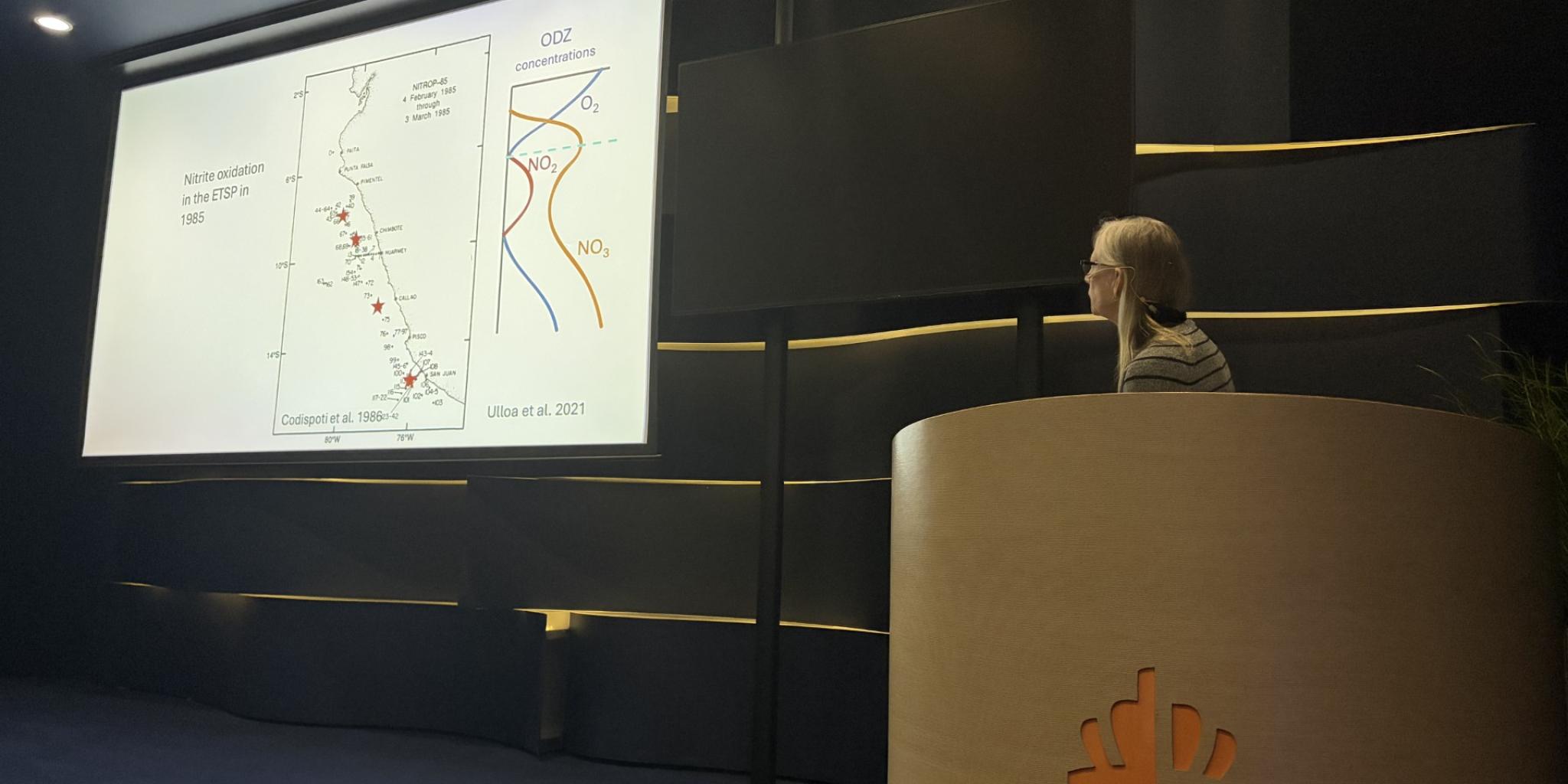
Prof. Bess Ward (Princeton University) explores enigmatic processes in the marine nitrogen cycle, during the fifth NIOZ 150 Colloquium (photo: NIOZ/Guy Schleyer)
As part of the special NIOZ 150 Colloquium Series celebrating NIOZ's 150th anniversary, NIOZ welcomed Prof. Bess Ward from Princeton University for a fascinating lecture on “Enigmatic processes in the marine nitrogen cycle.” Her talk explored some of the unresolved questions surrounding microbial nitrogen cycling in the ocean, with a particular focus on processes occurring in oxygen-depleted marine environments.
Why is nitrogen so important?
The lecture began by emphasizing a fundamental principle of ecology. Why is nitrogen so fundamental? Nitrogen is important no matter what ecosystem. It’s the nutrient control of ecosystem production. Professor Ward began by highlighting the fundamental importance of nitrogen for ecosystem productivity. Nitrogen is an essential nutrient that controls biological production across many ecosystems, including the ocean. She provided an overview of the microbial nitrogen cycle and introduced the key transformations that regulate the availability and loss of nitrogen in marine environments.
Part one: anaerobic nitrite oxidation
A central focus of the lecture was nitrite oxidation in oxygen-depleted zones of the ocean, explored in the 1980s. Nitrite oxidation normally involves the conversion of nitrite (NO₂) to nitrate (NO₃) and is generally associated with aerobic microorganisms known as nitrite-oxidizing bacteria (NOB).
However, experiments from oxygen minimum zones, including regions of Namibia and Peru, have shown substantial rates of nitrite oxidation under conditions where oxygen is extremely low or absent. These observations raise an important question: How can nitrite oxidation occur when oxygen, traditionally considered necessary for the process, is not available?
Discovering novel NOB through metagenomics
Professor Ward discussed how advances in genomic approaches are helping researchers investigate this mystery. By sequencing DNA directly from environmental samples, scientists can reconstruct Metagenome-Assembled Genomes (MAGs) and identify microorganisms that are difficult or impossible to culture in the laboratory. These studies have revealed novel groups of NOB associated specifically with anoxic layers of marine oxygen minimum zones, providing important clues about their metabolism and ecological role.
Testing the oxygen intrusion model
One proposed explanation was the O₂ intrusion model. According to this hypothesis, small or temporary intrusions of oxygen into otherwise oxygen-depleted waters could provide enough oxygen for aerobic NOB to carry out nitrite oxidation. Professor Ward presented experimental work testing this idea by exposing different NOB communities to different oxygen conditions and measuring their nitrite oxidation rates. The results provided an important insight: the response depended strongly on the initial microbial community. Oxygen intrusions could not consistently explain the observed nitrite oxidation.
The marine nitrogen cycle
The second part of Ward's lecture broadened to other enigmatic processes within the marine nitrogen cycle, including nitrate reduction and microbial processes involved in the production of nitrous oxide (N₂O). Professor Ward's lecture demonstrated how observations from marine environments, experimental work, and modern genomic approaches can come together to challenge long-standing assumptions about microbial metabolism.
Professor Ward concludes that even fundamental processes such as nitrite oxidation can behave in unexpected ways in oxygen-depleted marine environments. These discoveries open new questions about the organisms responsible, their metabolism, and their role in the global nitrogen cycle.
Presentation II: Jamies Goodman (NIOZ PhD student)
During the second part of the Colloquium, Jamie Goodman, a PhD student lectured about potential contribution of Flavobacteria to nitrous oxide reduction in permeable sand. The results suggested that increased nitrous oxide (N₂O) availability can stimulate Flavobacterial growth, although responses varied among bacterial groups. Overall, the findings indicate that N₂O availability may promote organic matter degradation and mineralization, potentially enhancing CO₂ production while contributing to N₂O reduction.
Presentation III: Dr Nicole Bale (NIOZ)
Dr Nicole Bale talked about the nitrogen cycle in the Black Sea and how it's been changing over the past 20,000 years. The Black Sea has undergone major changes. The blackwater used to be a freshwater lake. What has happened to the nitrogen cycle through these changes? Thanks to the sediment layers and molecular fossils, this has been able to be studied. Over the past 20,000 years, the Black Sea shifted from a freshwater lake to the saline, stratified sea it is today, fundamentally altering its oxygen conditions and nitrogen cycling. By studying sediment layers and molecular fossils, researchers can reconstruct how nitrogen processes changed alongside these major environmental transformations.
What can be said for the future? In summary, the oxygen content of the ocean has declined 2% over the past 80 years. It is expected to fall 3-4% by 2100, due to climate change and human activity.
Wrapping up the anniversary colloquium series
After the presentations of the fifth and final colloquium, there was time for a chat and a drink. We look back on an inspiring colloquium series celebrating NIOZ's 150th anniversary together. The series connected people, ideas and the international scientific community. It sparked dialogue from cutting-edge research infrastructure to biodiversity, restoration, climate tipping points, and microbial processes. We would like to thank all guests and speakers for their valuable contributions and insights.
Suggestions for future colloquia? Share your idea with the NIOZ colloquium committee (colloquium@nioz.nl).
Linked staff
Nicole Bale
Senior Scientist