Nitrogen processes and the ‘breathless seas'
Thesis cover with abstract illustration of an ocean wave in blue tones with circular patterns, referring to a lipid biomarker approach.
As more and more nutrients from land and air enter the world’s oceans, the dead zones without oxygen in the water will increase in size and intensity. Zoë van Kemenade has focused her PhD research project on combining fossil molecules and chemical analyses, to reveal how nitrogen processes and especially anammox bacteria impact these "breathless seas" and may mitigate oxygen decline. On 24 January, she will defend her PhD Thesis at Utrecht University.
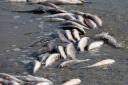
Dead fish on the shore (photo: Shutterstock)
The oceans play a crucial role in the health of our planet, from regulating biogeochemical cycles to influencing the climate. However, due to climate change and ocean fertilization – the runoff of nutrients such as nitrogen from intensive agriculture – increasingly large parts of the oceans are becoming oxygen-depleted. This leads to the formation of so-called "oxygen minimum zones." These 'breathless seas' disrupt the ocean's nitrogen cycle, which is essential for regulating marine life. Disruptions in this cycle can also have significant impacts on the ocean's chemical composition, which in turn affects oxygen levels and the climate.
In oxygen-deprived conditions, nitrogen compounds are removed by processes such as anammox: anaerobic ammonium oxidation, and denitrification. At the same time, nitrogen fixation converts nitrogen gas into nutrients that are critical for life. How these processes interact in a changing climate remains poorly understood. The past, however, provides valuable insights: previous warming periods of the Earth can serve as analogues for the current situation.
This research examined the nitrogen cycle in both modern oceans and during Quaternary climate change, across various seas worldwide. By using fossil molecules (lipid biomarkers) and other chemical analyses, new insights were gained into the interplay between nitrogen processes and oxygen depletion in the oceans. A striking discovery is the role of anammox bacteria in breathless seas: these bacteria remove nitrogen and may help slow the further decline of oxygen in the oceans.
This research not only highlights how regional differences affect the nitrogen cycle but also provides new tools to trace biogeochemical processes. This knowledge helps us better understand how oceans respond to climate change – and what this means for the future of our planet.
PhD defence Louise Delaigue: Tracing the marine nitrogen cycle in breathless seas a lipid biomarker approach.
Linked staff
Darci Rush
Senior Scientist

Laura Villanueva
Head of Marine Microbiology & Biogeochemistry

Zoe van Kemenade filtering sea water on RV Pelagia
First author Zoe van Kemenade filtering sea water on RV Pelagia