Natural coastal protection influenced by seagrass and soil animals
NIOZ PhD candidate Jaco de Smit investigated the role of the tidal zone in natural coastal protection. He improved a research method to conduct realistic experiments in the sea. In doing so, he discovered that offshore seagrass is surprisingly resilient to storms and that soil-dwelling crustaceans make the soil less stable. On Friday 17 March, De Smit will defend his thesis at Utrecht University.
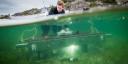
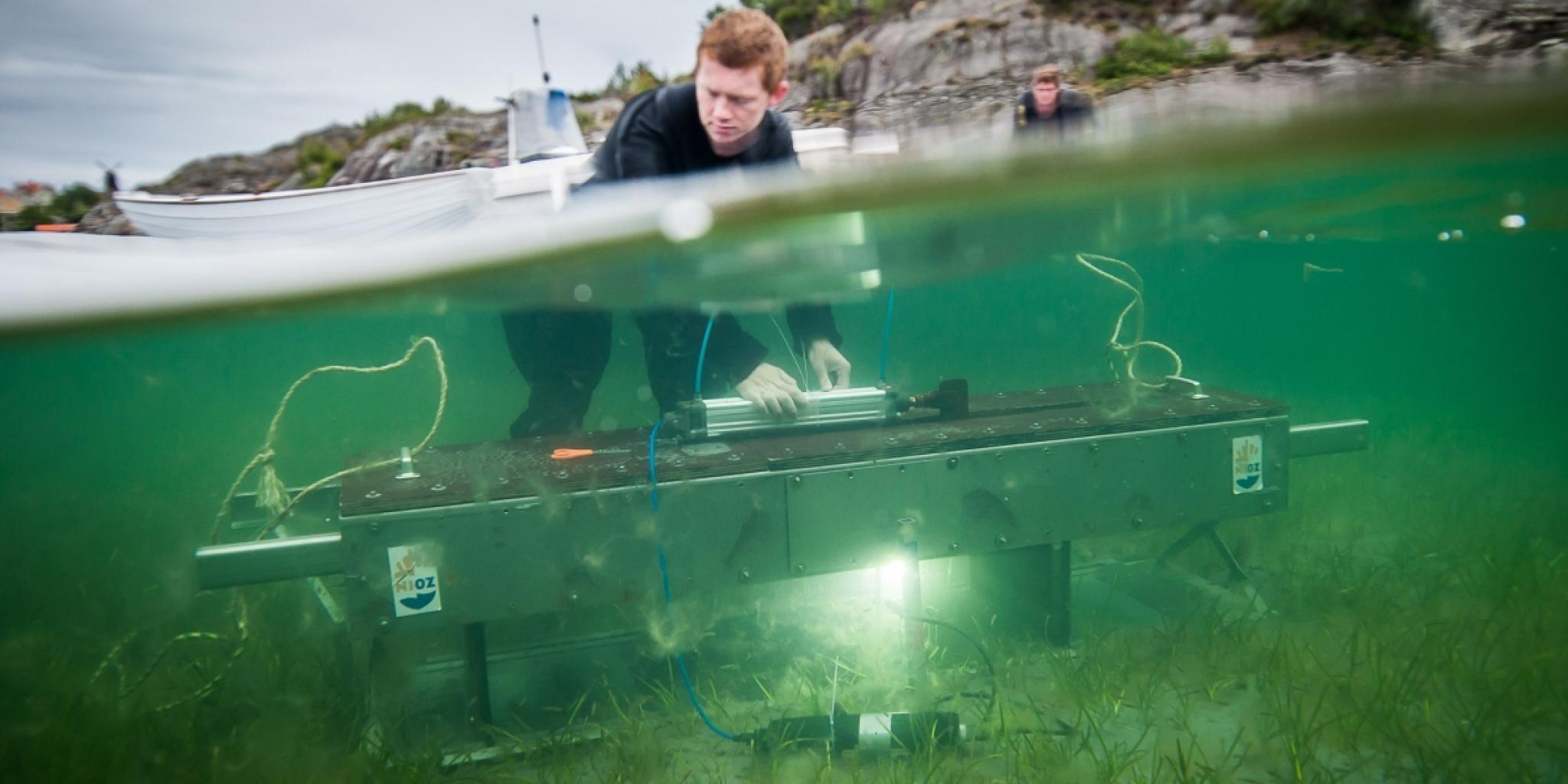
Researcher Jaco de Smit in action with a field flume. This is a test rig in which a piece of seabed is subjected to a fixed amount of current or waves. Photo: Eduardo Infantes.
Soil stability of great importance
For hundreds of years, the Netherlands has protected its coastal areas with dykes, but rising sea levels mean that dykes have to be made higher and wider to withstand severe storms. This is not only very costly, it also puts a strain on nature in tidal areas. While those ecosystems, comprising salt marshes and mud flats, can actually help protect the coast. In the Netherlands, but also in many other countries worldwide.
Coastal defences that keep up with sea level
"Aquatic plants can trap the sand and mud that is carried by the sea water. As a result, when the sea level rises, the foreshore grows with it," says coastal ecologist and expert on natural coastal protection Tjeerd Bouma of the Royal Netherlands Institute for Sea Research (NIOZ). "That makes the foreshore deployable as part of coastal protection. An important condition, however, is that it is possible to accurately predict how the force of the seawater affects the stability of the seabed." This is one of the reasons why NIOZ is studying the dynamics of coastal systems.
Doing experiments in the lab or in the field
Physical geographer Jaco de Smit contributed to this with his PhD research in several ways, under the guidance of Bouma and Professor of Biogeomorphology Maarten Kleinhans of Utrecht University. "In practice, it is difficult to measure bottom stability in the tidal zone because you cannot control the waves and currents in 'the field'. But in the lab, you would have to transplant or recreate the whole ecosystem with plants and soil animals."
Flow channels in the tidal zone
De Smit therefore applied a relatively new experimentation method, midway between the natural system and lab experiments: he built so-called field flumes. These flow or stream channels of several meters long are placed in the tidal area. For different parts of the foreshore, De Smit and his colleagues built three different types of field flumes, enabling him to measure and change both below and intertidal water conditions.
Seagrass mitigates the strength of storms
His results from a project in Sweden show that eelgrass (Zostera marina), which grows in shallow water, makes the seabed more stable because it takes away the force of the water, thus preventing sand from washing up. De Smit: "Remarkably, the effect of increasing storm activity is small. This means that seagrass beds have great potential for coastal protection."
Little crustacean makes soil unstable
On Texel and in Zeeland, De Smit studied how strongly the intertidal soil wears as a result of the activity of bottom-dwelling animals in the mud. "The mud crustacean Corophium votulator, which makes up only a small part of the biomass in a habitat community, can have a big negative effect on soil stability. Even if other, much larger species like the Baltic clam and the sea centipede are also present in the soil. The 2 to 3 millimeter small crustacean is therefore a key species for mudflat soil instability."