Genetic insights shed light on shiny bacteria
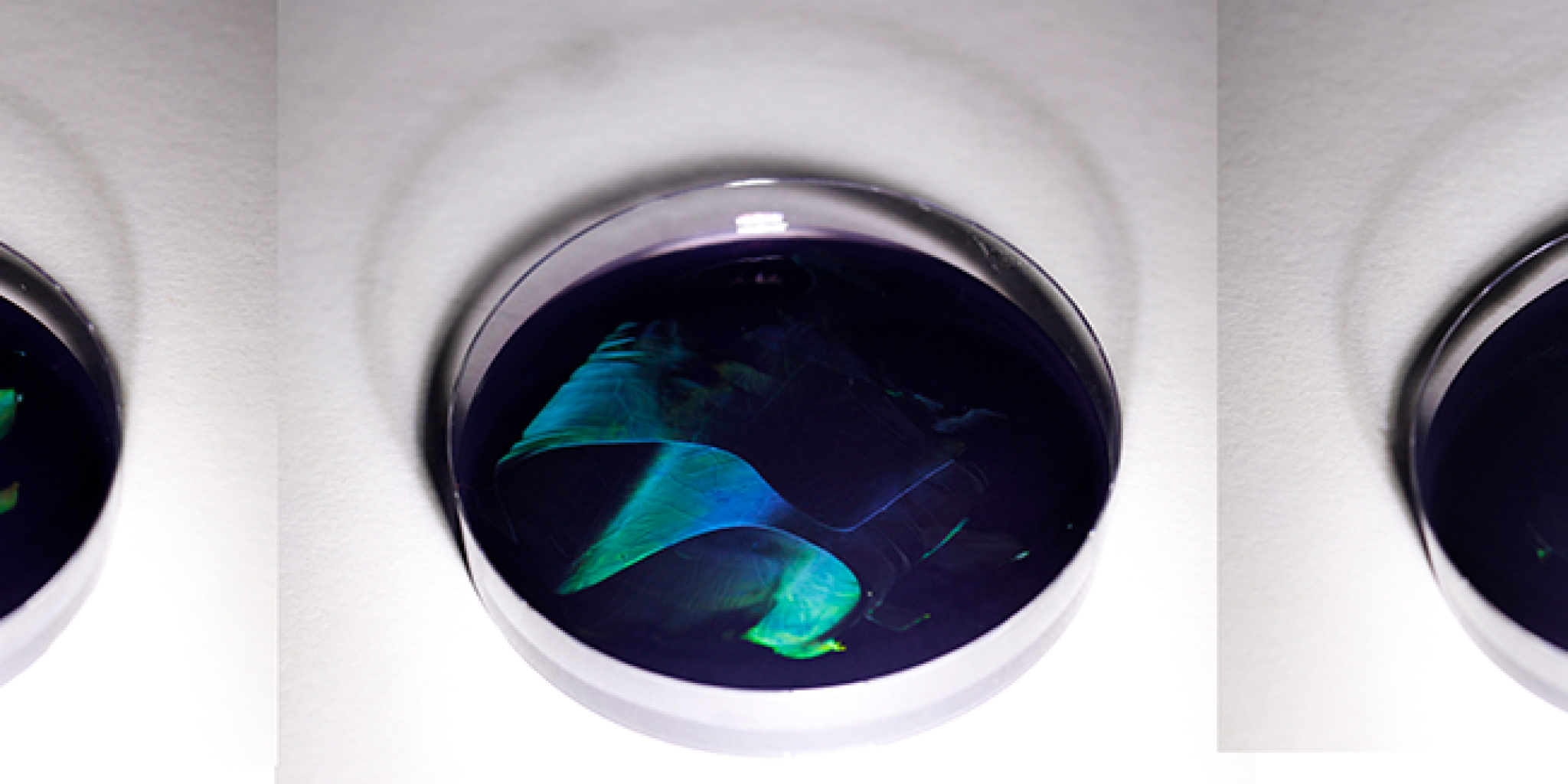
Iridescence in colonies of the marine bacterium Muricauda ruestringensis growing on agar, viewed from three different angles. (photo: Colin Ingham/Hoekmine BV)
Some bacteria form colonies that display striking, reflective colours. An international, interdisciplinary team with NIOZ researchers Henk Bolhuis and Bastiaan von Meijenfeldt, gained new genetic insights into the formation of such colours which allowed them to identify the environments and bacterial groups in which these colours are found. The findings, which were published in the scientific journal Proceedings of the National Academy of Sciences (PNAS), form a starting point to understand the function of these colours in bacteria, and might have implications for the development of new innovative materials to replace non-sustainable dyes.

Iridescence in colonies of the marine bacterium Muricauda ruestringensis growing on agar, viewed from three different angles. (photo: Colin Ingham/Hoekmine BV)
Structural colour
The striking, vibrant colours that we know from butterfly wings and peacock feathers are not the result of dyes or pigments. Instead, they are created by tiny, ordered structures that interact with light, creating a vibrant display of hues that is often perceived as iridescence (changes in colours depending on the angle of view or illumination). Such ‘structural colour’ is widespread in nature, and also exist in bacteria.
Structural colour is not displayed by individual single-cell bacteria, but by colonies of certain bacteria. Previous studies showed that specific genes involved in motility allow these bacteria to precisely align and form highly structured colonies that are able to produce iridescence. The exact function of structural colour in bacteria, as well as the genetics behind them, remained largely unknown up to now. In other life forms, structural colour plays a role in display, camouflage or protection from light, amongst others.
Specific genes
To gain more insight into the genetics behind structural colour in bacteria, the first step the researchers took was to collect 87 structurally coloured bacterial isolates, alongside 30 closely related non-iridescent strains. They then determined the sequence of the DNA of these bacteria. By comparing the DNA-sequences of the different strains, the researchers found that the bacteria that exhibited structural colours shared specific genes, even though the iridescent bacteria belonged to very diverse and different bacterial groups. These genes were absent in non-iridescent bacteria.
“This suggested that genes leading to structural colour may be shared between bacteria that are not directly related,”, says Bas Dutilh, professor at the University of Jena and visiting professor at Utrecht University. “Being able to trace the evolution of this colony characteristic, which is so striking to us, may help us to understand its function in bacteria.” Interestingly, some of the genes that were associated with structural colour in bacteria also contribute to the phenomenon in butterfly wings.
Machine learning
Combining the genetic insights with the data of the 117 DNA-sequences, the researchers also trained a computer model to be able to predict whether bacteria would display iridescence based only on their DNA-sequence. They used a technique called machine learning, a form of artificial intelligence that uses mathematical models to allow computers to learn without giving them direct instructions. “The machine learning model unexpectedly also predicted structural colour in new groups of bacteria, which we confirmed in the lab. This really shows the power of machine learning to predict biological functions from very complex genetic data”, says UU-researcher Aldert Zomer.

Colonies of the marine bacterium Marinobacter algicola HM-28’ showing brilliant structural colours. (photo: Colin Ingham/Hoekmine BV)
Distribution of structural colour
Bastiaan von Meijenfeldt, currently working at NIOZ but at the time a PhD student in Utrecht, used this machine learning model to analyse the DNA of all kinds of other bacteria. He screened and analysed 250,000 publicly available bacterial DNA-sequences and 14,000 metagenomes, which are complete sets of DNA-sequences found in environmental or clinical samples. Using this data, Von Meijenfeldt set out to map the distribution of structural colour in the bacterial tree of life, and across habitats.
The researcher found that bacteria that live in or on hosts, such as our gut bacteria, almost never showcase structural colour. In contrast, structural colour was predicted to be abundant in bacteria that live in marine waters and lakes, and in interfaces between surface and air such as on glaciers and in intertidal areas. The latter finding could suggest that the function of the structuring in these bacterial colonies is indeed to interact with light. However, this does not always seem to be the case.
More colour in deeper water
Von Meijenfeldt: “We were very surprised to see that the abundance of genes involved in structural colour increased in bacteria living in deeper waters, where light does not penetrate. This is not what you would expect if breaking of light plays a role in bacterial structural colour. We did find support for a hypothesis that bacterial structural colour is associated with floating particles in these dark depths, which potentially could mean that the structuring has other advantages and structural colour in this case is a byproduct.”
Interdisciplinary research project
The study is the result of a large scale and highly interdisciplinary collaboration between institutes, initiated by Henk Bolhuis who received a ZonMW grant for this earlier. “We were intrigued by these strikingly coloured, reflective bacterial colonies, and we wondered how widespread this phenomenon was.” Bolhuis’ knowledge on marine micro-organisms was combined with the expertise from the team in Utrecht in machine learning and genomics: the field that focuses on the study of the complete set of DNA of organisms. Richard Hahnke (Leibniz Institute DSMZ) contributed rare bacterial isolates and Silvia Vignolini (University of Cambridge and Max Planck Institute of Colloids and Interfaces) performed experiments that proved the colony structuring.
Linked staff
Henk Bolhuis
Senior Scientist

Bastiaan von Meijenfeldt
Postdoc