Coastal ocean chemistry now substantially shaped by humans
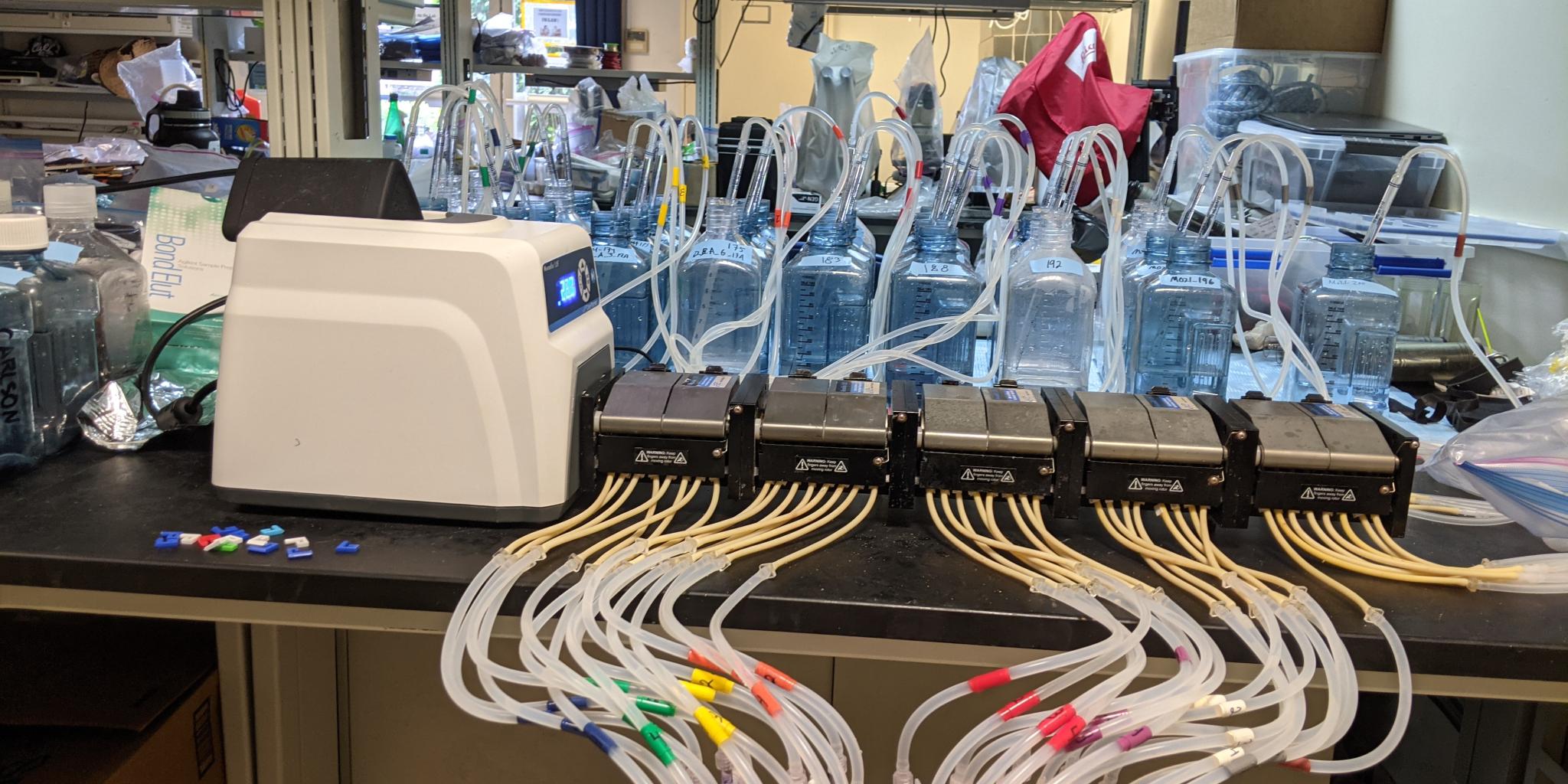
Filtration setup in Mo'orea that was used to collect the Seawater metabolomics samples (credit: NIOZ)
There are no places in the ocean completely untouched by human chemical impacts. A global analysis of more than 2,300 seawater samples from more than 20 field studies around the globe indicates that human-made chemicals make up a significant portion of organic matter in coastal oceans. The study, in which two NIOZ scientists were involved, was published on 16 March in Nature Geosciences.
The international study, led by the University of California, Riverside, analyzed seawater samples collected over a decade from coastal regions from the Pacific, Atlantic, and Indian Oceans. NIOZ Biogeochemists Andreas Haas
Opens in a new tab and Lisa Schellenberg collected and analyzed the data from Curacao and the Caribbean Netherlands. They also sampled parts of the data from Mo'orea.
Craig Nelson from UH Manoa and Andi Haas heading out in Paopao bay on Mo'orea to collect the watersamples (Credt: NIOZ)
While pesticides and pharmaceuticals were expected to be most concentrated near shorelines, the study found that industrial compounds, including substances used in plastics, lubricants, and consumer products, dominate the anthropogenic chemical signal in the ocean.
Another, largely invisible human footprint
The findings show that industrial chemicals, many of which are rarely monitored, are far more abundant and widespread than previously recognized. Daniel Petras
Opens in a new tab, an assistant professor of biochemistryOpens in a new tab at the University of California: ‘For decades, scientists have tracked plastic debris floating on the ocean’s surface and measured rising temperatures that signal climate change. But another, largely invisible human footprint has been accumulating in the sea: thousands of synthetic chemicals. Even in places we consider relatively pristine, we found clear chemical fingerprints of human activity. The extent of this influence was surprising.’From agricultural development to tourism
According to Petras, even remote coral reef systems, often viewed as among the most pristine marine environments, showed clear chemical signatures of nearby human activity — from agricultural and coastal development to tourism. ‘There was virtually nowhere we sampled that showed no human chemical influence,’ said Jarmo Kalinski
Opens in a new tab, a postdoctoral researcher in Petras’ groupOpens in a new tab.The study found that in datasets from coastal environments, median signal levels of human-made organic molecules reached up to 20%, compared to lowest values of about 0.5% in the open ocean. In extreme cases, such as river mouths impacted by untreated or poorly treated wastewater, that figure exceeded 50%. Across all samples, 248 human-derived compounds made up a median of ~2% of the total detected signal.
An unrecognized role
Petras explained that some of the human-made compounds sit at the boundary between traditional organic molecules and nanoplastics, blurring the line between chemical pollution and plastic pollution. ‘These chemicals contribute substantially to the ocean’s organic matter pool. That means they may play an unrecognized role in marine carbon cycling and ecosystem function.’
The researchers also found that anthropogenic chemicals persist well beyond the coastline. Even more than 20 kilometers offshore, human-derived compounds accounted for roughly 1% of detected organic matter. ‘At a global scale, that’s a huge amount of material,’ Petras said.
A key innovation
The study represents one of the most comprehensive chemical meta-analyses of coastal oceans to date, drawing on samples collected for many different research purposes, including coral reef health, algal blooms, and carbon cycling.
A key innovation the research team used was the combination of consistent, high-resolution mass spectrometry methods across multiple laboratories, as well as the use of scalable computational tools developed by Mingxun Wang, an assistant professor in computer science at UCR. Thanks to these technological advances, the group was able to combine and analyze thousands of samples from unrelated studies as a single, unified dataset.
Collaborators around the globe and open science
‘This work was only possible because of the efforts of our collaborators around the globe and open science,’ Petras said. ‘By making our data public, we hope to accelerate research and enable a more complete understanding of human chemical impacts on the ocean.’ All data from the study are publicly available, allowing other researchers to reanalyze the results or integrate new datasets as they emerge.
A first overview
Despite the size of the dataset, the researchers note that large parts of the world remain understudied. Data were heavily concentrated in North America and Europe, with limited coverage in the Southern Hemisphere and almost no representation from regions such as Southeast Asia, India, and Australia. The authors acknowledged that this analysis serves a first overview, and detailed targeted analyses with precise quantification are still needed. Further, the effects of the cumulative chemical concentrations and their long-term ecological impacts remain largely unknown.
Everyday activities contribute chemicals
The findings also highlight a broader, often overlooked reality: everyday activities, driving, cleaning, food packaging, and personal care contribute chemicals. Washed down drains or carried by rainwater, they move through rivers and wastewater systems and eventually reach the ocean.
Image above article: Filtration setup in Mo'orea that was used to collect the Seawater metabolomics samples (credit: NIOZ)
Opens in a new tab
Linked staff
Andi Haas
Senior Scientist
